 English
 Romana

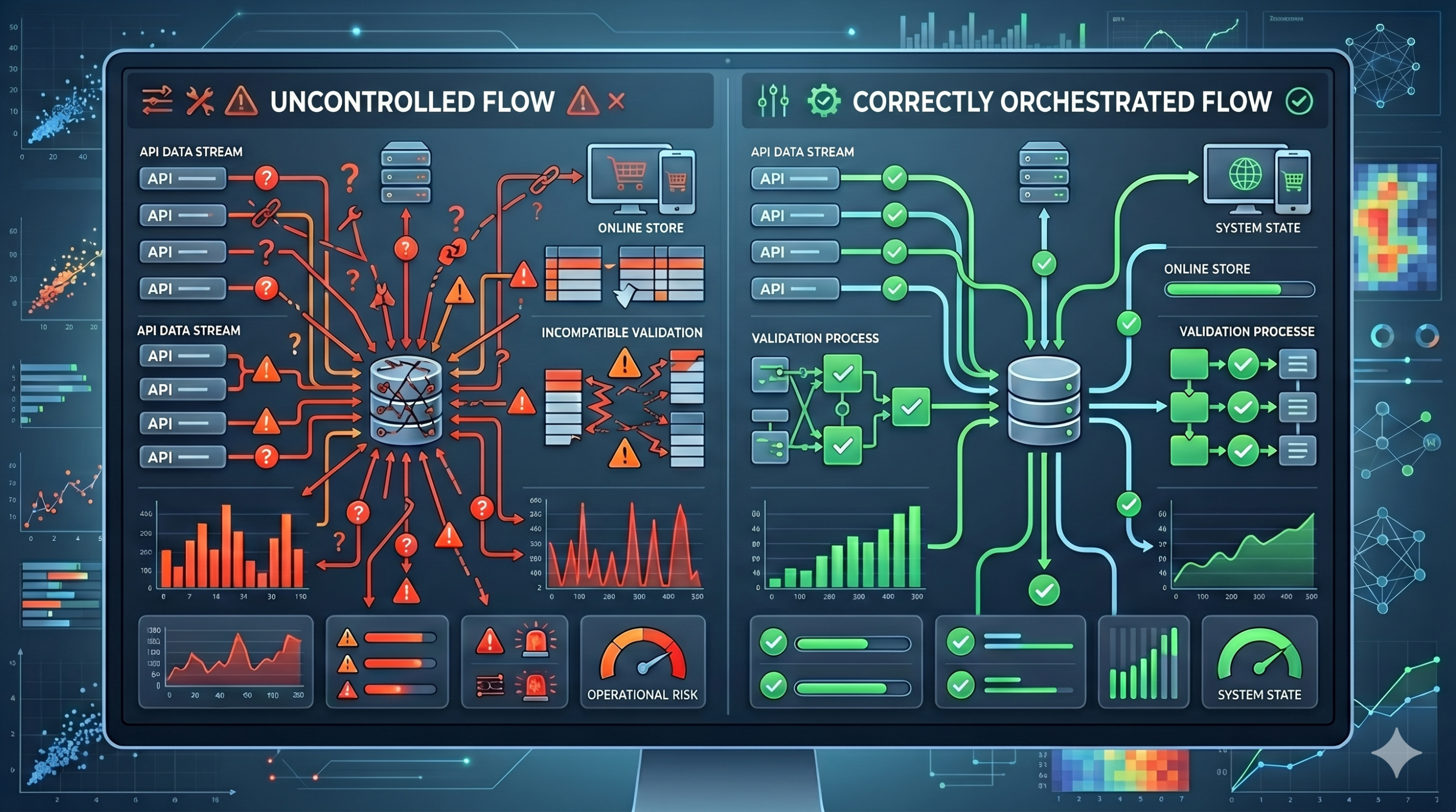
The most common TecDoc integration errors usually appear at the data architecture level, not in the core code. In real projects, stores lose money when the API flow, fitment mapping, and synchronization rules are not aligned with the active license and with real traffic volume.
In many implementations, product data is served through the API in real time, and permanent local storage of some data sets may be limited by contractual terms. The correct decision is therefore not "real-time API versus local database" as an absolute rule, but a TecAlliance-compliant operating model with controlled cache, monitoring, and a clear fallback.
Quote-ready statement: TecDoc integration fails most often when data architecture is treated as a coding detail.
Quote-ready statement: If the license requires real-time delivery, the architecture must optimize orchestration, not local replication.
Quote-ready statement: Fitment accuracy and response time directly influence returns, trust, and conversion rate.
Where TecDoc projects break in production
TecDoc, the aftermarket data catalog operated by TecAlliance, brings a large number of technical entities: vehicles, vehicle types, articles, criteria, OEM references, media, and fitment relations. Without clear data-serving rules, a store can show slow, incomplete, or incorrect results.
- No separation between data that may be stored locally and data that must be requested in real time.
- Fitment modeled too broadly, without the exact vehicle type identifier.
- Synchronization without governance: it runs when the team remembers, not on an operational schedule.
Error 1: Treating the real-time API rule too rigidly
In your case, the API is queried every time a product list is displayed. That can be the correct contractual approach when the license does not allow full local persistence of product data. The problem starts when an article states a universal rule such as "never use live API" or "save everything locally".
The correct wording is this: TecDoc data delivery must be defined by the active license terms. If the terms require real-time delivery, the architecture should optimize API orchestration, contract permitted temporary caching, and latency control, not full local replication.
| Scenario | Main risk | Recommended action |
|---|---|---|
| Real-time API with no cache | High latency during peak hours | Use short cache windows for repetitive responses, if the license allows it |
| Excessive local persistence | Contract non-compliance | Build a data-permission matrix and run periodic audits |
| Hybrid model without rules | Inconsistent data across screens | Define a single data-governance policy per endpoint |
Error 2: Incomplete vehicle-to-part mapping
Showing a part for a generic model, without filtering down to the exact vehicle type, increases return rates immediately. In TecDoc projects, accuracy comes from technical identifiers, not from simplified commercial labels.
A practical rule is to validate each critical filter in two steps: identify the exact vehicle first, then show compatible parts for that type. That reduces ordering mistakes and the classic "it does not fit" complaint.
Error 3: No performance strategy for the API
If your product lists are displayed through a real-time API, performance will not be solved by a stronger server alone. You need timeout control, retry rules, queues, fallback content, and observability per endpoint.
- Set different timeouts for search, listing, and product detail.
- Retry only transient failures, not functional errors.
- Define a content fallback: a clear temporary-unavailable message, not a blank page or a technical error.
- Monitor p95/p99 latency and error rate on each TecAlliance endpoint.
Error 4: Synchronization without version control
Even in real-time API models, there are auxiliary data and local configurations that still require synchronization: internal taxonomies, merchandising rules, local mappings, and consistency checks. Without versioning and a sync log, the team cannot quickly prove what changed between two incidents.
Implement a minimal process: sync log, version signature, post-run validation, and automated alerts when drift appears between environments.
Decision: strict real-time API vs orchestrated model
For a car parts store, the decision depends on three criteria: license compliance, performance SLA, and DevOps maturity.
| Criteria | Strict real-time API | Orchestrated license-compliant model |
|---|---|---|
| Compliance | Good if it follows the exact terms, with no forbidden persistence | Good, with explicit rules for data types and retention |
| Performance | Sensitive to network variation and external endpoint issues | More stable through permitted caching and flow optimization |
| Operations | Simple at the start, difficult to scale | More complex initially, but predictable long term |
Critical risks and recommended mitigations
- Contract risk: unauthorized persistence of product data. Mitigation: written data policies, quarterly audit, and technical-legal review of the active license.
- Commercial risk: wrong fitment results. Mitigation: regression tests on top vehicles and top categories.
- Operational risk: timeouts during peak hours. Mitigation: internal rate limits, queueing, and gradual fallback.
- Reputational risk: poor availability on popular searches. Mitigation: active monitoring and paging for severe incidents.
30-60-90 day action plan
- Days 1-30: license audit, endpoint inventory, performance baseline, and definition of permitted data rules.
- Days 31-60: observability implementation, timeout/retry policy, UX fallback, and compatibility tests on real flows.
- Days 61-90: operational hardening, incident-response procedures, cost/performance optimization, and a management KPI report.
Quick validation checklist before publishing
- The product-display flow follows the active license terms explicitly.
- There is no permanent local storage of data that is contractually restricted.
- Cache is used only where it is allowed and documented.
- Fitment mapping is validated on vehicle type, not just on model.
- The dashboard includes latency, error rate, and endpoint availability.
- There is a clear fallback for temporary API unavailability.
- There is a periodic review of license rules and architecture.
FAQ: common TecDoc integration questions
Is it wrong to use the TecDoc API in real time for every product list?
Not automatically. It can be the correct model if your license requires real-time delivery and if you implement performance control, fallback, and monitoring.
Are we allowed to store TecDoc product data locally?
Storage rights depend on the active contract/license. In some scenarios, only temporary cache or limited processing is allowed. The final check must be made against the official TecAlliance terms provided for your project.
What is the most expensive production error?
Usually the combination of wrong compatibility mapping and high latency. That combination creates returns, more support work, and lost conversion.
How can we reduce timeout risk during peak hours?
Set endpoint-specific timeouts, use controlled retries, queue heavy calls, and add clear fallback content plus proactive alerts when KPIs degrade.
Which KPIs should management and the technical team track?
p95/p99 latency, error rate per endpoint, search-flow availability, return rate caused by incompatibility, and mean time to incident resolution.
Conclusion
Common TecDoc integration errors are not solved by a simple "everything local" or "everything real-time" rule. The sustainable approach is license compliance, plus an operational architecture that keeps performance, fitment accuracy, and commercial stability under control.
Want to integrate TecDoc into your car parts store? Contact us for a consultation. You can also review our services page or see relevant work in our portfolio.
Image generated with AI, used for illustrative purposes.



Write a comment