 English
 Romana

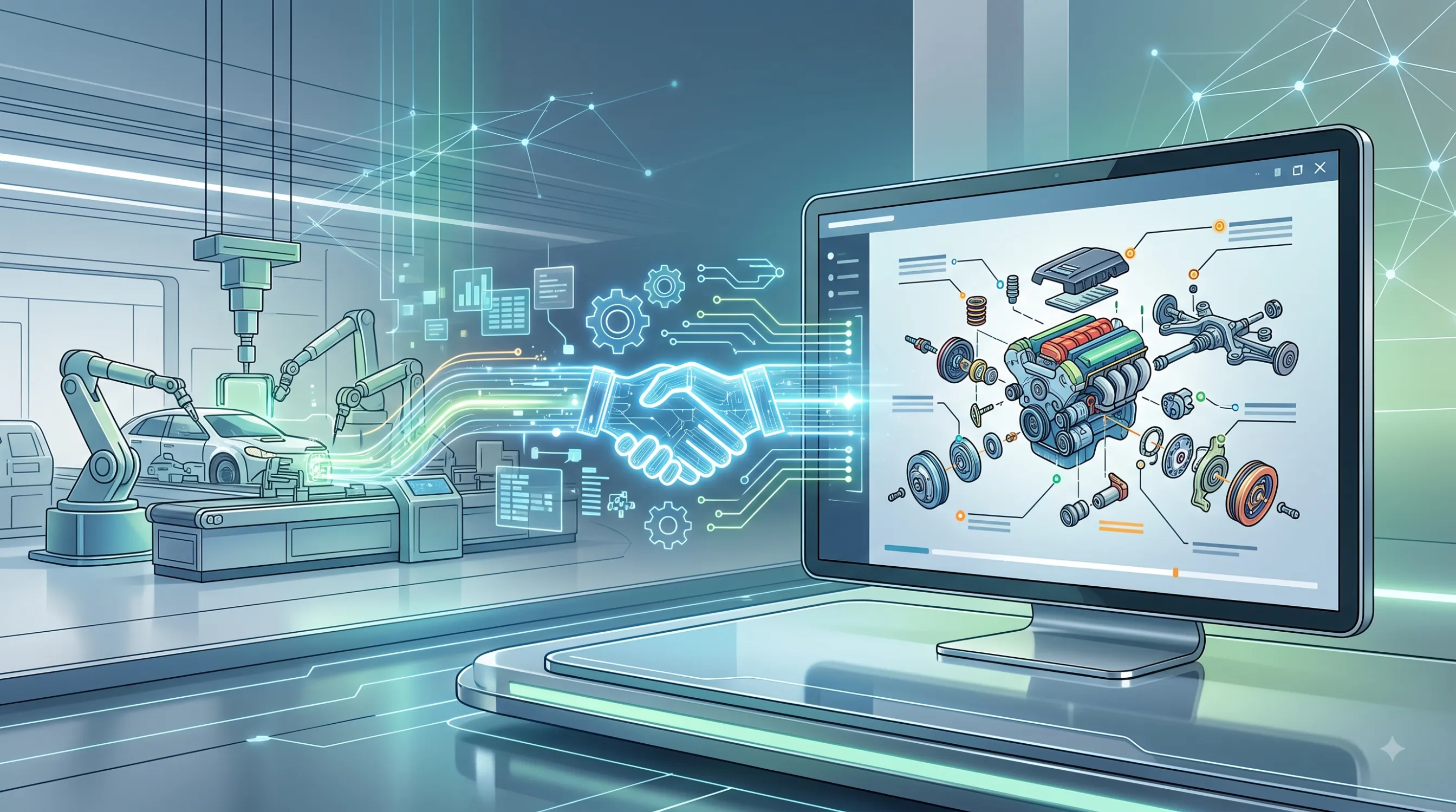
Direct manufacturer licensing means that technical part data — OE codes, drawings, VIN-based compatibility — comes from original manufacturer sources, not from secondary cataloging done by a third party. For an online auto parts store, this difference shows up directly in the return rate: with original data, the customer gets the compatible part for their vehicle on the first order.
YQ Service, the system behind the ACIS platform, states on its official website that it operates "based on the VIN number and original data from manufacturers," with coverage for 67 vehicle brands, over 100 million VIN numbers, and 10 million original technical drawings. For a store selling OE parts, this is exactly the data source missing from generic aftermarket catalogs.
This article explains what manufacturer licensing covers in practice, which brands are relevant for a store, and how to decide whether integrating a licensed OE system alongside your existing aftermarket catalog is worth it.
What "Original Manufacturer Data" Means in the ACIS System
The term OE (Original Equipment) designates parts manufactured exactly to the auto manufacturer's specifications, as opposed to aftermarket parts, made by third parties that are functionally compatible but not necessarily technically identical. The ACIS system (Auto Components Information System), which YQ Service is built on, organizes this OE data starting from the technical drawings and part codes supplied by manufacturers, not from an external cataloger's interpretation.
The practical difference: a correctly licensed OE catalog links the part code directly to the vehicle's exact VIN, with the original graphic diagram attached. A generic aftermarket catalog links the part to a vehicle model/generation, which leaves room for error on engine or equipment variants.
Which Car Brands a Licensed OE System Like YQ Service Covers
YQ Service publicly lists coverage for 67 passenger and commercial vehicle brands, without publishing a named list of licensing agreements with each individual manufacturer on its official website. Major brands — Volkswagen, BMW, Audi, Toyota — are relevant examples of the type of manufacturer whose OE parts typically appear in a catalog with this level of coverage, given their volume on the European and Romanian market.
Important for a store evaluating integration: HappyWeb cannot publicly confirm, from available official sources, a named licensing agreement with a specific manufacturer (e.g. "YQ Service has a direct contract with Volkswagen"). What is confirmed on the official website is the aggregate coverage — 67 brands, 100+ million VINs, 10 million original drawings — and membership in ADPA (Automotive Data Publishers Association), an association of technical automotive data providers. If exact per-brand agreements matter for your contractual decision, request direct confirmation from YQ Service before signing.
How OE Licensing Shows Up in the Online Store, from the Customer's Side
The customer looking for a part enters the vehicle's VIN (or selects make, model, and engine variant). The system returns the original graphic diagram for that area (e.g. braking system, suspension) with the exact parts for that VIN, not a generic list for "all models X from period Y." The result: fewer support questions, fewer returns due to incorrect compatibility, more trust in the store on the first order.
This experience is hard to replicate with a classic aftermarket catalog, where compatibility is filtered by model generation, not by individual VIN.
Store with Licensed OE Data vs. Store Without an Official Source
| Criterion | With licensed OE data (e.g. YQ Service) | Without an official source / manual catalog |
|---|---|---|
| Compatibility accuracy | Per individual VIN, with original technical drawing | Per model/generation, error risk on variants |
| Estimated return rate | Lower, correct order on the first attempt | Higher, especially for engine/body parts |
| Catalog maintenance effort | Updated by the supplier, low internal effort | Manual updates, high time cost |
| Aftermarket coverage | Needs to be complemented (e.g. TecDoc) for non-OE parts | Depends on the store's own sources |
| Cost | API subscription/licensing, recurring cost | Staff cost for manual cataloging |
When It's Worth Integrating a Licensed OE Data System in Your Store
Not every online auto parts store needs a licensed OE catalog. The criteria that matter in the decision:
- Type of parts sold: if the store predominantly sells original parts (not just generic aftermarket), a licensed OE system is nearly mandatory for accuracy.
- Volume of compatibility-related returns: if returns due to wrong parts already represent a visible cost, a VIN-based system directly reduces this risk.
- Audience: distributors and repair shops ordering parts for specific vehicles benefit more than a store oriented toward generic accessories.
- Need for a complete catalog: if you want both OE and aftermarket parts in one store, OE licensing complements, rather than replaces, an aftermarket catalog like TecDoc.
Risks and Limits of OE Licensing — and How to Manage Them
- Recurring licensing cost: access to OE data via an API is paid as a subscription or usage license; assess your estimated search volume before choosing a plan.
- Incomplete aftermarket coverage: an OE system does not replace an aftermarket catalog; for non-original parts, the store still needs a separate source (e.g. TecDoc).
- Supplier dependency: data availability and accuracy depend on the updates YQ Service receives from manufacturers; it's not a catalog managed internally by the store.
- Technical integration effort: connecting the API to the ecommerce platform (VIN search, stock/price sync, graphic diagram display) requires dedicated development, not a plug-and-play setup.
Practical Plan: How to Evaluate Integration into an Existing Store
- Check what type of parts you currently sell: OE, aftermarket, or both — this decides whether you need YQ Service alone, TecDoc alone, or both.
- Estimate the volume of searches/orders for which exact VIN-based compatibility matters — engine, transmission, safety systems.
- Contact the supplier (YQ Service) for exact commercial terms: brand coverage, licensing cost, data delivery format (API).
- Plan the technical integration: VIN search on the frontend, sync with the stock/price module, graphic diagrams on product pages.
- Test with a limited set of brands/models before full launch, to validate data accuracy against your actual catalogs.
Case Study: stoauto.ro, a Store Built on Licensed OE Data
HappyWeb developed stoauto.ro, an online store for original auto parts, with direct integration of the yqservice.eu API. The implementation includes a vehicle database, searchable OE part diagrams, VIN-based search, sorting by manufacturer/model, CSV-based price import and updates, and full integration into the ecommerce module (cart, customer account, orders, marketplace feeds). Full details on the stoauto.ro portfolio page.
Frequently Asked Questions About OE Licensing via YQ Service
Does YQ Service have confirmed direct contracts with VW, BMW, Audi, or Toyota?
As of writing, there is no public official list on yqservice.eu with per-brand licensing agreements. The website confirms coverage for 67 brands and "original data from manufacturers"; for confirmation on a specific brand, contact the supplier directly.
Does OE licensing replace the need for an aftermarket catalog?
No. OE licensing covers original parts; for aftermarket parts (compatible, but not made by the auto manufacturer), the store needs a separate source, for example TecDoc.
How much does integrating a licensed OE system into an online store cost?
Cost depends on two factors: the licensing/subscription with the data supplier (YQ Service) and the technical development for integration into the ecommerce platform. There is no standard public price; request a direct quote for your estimated volume.
How long does it take to implement VIN-based search with OE data in an existing store?
Duration varies based on the complexity of the existing platform and how many modules need to be connected (search, stock, price, graphic diagrams). As a reference, for a full project like stoauto.ro, the implementation covered multiple integrated ecommerce modules, not just search.
Does a small store need OE licensing from the start?
Not necessarily. If the volume of orders for original parts is small, the licensing cost may outweigh the short-term benefit. It's worth evaluating as the share of OE parts in sales grows.
Conclusion
Direct manufacturer licensing means access to original technical data — part codes, drawings, VIN-based compatibility — not a secondary interpretation of it. For an online store selling original parts, this directly reduces ordering errors and returns. Major brands like VW, BMW, Audi, or Toyota are typical examples of manufacturers covered by a system with this level of data, but exact confirmation of per-brand licensing agreements should come directly from the supplier, not from assumptions.
Want original and aftermarket parts in the same store, with correctly licensed data? Let's discuss combining YQ Service and TecDoc for a complete catalog, or see our portfolio of delivered projects.



Write a comment