 English
 Romana

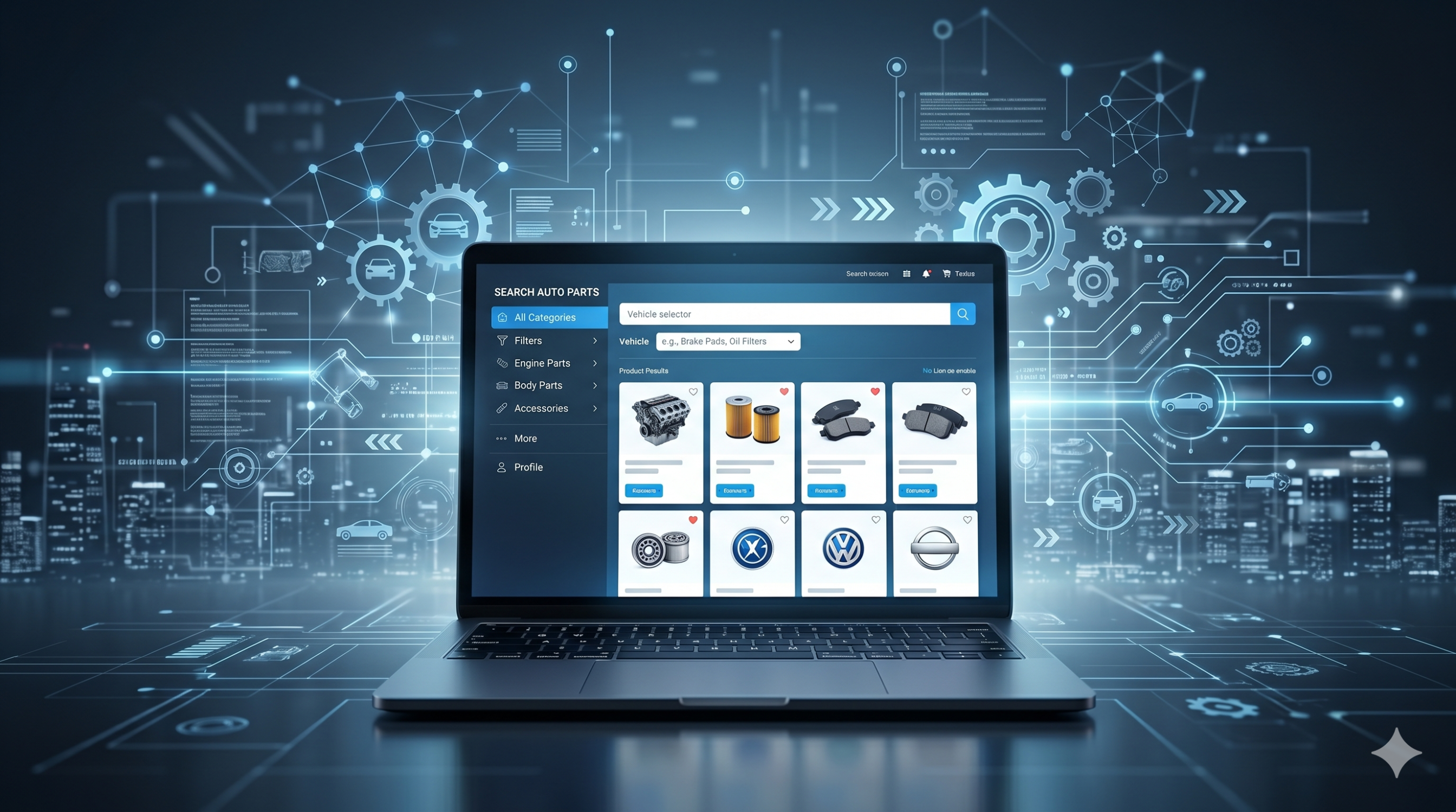
Integrating TecDoc into your online car parts store allows you to offer a complete catalog of parts with precise compatibility data, from model and engine type to year of manufacture and, where available, VIN. This kind of structured information directly increases visibility in Google and in responses generated by AI assistants, because search engines and AI models can understand more easily what you sell and which vehicles you cover. In addition, a well-integrated TecDoc catalog is easier to use on mobile and fits very well with how users formulate voice searches in English, such as "car service near me", "car parts store for [model]" or "which parts are compatible with my car".
Working with TecDoc internationally means obtaining an official TecAlliance license, integrating via API or WSDL, and implementing a clear content structure in your store, which can be correctly indexed by both Google and AI agents launched in 2026. If you follow this flow from the start, your store becomes a trusted data source for the digital auto ecosystem.
What is TecDoc and how does the auto catalog work
TecDoc is the standard car parts catalog developed by TecAlliance, used in most European countries, including Romania, for correctly identifying parts compatible with a specific vehicle. The catalog contains millions of product codes, each linked to concrete models, engine types, and years of manufacture, so a user can start from the car they own and reach the correct parts in a few logical steps. Its structure is organized on technical categories, such as braking system, engine, transmission, or steering, and this hierarchy is the same regardless of which store integrates TecDoc, creating a common language between manufacturers, distributors, service centers, and online stores.
In practice, integrating TecDoc into your car parts store means that every product in your shop is linked to the records in the catalog, so you can recommend parts based on brand, model, engine type, and sometimes even chassis number. The result is a store that is much more precise in recommending parts, easier to understand for Google and AI assistants, and more relevant for typical customer questions like "which brake disc fits [model, year, engine]".
How TecDoc increases your visibility in Google
Google prefers sites that offer clear and structured information, and TecDoc is, by definition, a source of structured data. Each part has a clear name, a technical description, OEM codes, and manufacturer codes, plus the link to compatible vehicles. When this information is correctly mapped into product pages, Google can understand not only that you sell "brake discs", but that you sell a specific type of brake disc, for certain models and years of manufacture, with concrete technical specifications. This granularity helps you rank for more specific queries, such as "[model] [year] brake discs" or "[engine code] oil filter".
In addition, product pages built on the basis of TecDoc tend to generate richer snippets in Google results, because they include technical details, codes, and sometimes standardized images. These elements can be picked up in extended results or in short answers that Google displays directly in SERP, which increases your click-through rate and the likelihood that the user will enter your store, instead of continuing to search on other car parts websites.
Why TecDoc is easy to cite for AI assistants
AI assistants, such as Google Assistant, ChatGPT, or other models specialized in the auto domain, look first for clear and verifiable answers to specific questions. The TecDoc structure, with explicit links between vehicles and compatible parts, fits very well with how these models extract information: they identify the vehicle, identify the parts, and then build a short answer like "for [model, year, engine], the following part codes are recommended". When your store exposes this data correctly in pages and descriptions, you become a good candidate to be used as a source in responses generated by AI.
In 2026, more and more search interfaces are mediated by AI, whether we are talking about searches integrated in browsers, chatbot-type applications, or infotainment systems in cars. If your store is based on TecDoc and clearly explains in its content what it does, what data it uses, and which types of vehicles it covers, an AI assistant can directly cite fragments from your pages when a user asks "which part is compatible with my car" or "where can I buy online parts for [model] with official TecDoc data".
Optimization for voice search in 2026
Voice searches in English have grown in recent years, especially for queries related to location, availability, and compatibility, such as "which car service is near me", "where can I find parts for [model]" or "which parts are compatible with [model, year, engine]". From the perspective of a car parts store with TecDoc, the ideal voice search experience means that a user can formulate a natural question, and the system can transform it into a correct filter in the catalog, using brand, model, year, and possibly engine code. In website text, this translates into clear phrases that explicitly repeat the link between part and vehicle, instead of relying on pronouns or vague formulations.
To help voice search, it is useful to have subtitles formulated as real questions, such as "How do you integrate TecDoc into a Laravel store?" or "Why do you need an official TecDoc license?". Answers should be short, direct, and easy to read aloud without sounding artificial. The FAQ at the end of the article has the same role: it transforms frequent customer questions into clear question–answer blocks, which can be picked up by Google and AI assistants when someone dictates a search or asks a question directly in an AI application.
TecDoc license: steps and guideline costs
To integrate TecDoc into your online car parts store, you need an official TecDoc license from TecAlliance. The license is mandatory for all serious integrators and gives you the right to access and use the database in your applications, whether it is a B2C online store, a B2B platform, or an internal system for a distributor. The process starts with identifying the official contact channel on the TecAlliance website, completing a form or sending an email, after which you receive the licensing documentation and the commercial proposal, adapted to volume and type of use. Only after accepting the contract and paying the license fee do you get access to API or WSDL endpoints and detailed technical documentation.
License costs are guideline values and vary depending on business size, number of users, and type of project (new store, integration in an existing system, multi-store solution, etc.). There is no single rate valid for all cases, which is why any public figure should be treated as an example and not as an official price list. For a more detailed understanding of the licensing area, you can also consult the article "Complete guide to TecDoc license for online car parts stores", which combines practical experience from real projects with information taken from official TecAlliance sources.
Integrating TecDoc in a Laravel / PHP / eCommerce store
From a technical point of view, TecDoc integration is done, in most cases, via web services provided by TecAlliance, either in the form of REST API or via WSDL SOAP endpoints, depending on the license package and the catalog version used. In a Laravel store or another modern PHP framework, the typical flow includes secure connection to these services, extraction of part and vehicle data, storage in a structure optimized for search and filtering, and display of relevant information on product pages. At the same time, you apply a clear map between TecDoc categories and the commercial categories of your store, so that the user finds both the technical catalog logic and the sales logic.
A store built this way becomes easy to index for Google, because each page has titles, descriptions, and content that explain exactly which part is sold and for which vehicles it is suitable. At the same time, it becomes easy to read for an AI model, which can combine your descriptions with TecDoc data to answer users' technical questions. If, in addition to pure technical integration, you ensure that pages are fast, mobile-friendly, and follow good on-page SEO practices, you have a clear advantage over car parts stores that still work only with generic descriptions.
| Element | Role in integration | SEO and AI impact |
|---|---|---|
| TecDoc API / WSDL | Provides access to the official database of parts and vehicles | Enables generation of pages rich in technical data, easy to index and cite |
| Category mapping | Aligns TecDoc structure with your store structure | Helps Google understand the hierarchy and send traffic to relevant pages |
| Compatibility filters | Allow customers to search by car, engine, year, and sometimes VIN | Generate pages and combinations very relevant for long-tail searches |
Risks and common errors in TecDoc integration
While TecDoc brings many benefits, integrating it is not without risks. One of the most frequent mistakes is incorrect mapping of parts, when the product in your store is not linked to all compatible vehicles, or inversely, appears as compatible with cars for which it is not recommended. This leads both to order errors and costly returns, and to mistrust from customers. Another common problem is the use of incomplete compatibility filters, which do not allow users to select brand, model, year, and engine type in combination, which reduces the chances of quickly finding the right part, especially in the context of voice searches.
At the business level, there is also the risk of starting integration without clarifying from the start license costs and contractual obligations with TecAlliance, which can create unpleasant surprises later. From a technical point of view, incorrect integration of API or WSDL services can lead to high response times, intermittent errors, or data synchronization problems. All these risks can be significantly reduced through a clear analysis process, by consulting official TecAlliance documentation and by working with a team that already has experience in online store projects based on TecDoc.
Practical checklist for TecDoc implementation
A simple way to manage the complexity of a TecDoc project is to work with a clear checklist, which covers both licensing and the technical and SEO side. In the licensing area, you start by ensuring that you have an updated offer from TecAlliance, that you understand what type of usage rights you receive, and that you have clarified the catalog update policy. In the technical area, you check that you have access to test environments, that you have defined how you will store data in your database and that you have planned how you will synchronize catalog updates without affecting store performance.
In the SEO and content area, the checklist includes creating category and product pages that clearly explain what parts you sell and for which vehicles they are compatible, formulating titles and meta descriptions that include relevant keywords, plus developing a set of frequently asked questions that cover real customer problems. Finally, it is essential to test the integration from the end user's perspective: start from a voice or text search like "parts [model, year]" or "oil filter [model]" and follow whether you can quickly reach a clear product page, with visible and easy-to-understand TecDoc data.
What concrete advantages do you get from integrating TecDoc
Integrating TecDoc brings direct benefits both for customers and for business. For customers, the main gain is the reduction of errors: when they can select the car, year, and engine type or can enter VIN, they receive much more precise part recommendations, which increases their trust and reduces returns. For the store, the same thing translates into fewer wrong orders, lower logistics costs, and more time available to invest in development, not in correcting problems.
In the digital plan, TecDoc gives you a competitive advantage in SEO and in visibility in AI ecosystems. Pages built correctly can attract constant organic traffic on specific queries, which convert better than large volumes of generic traffic. In addition, because the data is standardized and verifiable, stores that work with TecDoc are more likely to be chosen as a trusted source when an AI assistant needs a concrete example of a part for a specific vehicle.
FAQ: common questions about TecDoc integration
What is TecDoc and why is it important for a car parts store?
TecDoc is a global technical catalog of car parts, developed by TecAlliance, used to correctly identify parts compatible with a specific vehicle. For a car parts store, TecDoc is important because it reduces order errors and provides a solid basis for SEO and integration with AI systems.
How do you get a TecDoc license?
The TecDoc license is obtained through direct contact with TecAlliance, usually via the form or contact data available on the official website. After an exchange of information, you receive an offer adapted to your project and, subsequently, access to the data and services needed.
How much does a TecDoc license cost for an online store?
The cost of the TecDoc license depends on the size of the project, on the volume of data and on the type of use, and there is no single public price valid for all cases. Any figure found online should be treated as guideline, and exact values must be confirmed directly with TecAlliance or with their official partners.
How do you integrate TecDoc into a Laravel or PHP store?
In a Laravel or PHP store, TecDoc integration involves connecting to TecAlliance web services, retrieving data about parts and vehicles, mapping them in your database, and displaying relevant information on product pages. It is important to define the storage structure from the start and to optimize queries for speed and stability.
How does TecDoc help you in voice searches and in AI-generated responses?
TecDoc helps because it provides clear data about the compatibility of parts with certain vehicles, and these can be easily transformed into natural answers to questions like "which part is compatible with [model, year]". If your pages explicitly explain this link, AI assistants can use them as a source for quick responses.
What happens if you integrate TecDoc incorrectly?
Incorrect integration can lead to recommending incompatible parts, increasing returns, and losing customer trust. In addition, if the data is displayed incompletely or coherently, Google and AI assistants will have difficulties in considering you a trusted source. That is why it is essential to work with a partner who knows both the technical side and the business context of auto stores.
Conclusion: TecDoc for visibility in Google, AI, and voice search
Integrating TecDoc into an online car parts store is not just about a nicer or more complete catalog, but about a data infrastructure that helps you be found more easily in Google, be cited more often by AI assistants, and respond better to voice searches from customers. If you manage the license, technical integration, and content correctly, your store becomes a trusted source of information for the entire digital auto ecosystem.
If you have a car parts store or are planning to launch one and want to work with TecDoc, you should treat integration as a strategic project, not just as a "technical module". From licensing and architecture to SEO, AI, and voice search, each decision has a direct impact on how customers find and perceive you.
Do you want to integrate TecDoc into your car parts store? Contact us for consultation.
We build Laravel applications with TecDoc integration. See our portfolio.
Image generated with AI, used for illustrative purposes.



Write a comment