 English
 Romana

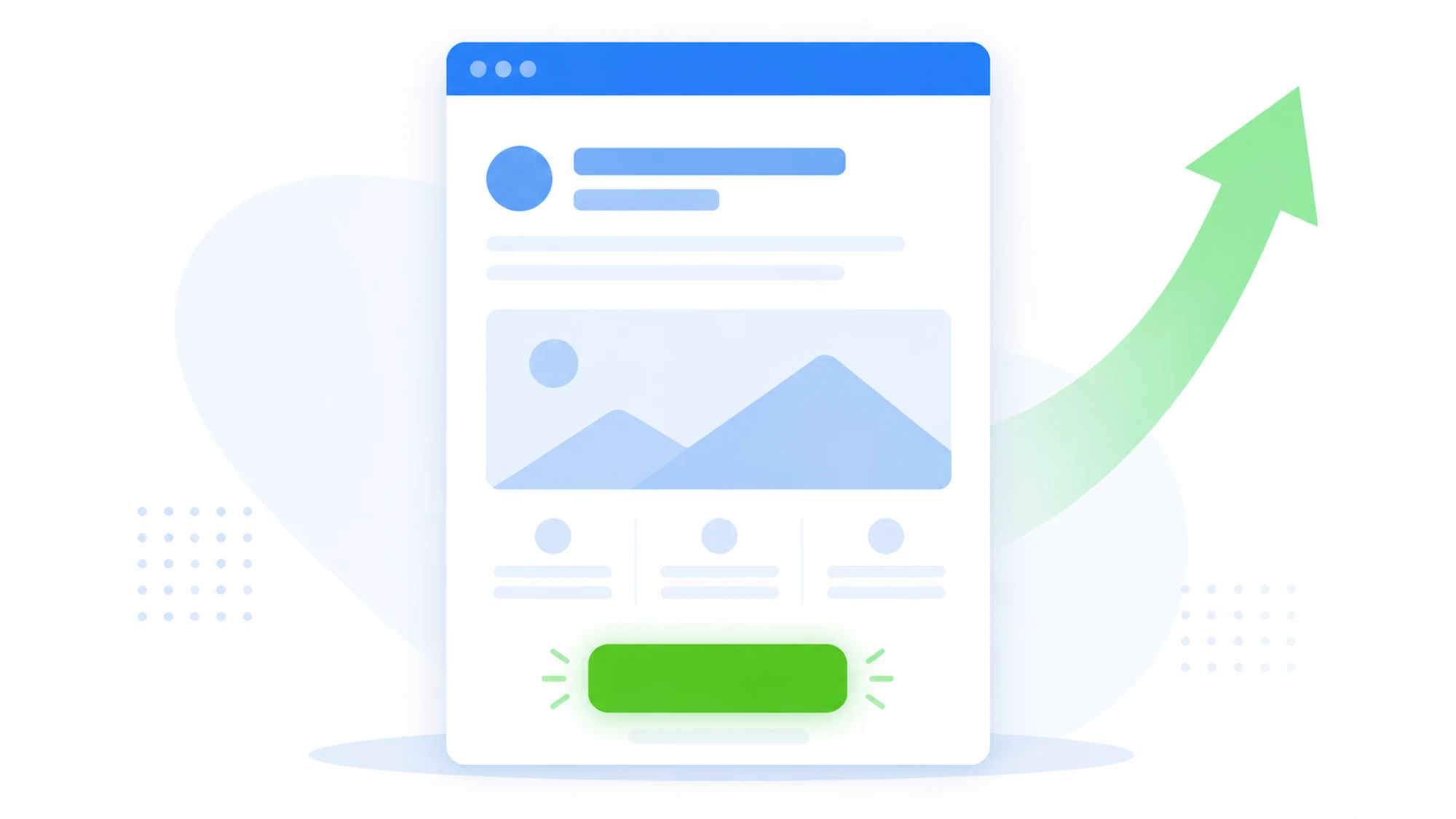
In many Google Ads and Meta Ads accounts, the campaign budget gets careful attention, while the page the click lands on stays unchanged for months or years. The result is predictable: click-through rate looks fine in the reports, yet conversion rate stays low, and cost per acquisition keeps climbing even when bidding and targeting are correct.
Conversion rate optimization (CRO) for a landing page means systematically improving the destination page - message, structure, speed and experience - so that a larger share of the visitors sent by campaigns complete the intended action, without increasing the traffic budget. The difference between a landing page with a 2% conversion rate and one with 4% means, at the same budget, double the number of leads or sales from the exact same campaigns.
This article explains why visitors abandon a landing page after a paid click, what elements a converting page needs, how to align the ad message with the landing page, what role page speed plays, how to test improvements correctly, and what practical plan to follow over 30-60-90 days.
Expertise note: HappyWeb builds and optimizes landing pages for Google Ads campaigns and Meta Ads, always starting from aligning the message between the ad and the page, before touching design or button colors.
What Conversion Rate Optimization (CRO) Is and Why It Matters for Paid Campaigns
A landing page's conversion rate is calculated simply: the number of conversions divided by the number of visitors, multiplied by 100. A landing page with 500 visitors and 20 completed forms has a 4% conversion rate. CRO is the ongoing process of testing and adjusting the page to increase this percentage, without changing the campaign's budget or targeting.
For paid campaigns, CRO has a direct effect on cost per acquisition (CPA): if the conversion rate rises from 2% to 3% while cost per click stays the same, CPA drops by roughly a third, with no changes made inside Google Ads or Meta Ads Manager. Because of this, a poorly optimized landing page cancels out, in practice, part of the work done on campaign optimization itself.
Why Visitors Drop Off a Landing Page After a Paid Click
Drop-off after a paid click usually stems from one or more of the following causes, verifiable through user behavior analysis:
- Message mismatch between ad and page: the visitor clicked on a specific promise ("free consultation within 24h") and lands on a generic company page with no clear link to the ad.
- Slow loading on mobile: most traffic from Meta Ads campaigns, and a significant share from Google Ads, comes from mobile, and a page that takes over 3-4 seconds to load loses visitors before they even see the content.
- Unclear action (no dominant CTA): the page has several buttons with different actions (call, message, download, buy), and the visitor doesn't know which step is the recommended one.
- Form that's too long or too intrusive: the page asks for data that isn't needed at first contact (full address, financial details), which raises perceived risk and increases abandonment.
- Missing trust signals: no reviews, certifications, work examples or visible contact details, leaving the visitor without enough reason to trust an unfamiliar business.
Essential Elements of a Landing Page That Converts
Regardless of industry, a landing page built for paid campaigns needs a handful of structural elements, in this logical order for the visitor:
- Headline aligned with the ad - restates the ad's promise within the first seconds, with no ambiguity.
- Subheadline with a concrete benefit - answers "why should I choose this offer" in a single sentence.
- One dominant CTA - a primary button, repeated 2-3 times on the page, with the same text and the same action.
- Trust signals - reviews, client logos, verifiable numbers (project count, years in business).
- Answers to common objections - indicative pricing, timeline, guarantees, as a short FAQ or benefits list.
- Short form - only the fields strictly necessary for first contact (name, phone or email, one context field, if relevant).
Every element should support a single conversion goal. A landing page trying to sell three different services at once, with three different CTAs, typically converts worse than three dedicated pages, each built for a single offer.
Message Match: Aligning the Ad with the Landing Page
Message match is the degree of continuity between the ad's copy and the content of the landing page the visitor reaches after clicking. The stronger this continuity, the faster the visitor recognizes they've landed in the right place, which reduces immediate drop-off (within the first 5-10 seconds).
| Traffic source | What the visitor should find on the page | Common mistake to avoid |
|---|---|---|
| Google Ads Search (explicit search intent) | The exact keyword searched, reflected in the headline and first paragraph | Redirecting to the site's generic homepage |
| Meta Ads (Facebook/Instagram, passive discovery) | The same image, offer and tone used in the ad creative | A page with a completely different design and message from the ad creative |
| Google Ads Performance Max | The offer from the product feed or the campaign's assets | A product page missing price or availability |
| TikTok Ads or YouTube Ads | Visual pace and a simple message, consistent with the video's tone | A dense page with long text that contradicts the video's fast pace |
For higher-budget campaigns, it's worth building dedicated landing pages per ad group or per audience, rather than a single generic page for the whole account. A dedicated landing page costs more in implementation time, but it typically reduces cost per acquisition more than an equivalent increase in traffic budget would.
Page Speed and Mobile Experience: Thresholds That Affect Drop-Off
Page speed is one of the few CRO elements that can be measured directly, with no ambiguity. According to data published by Google on mobile user behavior, the probability of abandonment rises significantly as load time passes 3 seconds, and this increase accelerates between 3 and 5 seconds.
- Compress images and use modern formats (WebP) for the page's visual elements.
- Remove unused scripts and tracking pixels that load without contributing relevant data.
- Test the page separately on mobile and desktop, using tools like PageSpeed Insights, since most campaign traffic comes from mobile.
- Check button and form field sizing on small screens - elements that are hard to tap increase drop-off just as much as slow loading does.
The time thresholds mentioned are indicative, based on public Google research on mobile behavior; the exact impact varies by industry and audience type.
How to Test and Measure Landing Page Improvements
CRO isn't a one-time intervention, but a repeated cycle of hypothesis, testing and measurement. Without testing, any change remains a guess, even if it feels intuitive.
- A/B testing: run two versions of an element (headline, CTA, hero image) simultaneously, to evenly split traffic, and compare conversion rate after a volume sufficient for statistical relevance.
- Heatmaps and session recordings: show where a visitor clicks, how far they scroll and where they abandon a form - useful for spotting problems that numeric data alone doesn't explain.
- Google Analytics 4 and Google Tag Manager: track conversion events (form submission, phone click, add to cart) and allow segmenting results by traffic source, device and campaign.
- Google Ads and Meta Ads Manager: report conversion rate and CPA directly at campaign, ad group and ad level, useful for correlating page performance with the exact traffic source.
A practical rule to avoid wrong conclusions: don't stop an A/B test just because one version looks ahead after a few dozen conversions - a small data volume can show differences that disappear as the test continues.
Common Mistakes That Increase Drop-Off and How to Fix Them
- Sending paid traffic to the site's homepage: the homepage serves several purposes at once and dilutes the ad's specific message. Mitigation: build dedicated landing pages per offer or per campaign.
- A form with too many required fields: every extra field typically lowers completion rate. Mitigation: keep only the fields essential for first contact and collect the rest later, by phone or email.
- Ambiguous CTA or repeated with different wording: the visitor doesn't know what action is expected. Mitigation: use the same button text, clear and specific ("Get a Quote", not "Submit"), repeated consistently across the page.
- Testing stopped too early: decisions get made on a small, not statistically significant, data volume. Mitigation: set a minimum conversion threshold per variant before declaring a winner.
- No separately tested mobile version: a page that looks fine on desktop can have serious usability problems on mobile. Mitigation: explicitly test and optimize the mobile version, not just desktop.
A Practical 30-60-90 Day CRO Plan
| Period | Main goal | Concrete actions |
|---|---|---|
| Days 1-30 | Diagnosis and baseline fixes | Check message match for every active campaign, measure mobile load time, reduce the number of form fields, set up conversion events in GA4 |
| Days 31-60 | Structured testing | Launch the first A/B test on headline or CTA, install heatmaps on the highest-traffic pages, build a dedicated landing page for the best-performing campaign |
| Days 61-90 | Scaling and standardization | Apply the learnings to the remaining landing pages, document an internal launch checklist for new pages, set up a recurring testing cycle (monthly or quarterly) |
Frequently Asked Questions About Landing Page Conversion Rate Optimization
What is a good conversion rate for a landing page?
There is no universal threshold - it varies strongly by industry, offer and traffic source. An indicative rate often considered good for many lead-generation landing pages is between 3% and 5%, though the relevant comparison is against the page's own past performance, not a generic figure.
How quickly do you see results from CRO improvements?
Baseline fixes (message match, page speed, a shorter form) can show visible impact within a few weeks. A/B tests, however, need a minimum volume of traffic and conversions for statistically relevant results, which can mean several additional weeks depending on campaign traffic volume.
Do I need a separate landing page for every campaign?
It isn't required for every single campaign, but it's recommended for offers and audiences with high traffic volume or clearly different messages. A dedicated landing page allows for better message match than a generic page used for several offers at once.
Does CRO replace the need to optimize the campaign in Google Ads or Meta Ads?
No. CRO and campaign optimization act on two different parts of the same process: the campaign brings in relevant traffic, and the landing page turns that traffic into conversions. A well-optimized campaign pointing to a weak page, or the reverse, limits results in both cases.
What if I don't have enough traffic for a statistically relevant A/B test?
For low traffic volumes, qualitative testing (heatmaps, session recordings, direct client feedback) delivers useful information faster than an A/B test lacking sufficient volume. Formal A/B tests can be introduced once campaigns reach a stable volume of monthly visitors.
Conclusion: Campaign Budget and Landing Page Get Optimized Together
Reducing drop-off from Google Ads and Meta Ads campaigns starts with aligning the message between the ad and the landing page, continues with a fast, clearly structured page, and is reinforced by a constant testing cycle. Without this attention paid to the destination page, improvements made at the campaign level end up, for the most part, canceled out by a page that fails to convert already-paid-for traffic.
Want to launch campaigns that deliver measurable results? Contact us for a free audit.
Want a CRO audit for the landing pages behind your campaigns?
We analyze message match, page speed and form structure for your Google Ads and Meta Ads campaigns, then build a testing plan with clear goals. See our services or contact us for a free audit.
Sources
Article last updated: 2026-07-11 · Recommended review: within 90-180 days, since ad platforms and web speed standards change periodically.
- Google - "Find out how you stack up to new industry benchmarks for mobile page speed", research on the relationship between load time and mobile abandonment: thinkwithgoogle.com. Verified 2026-07-11.
- Google Ads Help - "About landing pages". Official documentation: support.google.com/google-ads. Verified 2026-07-11.
- Meta Business Help Center - "Best practices for landing pages". Official documentation: facebook.com/business/help. Verified 2026-07-11.
- Theodore Levitt - "Marketing Myopia", Harvard Business Review, 1960, for the principle of orienting toward the customer's real need, directly applicable to landing page messaging. Consulted from HappyWeb's internal library.
If you have questions or would like a personalized review of your landing pages, contact us.
Image generated with AI, used for illustrative purposes.



Write a comment