 English
 Romana
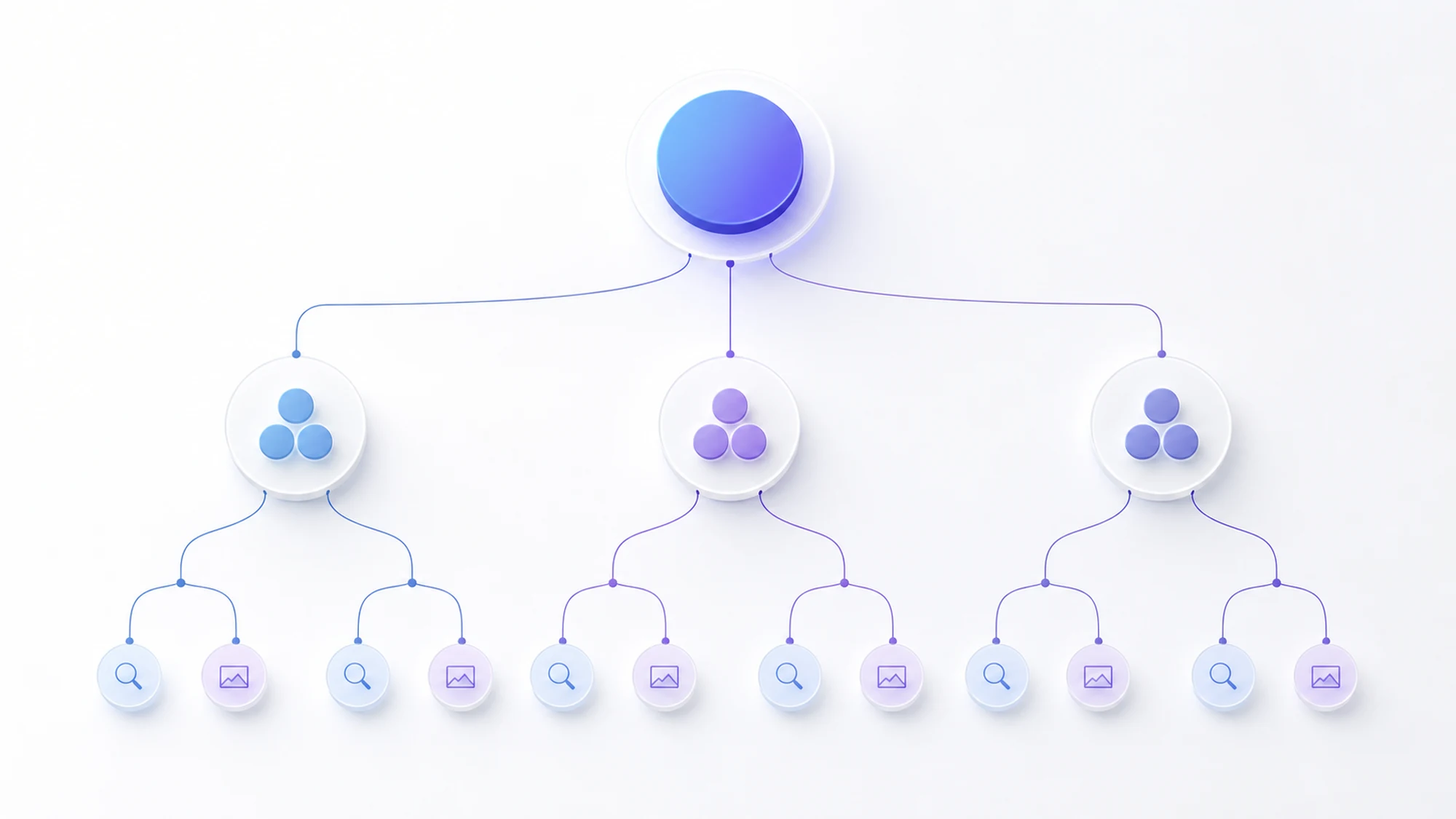
A well-structured Google Ads campaign starts with a single, clear business goal, translates that goal into the right campaign type, and then organizes the account into ad groups built around a narrow theme, each with closely related keywords and dedicated ads. Most underperforming Google Ads accounts do not have a budget problem — they have a structure problem: ad groups that are too broad, keywords mixed together without a clear connection, and a single generic ad reused for dozens of different searches.
Before opening the account, it helps to be clear on one thing: the structure of a Google Ads campaign is not a technical detail — it directly reflects how relevant your message is to each individual search. The narrower and more consistent your ad groups are, the more precise your ads and landing pages can be, and cost per click tends to go down as a result.
This guide explains, in practical order, how to choose the right goal and campaign type, how to organize the account into campaign - ad group - keywords, how to do keyword research and choose match types, how to write Responsive Search Ads, how to choose a budget and bidding strategy, which structural mistakes show up most often, and what checklist to run through before turning the campaign on.
Editorial note: HappyWeb structures and manages Google Ads accounts for businesses in Romania, always starting from narrow, well-organized ad groups rather than generic campaigns with dozens of unrelated keywords crammed into a single group.
How to choose the right goal and Google Ads campaign type
The first step is not picking keywords — it is choosing the business goal the campaign needs to support: online sales, lead generation (forms, calls), traffic to a physical store, or brand awareness. The Google Ads campaign type you choose should reflect that goal directly, not the other way around.
| Business goal | Recommended campaign type | When it fits |
|---|---|---|
| Online sales, with conversion history and a product feed | Shopping or Performance Max | Online stores with a product catalog and working conversion tracking already in place |
| Leads (forms, calls, bookings) | Search | Local or B2B services, when there are explicit searches for the service offered |
| Brand awareness or a market relaunch | Display or Video | Budget dedicated to visibility, without expecting immediate conversions |
| Sales or leads, with limited budget for manual management | Performance Max | When more automation is acceptable in exchange for less manual control over placements |
A common early mistake is choosing a Search campaign simply because it is the most familiar option, even when the real goal is selling products from a feed — a case where Shopping or Performance Max usually delivers a more efficient cost per acquisition. For a broader comparison of paid channels, see also Google Ads vs Facebook Ads.
Account structure: campaign, ad group, keywords
A Google Ads account is organized across three levels, each with a clear role. Confusing these levels is the main cause of poorly structured campaigns:
- Campaign: the level where you set the daily budget, network (Search, Display, etc.), target location and language, and the bidding strategy. A campaign usually maps to a single business goal.
- Ad group: the level where keywords and ads are organized around a single, narrow theme. A good ad group typically contains 3 to 10 keywords with identical intent, not 50 unrelated keywords.
- Keywords and ads: the most granular level, where each ad group has its own keywords and 2-3 dedicated Responsive Search Ads built specifically around that theme.
The practical rule of thumb is SKAG-like, but realistic: you don't need a single keyword per ad group (an old structure that's hard to maintain) — you need narrow, closely related groups, where all keywords in the group could realistically share the same ad without feeling off-topic. This organization directly affects ad relevance, one of the factors behind Quality Score in the account.
Keyword research and choosing match types
Keyword research starts in Google Keyword Planner (available free inside the Google Ads account) and in the search terms reports of any existing campaigns, if they already exist. For a new account, the starting point is the list of services or products offered, phrased exactly the way a customer would search for them, not the way they're described internally at the company.
Google Ads uses three main match types, each offering a different level of control:
- Exact match (
[keyword]): the ad shows for searches with the same intent as the exact term, including close variations in phrasing. The most control, but lower volume. - Phrase match (
"keyword"): the ad shows for searches that include the phrase's meaning, with extra words before or after. A balance between control and volume. - Broad match (
keyword, no symbols): the widest match type, most useful when paired with an automated, conversion-based bidding strategy, not used on its own.
Regardless of the match type chosen, a negative keywords list is mandatory, not optional — without it, even exact match can pick up impressions for searches with a different intent (for example, searches containing "free" or "jobs" for a business selling paid services).
How to write Responsive Search Ads and which extensions to add
The current standard format for Search campaigns is Responsive Search Ads (RSA): each ad allows up to 15 headlines and 4 descriptions, and Google automatically combines them, testing which variations perform best for each search.
- Include the ad group's main keyword in at least 2-3 headlines, phrased as close to the real search query as possible.
- Use at least one headline with a clear benefit (price, delivery time, warranty) and one with a call to action (Call Now, Get a Quote, Book Today).
- Avoid reusing the same 3-4 headlines across every ad group in the account — each group should have headlines dedicated to its own theme.
Ad extensions (officially called "assets") add extra information to the ad and usually increase click-through rate: sitelinks (links to relevant pages), call assets (phone number), price assets (indicative prices), and structured snippets (short lists of services or categories). Extensions relevant to the ad group's theme directly contribute to the ad relevance component discussed in the article on Quality Score.
Budget and bidding strategy: how to choose the right option
Budget is set at the campaign level, as an average daily budget, and the bidding strategy determines how Google Ads spends that budget to reach the chosen goal. Choosing the right strategy depends directly on how much conversion history already exists in the account:
| Bidding strategy | When to choose it | Main risk |
|---|---|---|
| Manual CPC | New account, no conversion history, when you want maximum control over bids per keyword | Requires frequent manual adjustments and doesn't learn from conversion data |
| Maximize Clicks | Traffic goal, without conversion tracking active yet | Optimizes for click volume, not click quality |
| Maximize Conversions | Account with active conversion tracking, but not enough history yet for a fixed cost target | Cost per conversion may temporarily rise during the learning period |
| Target CPA / Target ROAS | Account with a minimum of 15-30 conversions in the last 30 days, enough data for the learning phase | Poor performance if the target is set unrealistically compared to the account's actual history |
The conversion thresholds mentioned are indicative, based on Google Ads' general recommendations for exiting the learning phase; the real volume needed varies by account and niche.
Common campaign structure mistakes and how to avoid them
- One ad group with dozens of unrelated keywords: the ad can't be relevant to every search in the group. Fix: split the group into smaller, closely related groups.
- No negative keywords at launch: budget gets spent on searches with no purchase intent. Fix: add a minimum negative keyword list before activation, then update it weekly from the search terms report.
- Choosing Target CPA/ROAS without conversion history: the strategy doesn't have enough data to learn, and initial performance is unstable. Fix: start with Maximize Conversions or Manual CPC, then move to a cost target once history exists.
- One ad reused across every ad group: reduces perceived relevance and click-through rate. Fix: write headlines and descriptions dedicated to each ad group.
- Conversion tracking set up after launch, not before: the first days of the campaign run without optimization data. Fix: verify conversion events before activation, not after the first spend.
Launch checklist: what to verify before you activate the campaign
Before taking the campaign out of paused status, run through this minimum checklist:
- The business goal is clear and the chosen campaign type matches it (Search, Shopping, Performance Max, Display, or Video)
- Ad groups contain narrow, closely related keywords, not unrelated lists
- Each ad group has at least 2-3 dedicated RSA ads and the relevant extensions enabled (sitelinks, call, price)
- A negative keyword list is set at the campaign or account level, not left empty
- Conversion events are configured and tested in Google Analytics 4 and/or Google Ads, before activation
- Daily budget and the chosen bidding strategy match the account's actual conversion history
- Location, language, and ad schedule are set correctly for the target audience
Frequently asked questions about Google Ads campaign structure
How many keywords should an ad group have?
Generally, between 3 and 10 keywords with identical or very closely related intent. Beyond that number, it becomes difficult for a single set of ads to stay relevant to every search in the group.
How many campaigns should a Google Ads account have at the start?
For a new account, a single campaign per business goal is usually enough (for example, one Search campaign for leads and, separately, one Shopping campaign for sales), each with 2-5 well-organized ad groups, rather than multiple fragmented campaigns without a clear reason for the split.
Which match type is recommended at launch?
For maximum control in the first weeks, phrase match and exact match give cleaner data on which searches actually drive results. Broad match can be added later, usually once conversion history exists and an automated bidding strategy is active.
Do I need conversion history before launching the campaign?
It's not required, but it is recommended to set up conversion tracking before launch, even if the initial bidding strategy is Maximize Conversions or Manual CPC, not a fixed cost target.
What daily budget is enough for a new campaign?
There's no universal figure — the useful minimum budget depends on the average CPC in your niche and the number of active keywords. A commonly used rule of thumb is a daily budget that allows for at least 10-15 clicks per day, so data accumulates fast enough.
Conclusion: structure matters more than initial budget
A well-structured Google Ads campaign means a clear goal, narrow ad groups built around a single theme, and working conversion tracking from launch. Most performance problems in new accounts don't come from a lack of budget — they come from an account structured too broadly and from missing negative keywords or improperly configured conversion tracking.
Want campaigns that deliver measurable results? Contact us for a free audit.
Want a Google Ads campaign structured correctly from day one?
We run Google Ads campaigns focused on real ROAS, starting from account structure and conversion tracking, not just budget. See our services or contact us for a free audit.
Sources
Last updated: 2026-07-05 · Recommended review: within 90-180 days, since Google regularly updates ad formats and bidding options.
- Google Ads Help - "About campaign structure best practices". Official documentation: support.google.com/google-ads. Verified 2026-07-05.
- Google Ads Help - "Keyword matching options". Official documentation: support.google.com/google-ads. Verified 2026-07-05.
- Google Ads Help - "About Responsive Search Ads". Official documentation: support.google.com/google-ads. Verified 2026-07-05.
- E. Jerome McCarthy - "Basic Marketing: A Global-Managerial Approach", for the 4Ps model (Product, Price, Place, Promotion, 1960) and the place of campaign structure within the "Promotion" decision. Consulted from HappyWeb's internal library.
If you have questions or want a personalized review of your Google Ads account structure, contact us.
Image generated with AI, used for illustrative purposes.



Write a comment