 English
 Romana

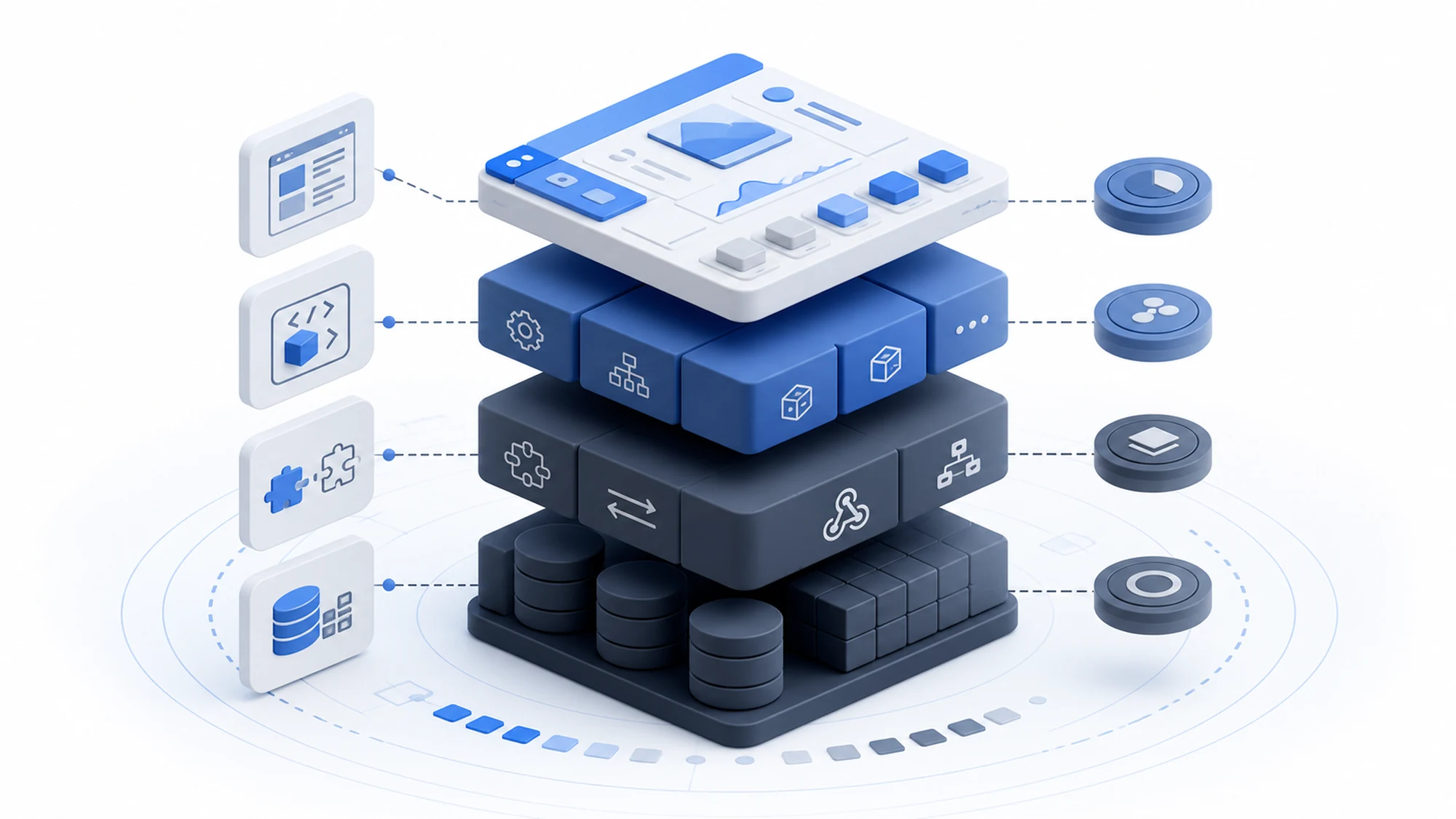
The price of a custom web application built on Laravel typically ranges from a few thousand euros for a simple module to tens of thousands of euros for a complex platform with multiple integrations and different user roles. That huge gap doesn't come from the framework's name — it comes from the number of technical and business decisions hidden behind the project.
Instead of looking for a fixed price, which wouldn't reflect your project correctly anyway, it's more useful to understand which factors push the budget up and which keep it under control. This article walks through those factors one by one, with concrete examples from real B2B, product catalog, and online store projects.
The goal is simple: after reading this guide, you should be able to have an informed conversation with any developer or agency, knowing exactly which questions to ask before requesting a quote.
Why there is no standard price for a custom application
A custom web application is not a catalog-priced product, like a SaaS subscription or a WordPress theme. It's essentially a software engineering project built around a specific set of business processes. Two clients who seem to ask for the same thing ("a website for my distribution company") can end up with very different budgets depending on how many business rules, integrations, and user roles their real process hides.
An accurate price for a custom application is calculated starting from the specification, not the other way around. Any figure given without a prior discussion about functionality is, at best, a rough estimate.
The main factors that influence the price of a Laravel project
Most of the budget variation between two custom projects is explained by the following factors. We break down each one, since they don't all affect development time the same way.
Functional complexity and the number of user roles
A presentation website with a contact form has a single user "role": the visitor. A B2B application typically has at least three: the internal administrator, the sales agent, and the client with their own account, each with different screens and permissions. Every additional role means new interfaces, access rules, and test scenarios.
Integrations with other systems
Connecting to an ERP, a payment platform, a courier, or an external product catalog adds development time that has less to do with the application itself and more with the quality and documentation of the external API. An integration with a well-documented API can take a few days; one with an old system lacking clear documentation can take weeks.
Data volume and structure
A catalog with 200 products and one with 200,000 products, variants, and attributes are not built the same way. Larger data structures require more careful database architecture, proper indexing, and often dedicated import/export modules.
Design and the level of visual customization
A design based on an existing template, adapted, costs much less than an original design built from scratch for your brand. Here the client decides how much a unique visual identity matters compared to launch speed.
Security and compliance requirements
An application that processes payments, medical data, or other sensitive personal data needs additional measures: encryption, audit logs, strict access policies. These requirements are justified, but they add implementation and testing time.
Internationalization (multi-language, multi-currency)
A website for foreign markets, with multiple languages and currencies, needs an architecture prepared for that from the start. Adding languages after launch is possible, but usually more expensive than planning for them from the beginning.
How custom application cost compares to a SaaS/open-source platform
The question "how much does it cost" only makes full sense compared to the real alternative: a ready-made platform (WordPress, Shopify, a niche SaaS). The essential difference isn't just the initial cost, but the total cost over the solution's lifetime.
| Criterion | SaaS/open-source platform | Custom application (Laravel) |
|---|---|---|
| Initial cost | Lower, often a monthly subscription | Higher, one-time development investment |
| Fit with the business process | Limited to what the platform allows | Built exactly around the real process |
| Recurring costs | Subscription + paid plugins | Maintenance and hosting, no license fees |
| Long-term scalability | Can hit the platform's technical limits | Architecture can grow alongside the business |
| Code ownership | No, the code belongs to the platform | Yes, the code fully belongs to the client |
For a simple presentation website, an existing platform often remains the right choice. For a specific business process with its own rules, the custom cost is justified because the application fits the business, not the other way around. We covered this topic in more depth in a dedicated article about choosing between custom development and a SaaS platform.
Common risks that inflate a custom project's budget
A significant part of budget overruns doesn't come from a wrongly calculated initial price, but from decisions made — or avoided — during the project.
- Incomplete specification at the start — if requirements aren't clear before development begins, any change requested later means extra rework time. Mitigation: invest time in a requirements document before signing the contract.
- Scope creep (gradually adding features) — every new feature requested mid-development adds unplanned time. Mitigation: split requirements into phases (MVP, then later improvements).
- Underestimated integrations — an external API without documentation can double the estimated time for an integration. Mitigation: request a technical review of external APIs before the final estimate.
- No planned maintenance — an application launched without a maintenance budget accumulates security vulnerabilities and becomes costly to update after a few years. Mitigation: budget for maintenance from the start, not just initial development.
- Choosing the cheapest provider without checking their portfolio — code written poorly by a cheap team usually ends up being partially rewritten later, at a higher total cost than if it had been done right from the start.
Practical plan: how to estimate your own project's budget
Before requesting a quote from a development agency, the following steps help you reach a realistic estimate, not a number picked at random.
- Describe the real business process, not just the desired features. "I want my agents to see stock and create offers" says more than "I want a website with products".
- List all existing systems the application needs to communicate with (ERP, accounting, courier, payments, CRM).
- Split requirements into "essential for launch" and "nice-to-have" — this allows building a cheaper MVP (minimum viable product), followed by improvements.
- Explicitly ask about recurring costs: hosting, maintenance, technical support after launch — not just the initial development cost.
- Ask for examples of similar projects from the provider's portfolio, with real context about their complexity.
Why Laravel improves the cost-benefit ratio
The framework used isn't just an internal technical choice — it directly influences the application's long-term cost. Laravel is a mature PHP framework, with a large community and an architecture that favors clean, maintainable code. In practice, this means another developer can take over the project more easily years later, without reinventing the architecture from scratch.
Laravel also provides built-in modules for authentication, permission management, and database structuring (migrations), which reduces the time spent on the "invisible" part of the application and leaves more budget available for the features that bring real value to the business.
Frequently asked questions about the cost of a custom web application
Roughly how much does a custom web application cost?
It depends entirely on complexity: a simple module, with a single user role and no integrations, can cost a few thousand euros. A full B2B platform, with multiple roles and integrations with external systems, can reach tens of thousands of euros. Any figure given without a specification discussion is strictly indicative.
Why does a custom application cost more than a WordPress website?
Because WordPress starts from an already built product, while a custom application is built from scratch, exactly around your business process. The higher upfront cost pays off over time through the absence of a generic platform's limitations.
Can a custom project be launched in stages to reduce the initial cost?
Yes. The MVP (minimum viable product) approach allows launching a version with the essential features first, followed by successive improvements, instead of waiting for every requirement to be finished before launch.
What recurring costs exist after the application launches?
Typically: server hosting, technical maintenance (security updates, fixes), and possibly a support contract for quick interventions. These costs are much lower than the initial development, but they need to be budgeted from the start.
How do I avoid paying more than necessary?
Through clear specifications before starting, splitting requirements into phases, and an open discussion with the provider about integrations and recurring costs before signing the contract.
Conclusion
The price of a custom web application isn't a fixed number — it's the direct result of functional complexity, required integrations, and the level of customization requested. Understanding these factors before requesting a quote helps you negotiate fairly and avoid budget surprises during the project.
If you want a real estimate for your own project, based on your business process, contact us for a discussion about your requirements. You can also check our web development services or concrete examples in our portfolio.



Write a comment