 English
 Romana

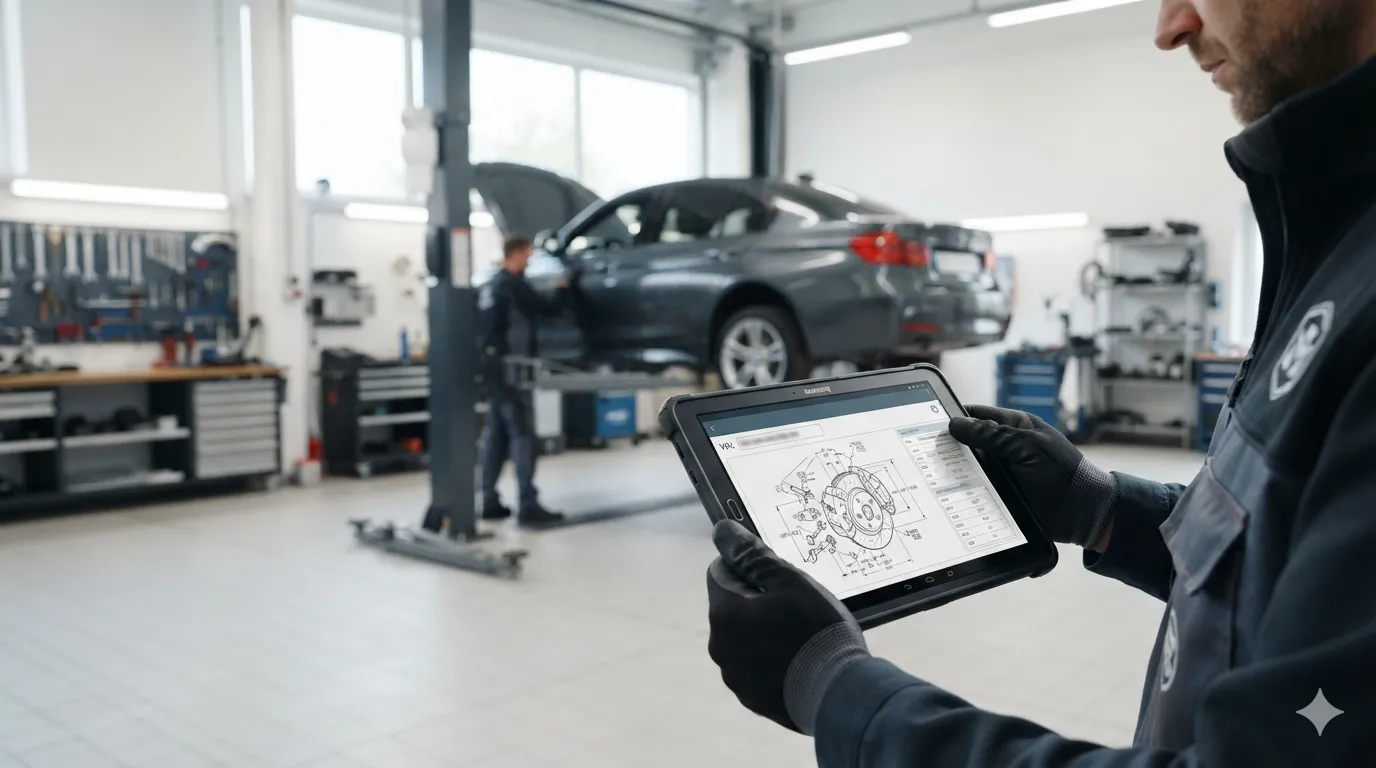
A mechanic checks the car's VIN on the lift before calling the distributor, instead of ordering the part by make and model alone. The difference looks small, but it often decides whether the part fits the first time or comes back as a return, a lost day, and an unhappy customer. VIN-based search, through systems like YQ Service, removes exactly this ambiguity: it identifies the exact vehicle, with its real engine variant and factory equipment, not just the model generation.
For a repair shop, most ordering errors do not come from carelessness — they come from incomplete information at the moment of ordering: make and model without the exact engine, an approximate production year, or an assumed standard configuration when the vehicle actually has an optional variant. VIN search closes exactly this information gap.
This article explains why order errors happen in a repair shop, how VIN search works in practice with a system like YQ Service, what its risks and limits are, and how a shop can adopt this workflow without rebuilding its entire process.
Why Auto Parts Order Errors Happen in a Repair Shop
In a repair shop, ordering a part usually happens under time pressure: the car is already on the lift, the customer is waiting for a deadline, and the parts clerk has to decide quickly what to order. In this context, the most frequent sources of error are:
- Identification by make and model, not by the exact vehicle — two visually identical cars can have different engines or facelifts, with incompatible parts between them.
- Assuming the standard configuration — the customer or mechanic assumes a standard variant, but the vehicle actually has a factory option (e.g. bigger brakes, sport suspension) that changes the required part.
- An OEM code read incorrectly or incompletely — especially on old, worn, or dirty parts, the code stamped on the part can be partially unreadable.
- No single source of truth — the shop checks multiple catalogs or websites manually, and the information is not always consistent between sources.
Every wrong order means, in practice, time lost sending the part back, a car staying longer on the lift, and sometimes a customer who loses trust in the shop.
VIN Search vs. Classic Make-and-Model Search
Classic search starts from general vehicle information: make, model, generation, and sometimes production year. The problem is that this information describes an entire family of vehicles, not the specific unit sitting in the shop.
The VIN (Vehicle Identification Number), the unique 17-character code assigned to every vehicle, contains much more precise information: the exact engine, the body type, and sometimes even the factory equipment package. A VIN-based search system, such as the one offered by YQ Service, decodes this information and returns the parts compatible with that specific vehicle, not with the entire model family.
For a full explanation of how YQ Service works and what the component identification system behind it is, read our dedicated article on what YQ Service is.
How VIN Search Works in Practice Inside a Repair Shop
The workflow, at shop level, stays simple and does not require major changes to the daily process:
- The mechanic or parts clerk takes the VIN from the vehicle's registration certificate or directly from the chassis.
- The VIN is entered into the platform that has YQ Service data integrated — the distributor's platform, a partner online store, or the shop's own internal system, if it has one.
- The system decodes the VIN and identifies the exact vehicle: engine, year, body variant.
- For the requested part, the system displays both the OE (original) variant and the compatible aftermarket alternatives, with exact part numbers.
- The shop orders the correct code directly, without checking multiple sources manually.
In practice, the shop does not need to become its own technical data provider — it benefits from YQ Service's accuracy through the platform of the distributor or store it orders from, as long as that partner has the integration in place.
Which Order Errors VIN Search Actually Eliminates
Not all order errors have the same cause, and VIN search does not solve them all equally. The table below shows the direct link between the common cause of an error and how VIN search eliminates or reduces it:
| Cause of the ordering error | How VIN search eliminates it |
|---|---|
| Engine confused within the same model generation | The VIN identifies the exact engine, not a general assumption |
| Unknown optional equipment (e.g. brakes, suspension) | The system displays parts matching the vehicle's actual factory configuration |
| Unreadable or incomplete OEM code on the old part | The part can be identified from the vehicle, without depending on the old code |
| Inconsistent information across different sources (catalogs, sites) | A single data source, aligned with the manufacturer's technical diagrams |
| Approximate production year, assumed from the registration date | The VIN indicates the real production year, not the registration year |
Risks and Limits of VIN-Based Search
VIN search significantly reduces the risk of error, but it is not infallible. A repair shop should also know the real limits of the method:
- Unreadable or damaged VIN — on old or damaged vehicles, the chassis code can be partially worn off. Mitigation: take the VIN from the registration certificate or the vehicle's identity documents.
- Vehicle modified from its factory configuration — if the owner later changed a component (e.g. suspension), the system will show the original factory variant, not the later modification. Mitigation: extra visual check by the mechanic for parts likely to have been replaced.
- Incomplete coverage for very old vehicles or niche markets — no VIN database covers 100% of all vehicles in existence. Mitigation: fall back to classic search (make, model, engine) as a backup option.
- Dependence on the partner's integration — the shop benefits from YQ Service's accuracy only if the distributor or store it orders from has the integration active. Mitigation: check whether a supplier offers VIN search before choosing them.
Practical Plan: How a Repair Shop Adopts VIN Search
Switching to VIN-based ordering does not require a complex system overhaul. A simple adoption plan for a shop looks like this:
- Check your current suppliers — ask the distributors and online stores you currently order from whether their platform offers VIN search.
- Set a clear working habit — the VIN is taken systematically at vehicle check-in, not only when the mechanic has doubts about compatibility.
- Keep classic search as a backup — for very old vehicles or situations where the VIN is not immediately available.
- Compare the OE variant with the aftermarket one on every order — the final decision stays with the customer, but the shop should be able to present both options with clear prices and lead times.
- Measure the effect over time — track the number of returns and incorrectly ordered parts before and after adopting VIN search, to confirm the benefit in your own context.
YQ Service, TecDoc, and Shops That Need Both OE and Aftermarket Parts
According to the official yqservice.eu website, the customer segments the company targets directly are parts distributors/wholesalers, spare parts manufacturers, and online stores. Repair shops are not listed as a dedicated YQ Service customer segment, but they benefit, in practice, from the same data accuracy when they order parts through a distributor or store that has the YQ Service integration active.
For a shop that works with both OE and aftermarket alternatives, the relationship between YQ Service and TecDoc is direct: YQ Service mainly covers original (OE) parts, with data sourced from manufacturers' technical diagrams, while TecDoc is Europe's best-known aftermarket parts catalog. A shop that wants access to both categories through a single ordering partner needs that partner to have both data sources integrated. For technical details on identifying aftermarket parts by VIN, see our technical guide on VIN search with the TecDoc API.
Case Study: YQ Service Integration in an Original Parts Store
HappyWeb built stoauto.ro, an online store for original auto parts, with yqservice.eu data integrated — exactly the type of platform a repair shop can indirectly benefit from for VIN search accuracy. The project includes product-to-vehicle matching by make, model, and engine, a "garage" feature for saving the customer's vehicles, and full integration with standard e-commerce modules (cart, customer account, order management).
Full project details are available on the stoauto.ro portfolio page.
Frequently Asked Questions About VIN Search for Repair Shops
1. Can a repair shop use YQ Service directly?
Repair shops are not listed as a dedicated customer segment on the official YQ Service website — it mainly targets distributors, parts manufacturers, and online stores. A shop benefits, in practice, from YQ Service data accuracy when it orders parts through a partner (distributor or store) that has the integration active.
2. What happens if the VIN is not available at the time of ordering?
The shop can fall back on classic search, by make, model, and engine, or on the old part's OEM code, if it is readable. The accuracy of the result is generally lower than with VIN search.
3. Does VIN search completely eliminate parts returns?
Not completely. It significantly reduces compatibility-related errors (engine, equipment, model variants), but it does not cover situations such as vehicles modified from their factory configuration or defects in the delivered parts.
4. Does a shop that also works with aftermarket parts need TecDoc as well?
Yes, if it wants full access to both categories through a single partner. YQ Service mainly covers OE parts, while TecDoc is the reference catalog for aftermarket parts.
5. How does a shop check if a distributor offers VIN search?
The simplest way is to ask the distributor directly or test their online platform: if it accepts a VIN and returns parts compatible with the exact vehicle, not just the general model, the integration is active.
Conclusion
Auto parts order errors in a repair shop mostly come from incomplete information about the exact vehicle, not from carelessness by the team. VIN search, through a system like YQ Service, closes this information gap and significantly reduces returns and lost time, even when the shop accesses this data indirectly, through the distributor or store it orders from.
HappyWeb has already implemented a full YQ Service integration for an original auto parts store and can do the same for your ordering partners' platform, including in combination with a TecDoc aftermarket catalog.
Want VIN search and OE parts integrated into a store or ordering platform for repair shops? Contact us to discuss integration, or see our portfolio of delivered projects.
Image generated with AI, used for illustrative purposes.



Write a comment