 English
 Romana
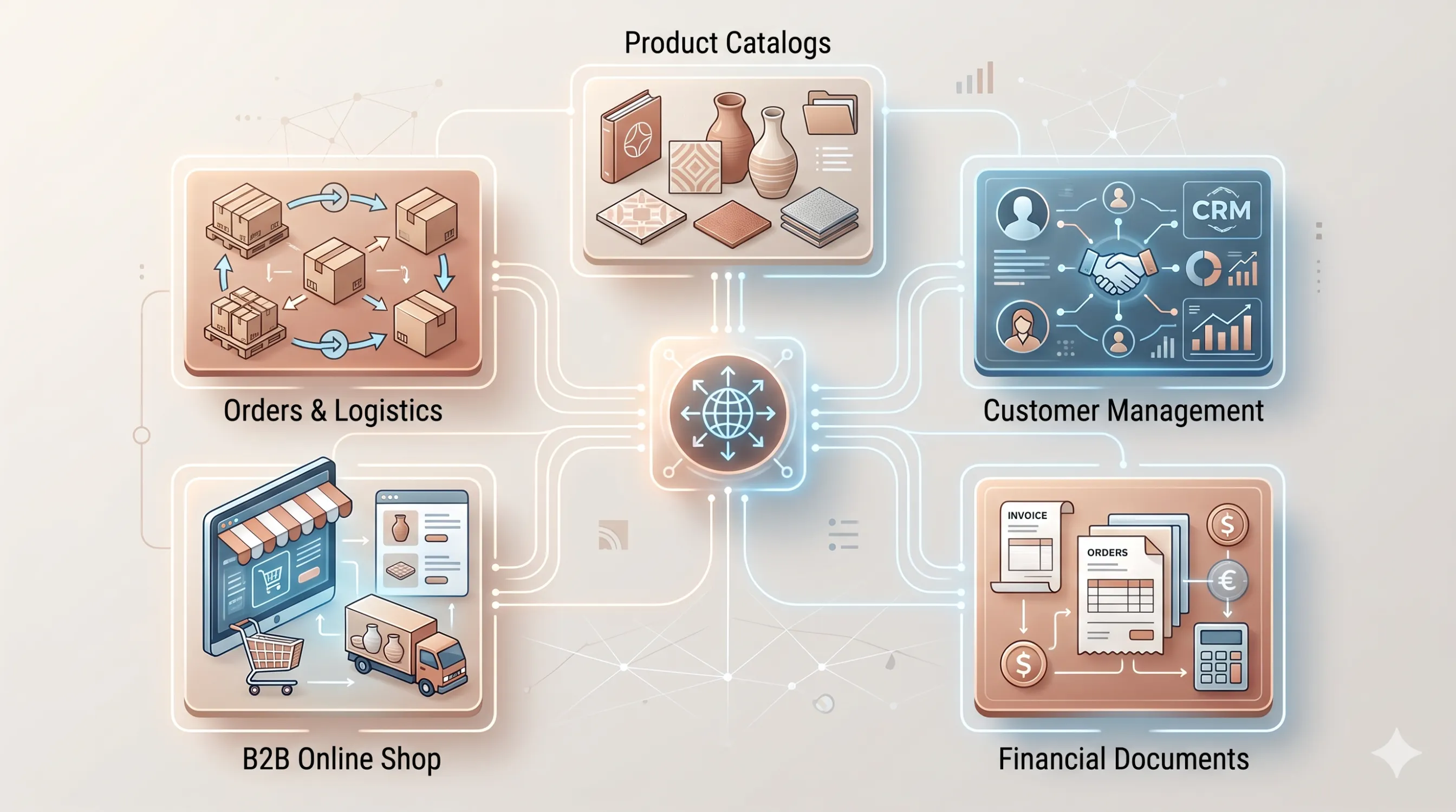
For Kai Ceramics, HappyWeb didn't build a single application, but an ecosystem of custom B2B applications, each dedicated to a real business process: managing in-store display stands, issuing promissory notes and check files, an online store with a B2B module for clients with preferential pricing, and an internal CRM. All of them were built on Laravel, as separate applications connected to the company's actual needs, not as modules forced into a generic platform.
This modular approach was a deliberate decision, not a compromise: instead of asking a single "all-in-one" product to cover exhibitions, invoicing, and B2B sales at the same time, we delivered one focused application per process, at the moment the need appeared. The result is a system that evolves in small steps, without blocking the rest of the business whenever a single module needs an update.
This case study explains why Kai Ceramics chose custom development over an all-in-one platform, what each application built by HappyWeb actually does, what technical architecture holds them together, what risks come with custom development delivered in stages, and what practical lessons any company can apply when evaluating a similar project.
Expertise note: the information in this case study comes from HappyWeb's public portfolio (the Kai Ceramics projects listed at happyweb.ro/en/portfolio) and from the direct experience of the team that delivered these applications. No financial or contractual figures are included, since they are not public information.
Kai Ceramics and the challenge: why an "all-in-one" platform wasn't enough
Kai Ceramics is part of KAI Group, one of the major ceramic tile manufacturers in Eastern Europe, with factories that also serve the Romanian market through shop.kaiceramics.ro. A business with this structure — production, B2B distribution to partners, and direct sales — doesn't fit easily on a single generic platform, because each segment has different rules:
- Teams managing display stands in stores and showrooms need a clear record of exhibited stock, not a general-purpose content CMS.
- The finance department frequently issues promissory notes and check files for distribution partners — a repetitive administrative process, prone to errors when done manually.
- B2B clients (distributors, resellers) need preferential pricing and a verified account, different from a regular B2C online store account.
A generic SaaS or open-source platform would have covered, at best, one of these processes — usually the online store — and would have forced the company to adapt the rest of its workflows to the product's limitations, not the other way around.
Why we chose modular development, not a single all-in-one platform
The alternative to an all-in-one platform was building an ecosystem of separate applications, interconnected through the same technical architecture. The decision was based on a simple criterion: each business process (exhibitions, invoicing, B2B sales, customer relationships) has its own lifecycle and its own security requirements, and forcing them into a single "universal" product would have created more compromises than benefits.
| Criterion | Generic all-in-one platform | Custom modular ecosystem (Kai Ceramics) |
|---|---|---|
| Fit to the real process | The company adapts to the product | The application is built around the existing process |
| Risk at update time | One change affects the entire system | Each module is updated independently |
| Starting cost per module | Single license, usually higher | Incremental development, in stages |
| Code ownership | No, only user access | Yes, source code owned by the client |
This modular logic isn't specific to Kai Ceramics alone — it's the same philosophy HappyWeb applies for any client who needs a custom application and won't settle for the limitations of a generic platform.
The display stand management application: direct control in the field
The first component in the ecosystem is a custom display stand management application, built as a responsive, bilingual (Romanian and English) application for the teams who manage the presence of Kai Ceramics products in stores and showrooms. The application allows products to be organized by category, access from any device, and integration with traffic monitoring tools (Google Analytics), to see how the application is actually used by field teams.
The difference from a generic admin panel is that the application's structure mirrors exactly how Kai Ceramics organizes its physical display stands, not a generic product hierarchy that doesn't match the reality of the showrooms.
The promissory note and check file application: automating financial documents
The second application solves a specific administrative problem: issuing promissory notes and check files for distribution partners. Before this application, the process was, as is typical for this type of financial document, a manual one — filling in, verifying, and archiving each issued document separately.
The custom application automates the generation of these documents, reduces the risk of human error when filling in data, and keeps a centralized history of issued documents, also available in English for international partners. This is exactly the type of process for which a generic eCommerce platform or an "off-the-shelf" CRM usually doesn't offer a dedicated solution.
The B2B component: an online store with preferential pricing and a dedicated CRM
The third area of the ecosystem is focused on sales and customer relationships. The shop.kaiceramics.ro online store includes a distinct B2B module, with preferential pricing and account verification for distributor or reseller clients, alongside standard eCommerce features: a catalog with categories and subcategories, a shopping cart, invoicing with PDF generation, and order status tracking.
In parallel, a responsive CRM built specifically for Kai Ceramics centralizes customer relationships, complementing the online store with a record of interactions that doesn't depend on a single sales channel.
The technical architecture: Laravel as the common foundation for every application
All four applications are built on Laravel, the open-source PHP framework used for robust, easy-to-maintain web applications. Choosing a single common framework, even though the applications are separate, has a direct practical advantage: any HappyWeb developer who works on maintenance or extension immediately recognizes the code structure, regardless of which of the four applications they are working on.
This technical consistency is the reason why a modular ecosystem doesn't turn, over time, into a set of incompatible systems — all of them follow the same security, unit testing, and documentation conventions, described generically in HappyWeb's portfolio for each Kai Ceramics project.
Risks of custom development delivered in stages, and how we managed them
Building an ecosystem out of several separate applications, instead of a single monolithic product, also brings specific risks, which we actively managed throughout the collaboration with Kai Ceramics:
- Risk of data fragmentation (duplicate information across applications). Mitigation: each application has a clear scope and a single source of truth for the data it manages, with no functional overlap between modules.
- Risk of technical inconsistency between applications developed at different times. Mitigation: using the same framework (Laravel) and the same code conventions for every new application added to the ecosystem.
- Risk of depending on a single maintenance provider. Mitigation: usage documentation delivered for every application, as described publicly in the portfolio, so the system's operation doesn't depend on one person's memory.
- Risk of higher cost through staged development (several small projects instead of one large one). Mitigation: each application was delivered only once the business need was confirmed, avoiding investment in a module built "just in case."
Practical results and lessons for other companies
The result for Kai Ceramics is an ecosystem of four complementary applications, each answering a real business process, without internal teams having to adapt their workflow to the limitations of a generic product.
| Application | Process covered | Main benefit |
|---|---|---|
| Display management | Managing products exhibited in stores/showrooms | Direct control, structured around the company's real categories |
| Promissory notes / check files | Issuing financial documents to partners | Automation, centralized history, reduced error risk |
| B2B online store | Direct sales and sales to distributors/resellers | Preferential pricing and verified accounts for partners |
| Dedicated CRM | Customer relationship tracking | Centralized visibility, independent of a single channel |
A useful mini-checklist for any company evaluating a similar project:
- Have you identified the internal processes that don't fit a generic platform?
- Can you prioritize a single process (the most costly to handle manually) for the first application?
- Do you have a technical partner who can deliver incrementally, not just "everything at once"?
- Will future applications use the same technical architecture, for consistency?
- Is usage documentation available for every application delivered?
The main lesson from the collaboration with Kai Ceramics is that a custom B2B application doesn't need to solve everything at once. The companies that get the most out of custom development are the ones that accept an incremental delivery, application by application, as the real need becomes clear — not the ones that try to build, from the very first phase, a single system meant to cover absolutely everything.
Frequently asked questions about the Kai Ceramics custom B2B application
What is a custom B2B application?
It's a web application built specifically for the workflows of a company that sells to or collaborates with other companies (business-to-business), with features such as preferential pricing, verified accounts, or automation of documents specific to the activity, as opposed to a generic, unadapted platform.
How many custom applications does Kai Ceramics have from HappyWeb?
Four distinct applications, built on Laravel: display stand management, promissory note and check file issuing, the online store with a B2B module, and a dedicated CRM for customer relationships.
Why didn't Kai Ceramics use a single all-in-one platform?
Because each process (exhibitions, invoicing, B2B sales) has different requirements, and a generic platform would have forced the company to adapt its internal workflows to the product's limitations, not the other way around.
What risk appears when you develop several separate applications instead of one?
The main risks are data fragmentation and technical inconsistency between applications. They are managed by clearly separating the scope of each application and by using the same framework and the same code conventions for every new project.
Is a custom B2B application only suitable for large companies?
Not necessarily. The advantage of modular development is that the first application can cover a single process that is costly to handle manually, without investing in a complete system from the start, which makes it accessible to mid-sized companies too.
Conclusion: a custom B2B application wins through incremental delivery, not scale
The Kai Ceramics case study shows that a custom B2B application doesn't have to be built in one single piece, but can evolve as an ecosystem of focused applications, each solving a real process, on a shared technical architecture. This approach reduces risk, controls costs, and leaves the business free to decide, stage by stage, which process is worth automating next.
Want a website or an application built around the real needs of your business? Contact us for a discussion about your project.
Curious how we built similar projects?
HappyWeb builds custom B2B applications on Laravel, delivered incrementally, around the real needs of your business. See our portfolio or contact us for a discussion about your project.
Image generated with AI, used for illustrative purposes.


Write a comment