 English
 Romana

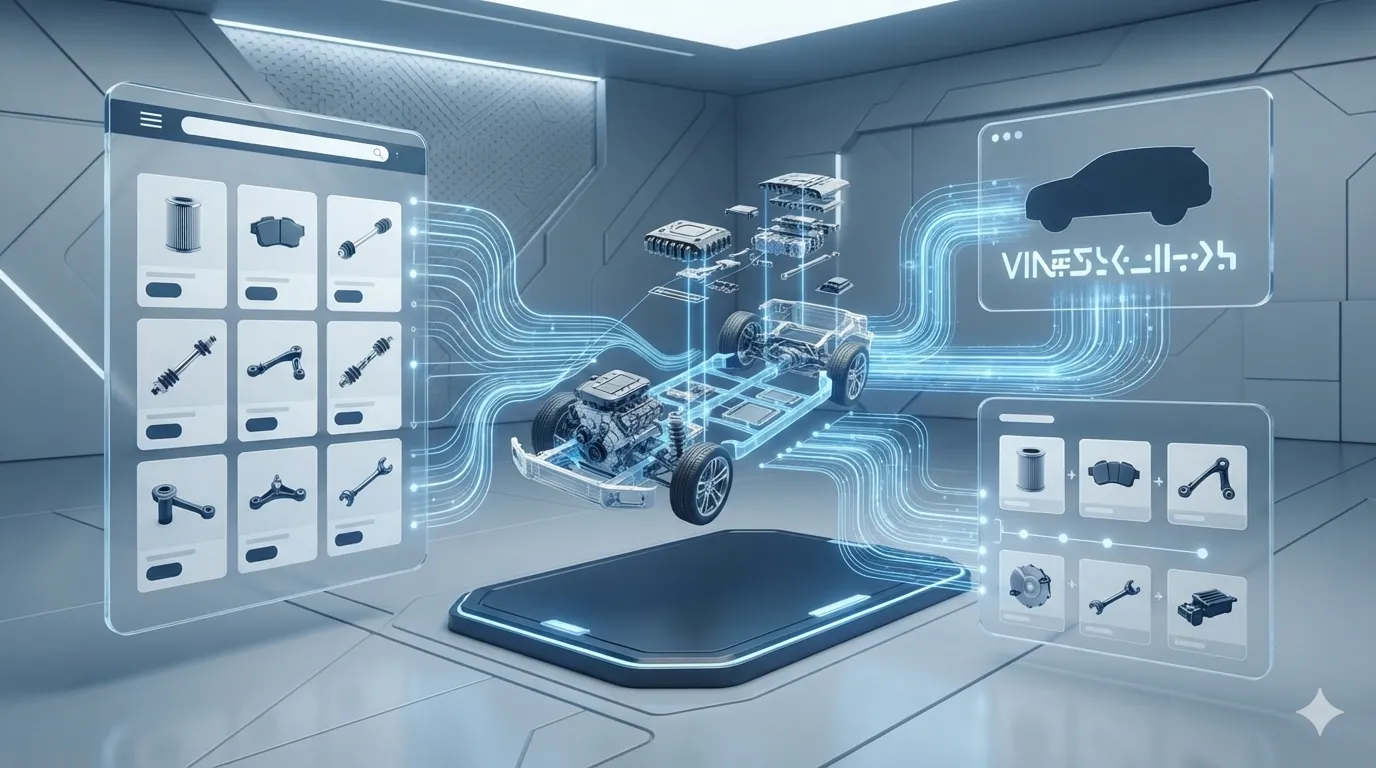
An original auto parts store faces a specific problem: the product catalog has to be matched correctly to the customer's vehicle, or the risk of a wrong order grows with every engine and equipment variant on the market. HappyWeb solved this problem for stoauto.ro through an integration with yqservice.eu technical data, the system behind ACIS (Automotive Components Information System).
This article describes, from the development team's perspective, which modules we built, which technical decisions mattered most, and what practical outcome the integration had for the store. It is not a code tutorial, but a case study aimed at whoever is deciding whether to invest in this kind of integration.
If you want general context on YQ Service and the ACIS system first, read What Is YQ Service (ACIS) and How VIN-Based Auto Parts Search Works.
The starting point: what stoauto.ro needed from an original parts store
The client needed an online store dedicated to original (OE) auto parts, not a generic aftermarket parts store. The base requirement was easy to state but hard to deliver correctly: the end customer had to find the right part for their exact vehicle quickly, without manually searching through printed catalogs or code lists.
Besides parts identification, the store needed standard e-commerce functionality — cart, customer account, order management — plus features specific to auto parts: price updates through files, product-vehicle association by make, model and engine, and a way for each customer to save their vehicles for future orders.
Why we chose a YQ Service integration for this project
For a store focused on original parts, a TecDoc-style aftermarket catalog did not cover the real need: the stoauto.ro client wanted parts identical to the ones fitted at the factory, not just compatible parts. YQ Service covers exactly this segment — OE data licensed directly or indirectly from vehicle manufacturers, combined in the ACIS system with technical parts schemes.
It is not an exclusive choice. YQ Service and TecDoc are complementary systems — the first covers OE parts, the second covers aftermarket parts — and can coexist in the same store, as explained in our article on a complete OE + aftermarket catalog. For stoauto.ro, the project priority was original parts, which is why YQ Service was the first integration implemented.
The modules we built for stoauto.ro
The implementation covered several areas of the store, not just an isolated search module. The main structure was:
- Product catalog for original auto parts, organized by manufacturer, technical category and maintenance packages.
- Product-vehicle association by make, model and engine type, so a customer sees only the parts relevant to their car, not the entire unfiltered catalog.
- A "garage" feature — customers save their vehicles in their account, so they don't repeat vehicle identification on every new order.
- Price import and updates through CSV files, so the client's team can update price catalogs without technical intervention for every change.
- Integration with standard e-commerce modules — cart, customer account, order management — so the technical catalog works as part of a complete sales flow, not as a separate tool.
You can see the public project summary on the stoauto.ro portfolio page.
Technical decisions that mattered most
Three decisions had a direct impact on the final store experience.
Identifying the vehicle correctly before showing the catalog
We built the flow so that product-vehicle association happens before the user browses the catalog freely, not after. In practice, the customer first confirms the make, model and engine, then sees only compatible parts. This reduces the risk of a user accidentally landing on a similar-looking but incompatible part for their exact engine variant.
Separating technical data from commercial management
Technical data (part-vehicle compatibility) comes from the YQ Service integration, but prices and stock stay under the client's direct control through CSV import. This separation was a deliberate decision: technical data changes rarely and needs external precision, while prices change often and need to stay easy to modify for the commercial team, without depending on a developer.
The garage feature as a retention factor
We added the garage feature not just as a convenience element, but as a retention mechanism: a customer who saves their vehicle comes back more easily for new parts, without repeating the identification process. It is a small decision technically, but with a direct impact on return visit rate.
Risks encountered and how we handled them
| Risk | Applied mitigation |
|---|---|
| Technical catalog showing no compatible parts for rare engine variants | We kept manual identification by make, model and engine as an alternative to automatic search, for situations where technical data doesn't cover a rare combination. |
| Outdated prices due to an incorrect CSV import | We built the import flow with file format validation before applying changes to the store, to avoid overwriting prices with incomplete data. |
| Confusion between OE parts and any aftermarket parts shown in the same place | The catalog was structured explicitly as original parts only, without mixing in aftermarket parts, so it stays clear to the customer what type of part they are buying. |
Practical plan: how we approach a similar project for another store
For a new client who wants an original parts store with a YQ Service integration, we follow a flow similar to the one applied for stoauto.ro:
- We clarify whether the store needs only OE parts, only aftermarket, or both — the answer determines whether we integrate YQ Service alone or together with TecDoc.
- We define the catalog structure: manufacturers, technical categories, maintenance packages, if relevant to the business.
- We build the vehicle identification flow before displaying the catalog, with a manual alternative for cases not covered by data.
- We integrate standard commercial modules (cart, account, orders) on top of the technical catalog, not as separate systems.
- We set up the price update flow, with validation, so the client's team can operate independently of the developer.
- We test identification on a real sample of vehicles before launch, to catch rare combinations not covered by data early.
What we learned from this project
Integrating a technical data system like YQ Service solves the problem of correct parts identification, but it doesn't replace the need for solid commercial architecture around it. Most potential issues don't come from the accuracy of the technical data itself, but from how that data is connected to the catalog, prices and order flow. A well-built store treats technical data as a foundation, not as an isolated feature.
FAQ about YQ Service implementation
1. How long does a YQ Service integration take in an existing online store?
It depends on the complexity of the existing catalog and how much the product architecture needs to be restructured for vehicle association. For a store built from scratch, like stoauto.ro, the integration is part of the overall development plan, not a separate later project.
2. Is a store built from scratch required to integrate YQ Service?
Not necessarily. An integration is also possible in an existing store, but it requires a technical assessment of the current catalog structure, to see how technical data connects to already existing products.
3. What happens if a vehicle has no data available in YQ Service?
For those cases, we keep a manual identification path by make, model and engine, so the user is never left without any search option.
4. Can a TecDoc aftermarket catalog be added later on top of a YQ Service integration?
Yes. The two systems are complementary, and the architecture built for stoauto.ro was designed to allow expansion toward an aftermarket catalog, if the business ends up needing one.
Conclusion
Implementing YQ Service for stoauto.ro showed, in practice, how a technical auto data system connects to a functional online store: correct vehicle identification, a structured original parts catalog, independent price management and full integration with the order flow. The result was not just a search feature, but a store built from the ground up around technical accuracy.
HappyWeb already has direct experience with this integration and can build a similar store for your business, alone or combined with a TecDoc aftermarket catalog. Contact us to discuss your project.
Image generated with AI, used for illustrative purposes.



Write a comment