 English
 Romana

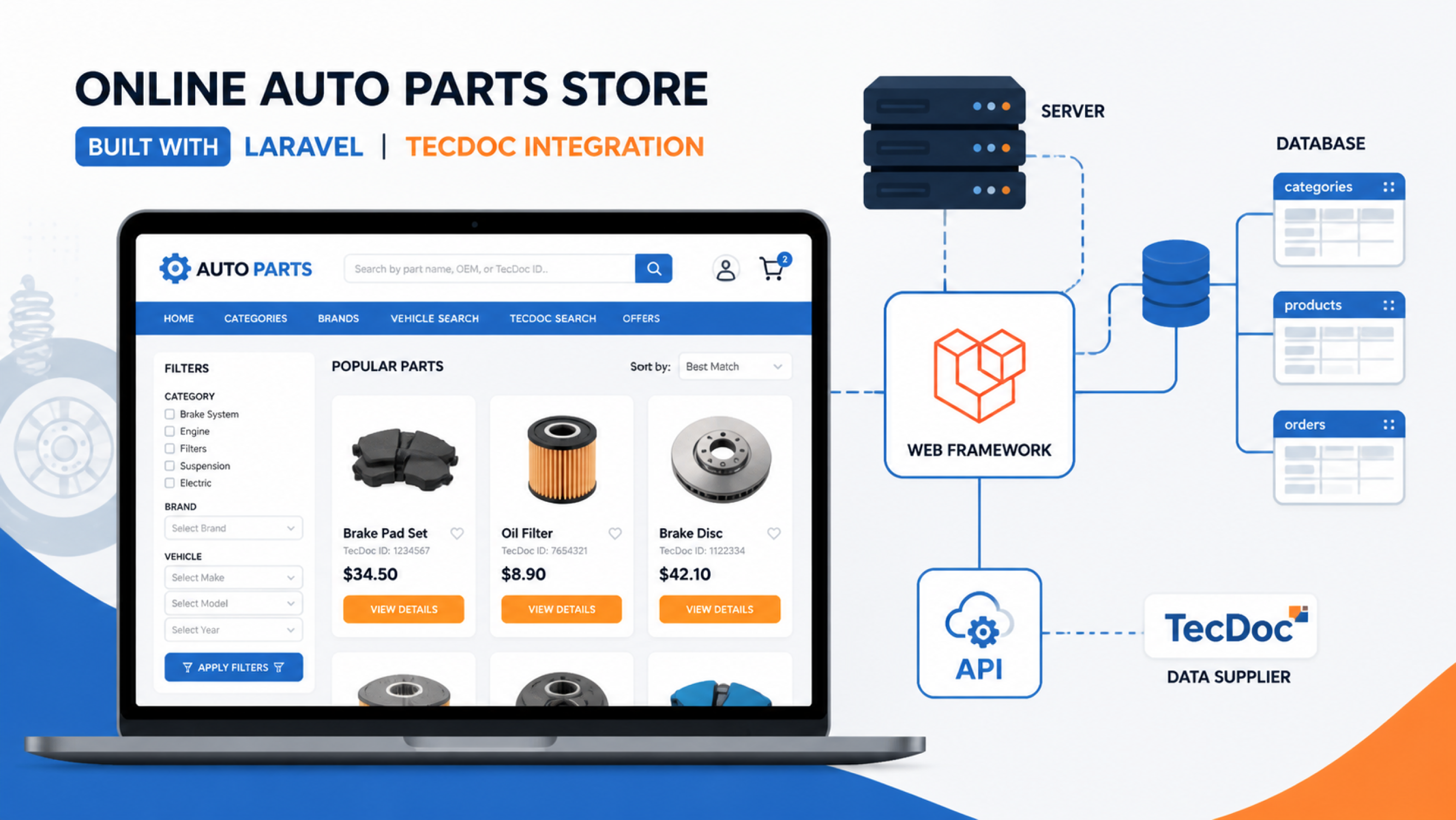
If you want an auto parts store that can handle hundreds of thousands or even millions of products, architecture matters more than theme design. Laravel, combined with TecDoc API integration, allows you to build a scalable platform that is easy to extend and maintain. In this article, I will show you how we approach this type of architecture and which technical decisions make a long-term difference.
Why Laravel for auto parts + TecDoc
Laravel is a modern PHP framework with a mature ecosystem and a very active community, which makes it ideal for complex e-commerce projects. Combined with a parts database such as TecDoc, you get an engine powerful enough to display millions of products quickly, without sacrificing user experience.
Here are a few concrete reasons why we use Laravel in auto parts projects:
- Clear MVC structure that separates business logic from interface and data.
- Eloquent ORM with expressive relationships for vehicles, models, parts, and fitments.
- Queue and job system, perfect for massive imports and periodic TecDoc synchronization.
- Middleware and authentication/role policies for admins, operators, and B2B partners.
In our portfolio, there are multiple examples of auto parts stores built with TecDoc integration and scalable architecture, including projects such as sewa-pieseauto.ro and stoauto.ro.
Core architecture structure
An auto parts store with TecDoc is not just another online shop. It is a complex catalog application with detailed relationships between vehicles and products. In Laravel, the base structure we recommend includes:
- External integration layer (TecDoc API / TecAlliance Webservice).
- Business logic layer (services that translate API responses into internal entities).
- Persistence layer (Eloquent models and dedicated tables for vehicles, parts, categories, and compatibility).
- Presentation layer (controllers + views + front-end components).
This separation lets you replace or extend components (for example, adding another catalog supplier) without breaking the whole project.
Main entity examples in the database
In a real auto parts store, database structure is not limited to a few generic tables. You need both catalog tables and dedicated tables for makes, models, engines, and compatibility.
In practice, the structure looks like this:
- Vehicle zone - tables such as
cars,car_models,car_model_groups, andcar_engineshandle makes, models, body types, and engines. This is where you map the full vehicle universe for which parts are available. - Product zone -
catalog_productsstores actual part records: SKU/code, title, brand, price, stock, images, and commercial attributes. - TecDoc category zone -
parts_categoriesmaps TecDoc catalog categories (for example: braking system, steering, filters, suspension). - Codes and types zone -
part_codes,part_original_codes, andpart_typesconnectcatalog_productsto secondary codes, OE codes, and vehicle types, especially when compatibility is stored locally and not only fetched in real time from TecDoc.
In this model, TecDoc is the primary source for vehicles, parts, and categories, while the Laravel app keeps its own data model optimized for speed and business logic.
TecDoc integration through dedicated services
TecDoc is a huge database, with millions of parts and tens of thousands of vehicle types, accessed through the TecAlliance Webservice API. You do not want to mix direct API calls into Laravel controllers because you will quickly lose control.
That is why the recommended approach is to use a dedicated service, for example TecDocService, responsible for:
- authentication and request signing for the API;
- mapping request/response payloads into internal DTOs;
- error handling and retries;
- logging key requests (for example VIN searches).
This service can then be injected into import jobs, artisan commands, or controllers that need real-time data.
In our article about selling auto parts online with TecDoc integration, we explain in detail how catalog integration reduces order mistakes and improves the search experience.
Data storage strategies: extended import vs smart cache
One of the key decisions in a Laravel + TecDoc project is how much TecDoc data you want to import and store locally. There are two main models:
1. Extended import (full import or near-full)
- You import a large part of the parts, categories, and vehicle structure locally.
- Advantage: very fast search and filtering, less dependency on real-time API calls.
- Drawback: requires storage, carefully designed indexes, and robust synchronization processes.
2. Cache on demand (smart cache)
- Data is fetched on demand through the API and cached locally (Redis / database).
- Advantage: lower local data volume, easier to start quickly.
- Drawback: higher dependency on API latency, more API calls as traffic grows.
Large auto parts projects usually use a hybrid strategy: taxonomy, vehicles, and TecDoc categories are stored locally in tables like cars*, parts_categories, and part_types, while fine-grained details or stock updates are refreshed on demand.
Database architecture for performance
A poorly designed database can bring any framework down, no matter how optimized Laravel is. In auto parts stores, the most important elements are:
- Vehicles - table structures such as
cars,car_models,car_model_groups, andcar_enginesdefine exactly which vehicles you cover by year, engine, and body type. - Products -
catalog_productsstores the parts you actually sell, including price, stock, brand, status, and promotions. - Categories -
parts_categoriesensures clear hierarchy for navigation and filtering (for example: Brakes > Brake Pads > Front / Rear). - Codes and compatibility -
part_codes,part_original_codes, andpart_typesconnect products to OE codes, alternative codes, and compatible vehicle types, especially if this data is persisted locally and not only pulled from TecDoc in real time.
Key performance principles:
- Composite indexes on columns frequently used in filters (for example brand, model, engine type, years).
- Tables optimized for fast filtering, avoiding overloaded JSON columns for queryable fields.
- Normalization where fields repeat (engine types, vehicle side position, and similar attributes).
Laravel Eloquent provides expressive relationship syntax, but in large projects it is essential to monitor generated queries and use eager loading (with()) to prevent N+1 issues.
Search and filtering: UX + performance
Users do not perform simple searches in an auto parts store. They ask things like, "Which brake pads fit my car?" From an architecture perspective, we treat search and filtering as a separate module built on top of the table structure described above.
Main components of the search module are:
- Vehicle-based search (manufacturer -> model -> engine -> year), powered by
cars*tables. - VIN search, when TecDoc license and integration allow it, with compatible parts output.
- Search by part code or OE code, using
part_codesandpart_original_codes. - Advanced category-based filtering through
parts_categories(brand, axle, car side, price range).
The search and filtering experience is designed for end users, while the Laravel architecture behind it is optimized to deliver fast results, even under high traffic.
Jobs, queues, and synchronization with TecDoc
To keep data up to date (stock, prices, new references), automated synchronization processes are required. Laravel offers a queue and jobs system that integrates easily with server cron jobs.
Typical jobs in this kind of project include:
- Periodic updates for supplier prices and stock.
- Incremental import of new references from TecDoc.
- Data reindexing for internal search engine or external services (Elasticsearch / OpenSearch).
- Cache cleanup and regeneration of materialized views for category pages or large listings.
These jobs run in the background and keep the main application responsive, even while large data volumes are processed.
Security and roles: B2C and B2B in the same app
Many auto parts stores start as B2C and later add B2B features (workshop accounts, fleets, dealers). Laravel provides a straightforward infrastructure for this scenario:
- Guards and providers for different user types.
- Policies and gates to control access to special pricing, discounts, and payment terms.
- Middleware for role checks or account status validation (active, pending, limited).
This way, the same application can support both a classic public online store flow and a dedicated partner portal for frequent high-volume orders.
Operational integration after launch
In practice, a high-performing auto parts store is not only about the catalog and compatibility logic. It also depends on connected operational workflows. In HappyWeb projects, Laravel architecture is often extended with integrations such as automated invoicing (for example SmartBill), online payments, courier AWB generation, and marketplace synchronization. These components reduce manual back-office work and shorten order processing time.
On the front-end and marketing side, the technical stack is complemented by responsive design and on-page SEO optimization, so the store performs both in organic search and paid campaigns. In other words, scalable architecture should be designed end to end: from TecDoc data modeling to actual order fulfillment and traffic acquisition.
Conclusions
In our auto parts projects - both aftermarket and genuine parts - we use a scalable Laravel architecture that combines catalog tables such as catalog_products, parts_categories, part_codes, part_original_codes, and part_types with the vehicle area cars* and TecDoc integration through dedicated services.
If you are an entrepreneur in the auto parts industry or a developer building this type of store, the key is to start from architecture, not design. Laravel gives you a solid backbone, and TecDoc integration gives you access to a massive product catalog. Combined correctly, these two can support a platform that scales for years without painful refactors.



Write a comment