 English
 Romana

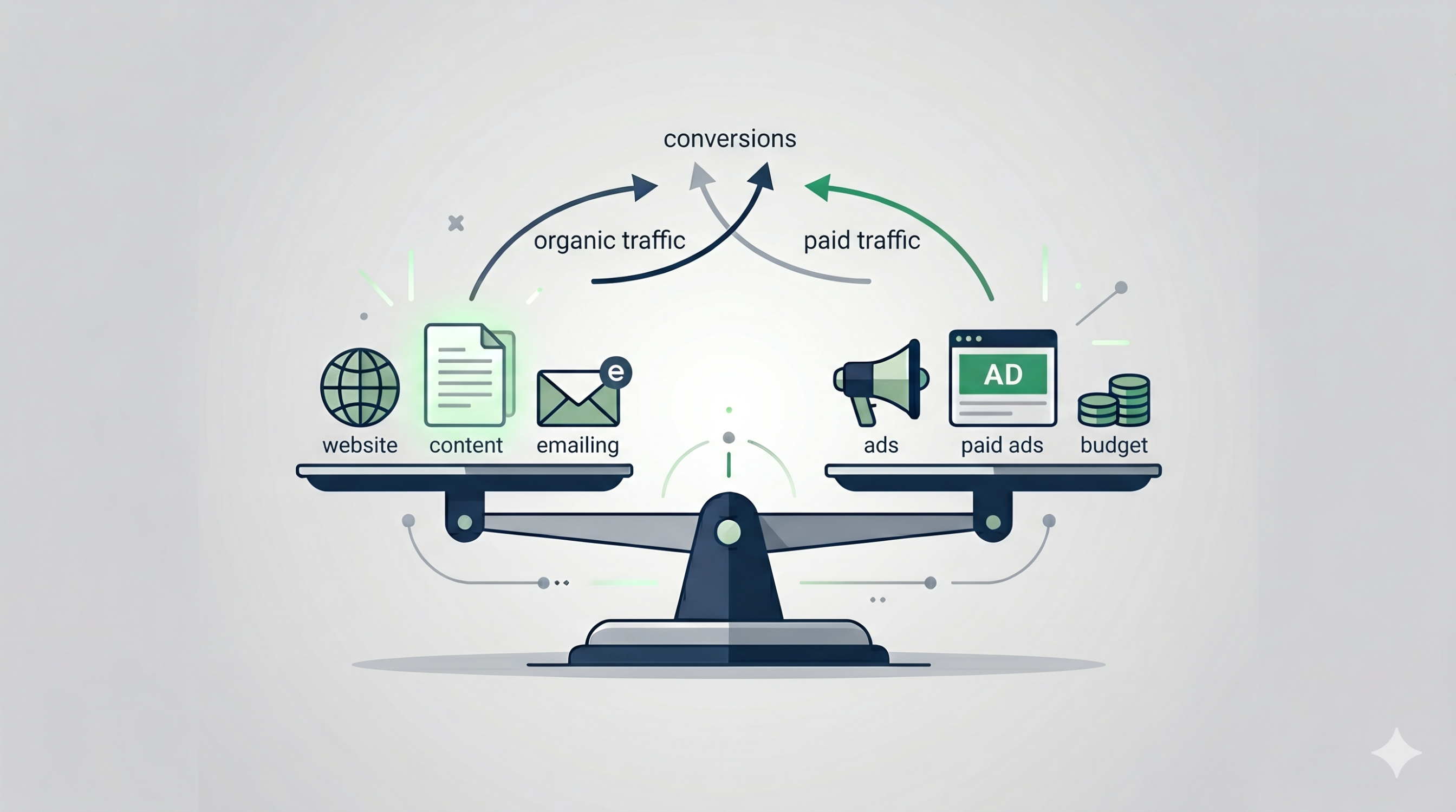
A long-term online marketing strategy is not an "owned assets vs paid channels" debate. It's a positioning strategy. Paid channels are fast tactics for validation; owned assets are strategic levers that build brand equity, reduce costs and increase predictability.
If you look at the problem strategically, the question is not "SEO or Ads?" but "how do I use my website, content and email to position myself clearly in the minds of my target segment — and how do I support that positioning with tactical paid campaigns?" This guide provides the theoretical framework (Kotler, McCarthy, Levitt) and practical implementation steps.
Warning: avoid "Marketing Myopia" when considering owned assets
Theodore Levitt warned companies that they focus on what they produce rather than the problem they solve. The same myopia applies to owned assets.
Example of myopia: "I must invest in SEO because it's long-term" (focus on the asset) vs "I need to position my brand as an expert in solution X, and SEO is the channel to reach customers searching for that solution" (focus on the problem and positioning).
A solid strategy starts with: "Which segment am I targeting? What problem do they have? How do I position myself as their solution?" Only then: "Which owned assets and which paid channels support that positioning?"
What are owned assets and how they work as positioning levers
Owned assets are digital resources you directly control that build brand equity and mental availability for your target audience.
- Website and content architecture: pages for services, articles, landing pages — each element communicates and consolidates positioning.
- Organic visibility (SEO): search rankings for intents relevant to your target segment. When customers search, they find you — not the other way around.
- Audience base (email, organic social): direct relationships you control — not dependent on algorithms or ad budgets.
- First-party data: real behavior, feedback and conversions that inform positioning and future optimization.
- Proof of credibility (case studies, testimonials, results): social and tangible evidence of your positioning.
Why it matters: owned assets are not a marketing expense but an investment in property that increases long-term value. Paid channels are rented — good for quick testing, but costs rise with competition.
Strategic foundation: STP (Segmentation, Targeting, Positioning) and 4Ps/7Ps
Philip Kotler and Kevin Keller emphasize that brand strategy and budget allocation (including between owned assets and paid channels) must anchor in STP:
- Segmentation: What market segments exist? What are their different needs?
- Targeting: Which segment(s) will you prioritize?
- Positioning: How do you want that segment to see you versus competitors?
E. Jerome McCarthy (4Ps: Product, Price, Place, Promotion) shows that each marketing variable must be coherent. Why this matters here:
- Product: your offer (fit for the segment).
- Price: a signal of value and positioning.
- Place: where and how the customer finds you (SEO, email, ads, social).
- Promotion: messaging (content, copywriting, paid ads).
For owned assets, add the 7Ps (services context):
- People: team, visible expertise (case studies, expert bios, testimonials).
- Processes: how the service works — visible on the site, in content and email.
- Physical evidence: design, quality, user experience — all communicate positioning.
Practical application: if your positioning is "premium expertise", your website must look premium, content must demonstrate expertise, and email should communicate professionally. Owned assets and paid channels must reinforce each other.
How to allocate budget between immediate performance and sustainable growth
There is no universal percentage. Instead, allocate based on business stage and objectives.
| Business stage | Main focus | Indicative allocation | Priority metrics |
|---|---|---|---|
| Start (0-6 months) | Offer validation + quick leads | 60-70% paid channels, 30-40% owned assets | CPL, lead conversion rate, time to first purchase |
| Consolidation (6-18 months) | Lower acquisition cost | 40-50% paid channels, 50-60% owned assets | CAC, organic traffic, qualified organic leads |
| Scaling (18+ months) | Efficiency and predictability | 30-40% paid channels, 60-70% owned assets | LTV, retention, share of revenue from owned channels |
Percentages are indicative. Adjust based on real data for your industry, seasonality and offer maturity.
What the literature says about balancing channels and strategic assets
Relevant literature confirms that performance comes from strategic coherence, not magical budget shares.
- Kotler & Keller: Brand equity is built long-term through consistency. Owned assets are brand-building; paid channels capture demand. Both are necessary, but serve different purposes.
- E. Jerome McCarthy (4Ps/Place): Distribution (where the customer finds you) is a strategic decision. Owned assets and paid channels are two sides of the same "place" strategy.
- Theodore Levitt: Avoid myopia by thinking "what problem do we solve?" rather than "which channel do we invest in?" Owned assets vs paid channels is a false dichotomy; both execute the same positioning strategy.
- Chaffey & Ellis-Chadwick: Channel integration increases efficiency. Owned assets and paid channels should complement each other across the customer journey.
- Byron Sharp: Mental availability is built through consistent presence where the audience searches. Owned assets grow availability organically; paid channels accelerate it.
- Les Binet & Peter Field: The balance between demand capture (short-term) and demand building (long-term) produces the best efficiency. Owned assets = demand building; performance paid channels = demand capture.
Strategic conclusion: Budget allocation should follow STP and strategic objectives (brand equity vs immediate leads), not a fixed rule.
90-day practical plan for an online marketing strategy
Days 1-30: diagnosis and prioritization
- Audit channels, pages, messaging, tracking and funnel.
- Define KPIs: CAC, ROAS, CR, qualified lead rate, organic commercial traffic.
- Select 3 high-impact, short-execution initiatives.
Days 31-60: controlled execution
- Paid campaigns targeting transactional intent, with message and offer testing.
- Publish strategic content on topics with informational/commercial intent.
- Optimize landing pages for clarity, speed and conversion.
Days 61-90: optimize and scale
- Shift budget to channel+message combinations with proven efficiency.
- Consolidate SEO clusters around pages that generate leads.
- Introduce email sequences for retention and reactivation.
Mistakes that block growth in online marketing
- Total dependency on ads: stop the budget and you stop the leads.
- SEO without commercial intent: lots of traffic, few leads.
- Lack of alignment between teams: marketing, sales and operations pulling in different directions.
- Reporting vanity metrics: high views but low commercial impact.
Mini case study (anonymized): from volatile traffic to a predictable pipeline
A B2B services business experienced volatile results: good months on ads, then drops when CPC rose. Existing content did not cover real customer search intents.
The intervention combined three directions: redesign commercial pages, an SEO calendar focused on high-intent topics and restructuring paid campaigns around clearer segments.
Within 4 months, the share of leads from owned channels increased steadily and media cost pressure decreased. Exact numbers remain confidential, but the trend remained stable after the initial phase.
Sources
- Philip Kotler, Kevin Lane Keller - Marketing Management, Pearson. Resource: https://openlibrary.org/works/OL16962242W/Marketing_management
- E. Jerome McCarthy - Basic Marketing: A Managerial Approach (1960). Resource: https://en.wikipedia.org/wiki/E._Jerome_McCarthy
- Theodore Levitt - "Marketing Myopia" (Harvard Business Review, 1960). Article: https://hbr.org/2004/07/marketing-myopia
- Dave Chaffey, Fiona Ellis-Chadwick - Digital Marketing, Pearson.
- Byron Sharp - How Brands Grow, Oxford University Press.
- Les Binet, Peter Field - The Long and the Short of It, IPA.
FAQ - online marketing strategy
1. Is it better to choose SEO or Google Ads?
The best option is a combination. Google Ads accelerates testing, while SEO reduces long-term cost through recurring, relevant traffic.
2. When should I increase paid channel budgets?
Increase budget when message, offer and conversion page are validated with consistent data, not just 1-2 good weeks.
3. How do I know if I'm investing enough in owned assets?
If the share of leads from owned channels doesn't grow quarter over quarter, investment in owned assets is likely insufficient.
4. Which KPIs track the balance between short-term and long-term?
Track CAC/ROAS for short term and organic commercial traffic, qualified organic leads and LTV for long term.
5. How long until I see the effect of a mixed strategy?
Initial signals appear in 1-3 months for performance; owned assets stabilize typically between 6 and 12 months.
Conclusion: owned assets are positioning levers, not budget categories
An integrated online marketing strategy with lasting results is not a split of the budget between "owned assets" and "paid channels". It's a unified positioning strategy that uses both types of channels as complementary levers.
When STP and 4Ps/7Ps are clear, budget allocation follows naturally: paid channels accelerate testing and demand capture; owned assets consolidate brand equity and demand building. Costs become more predictable, growth is steadier, and dependency on a single traffic source decreases over time.
If you want to build this integrated strategy, see our services, examples in our portfolio or contact us at contact.
Disclaimer: Image generated with AI, used for illustrative purposes.



Write a comment