 English
 Romana
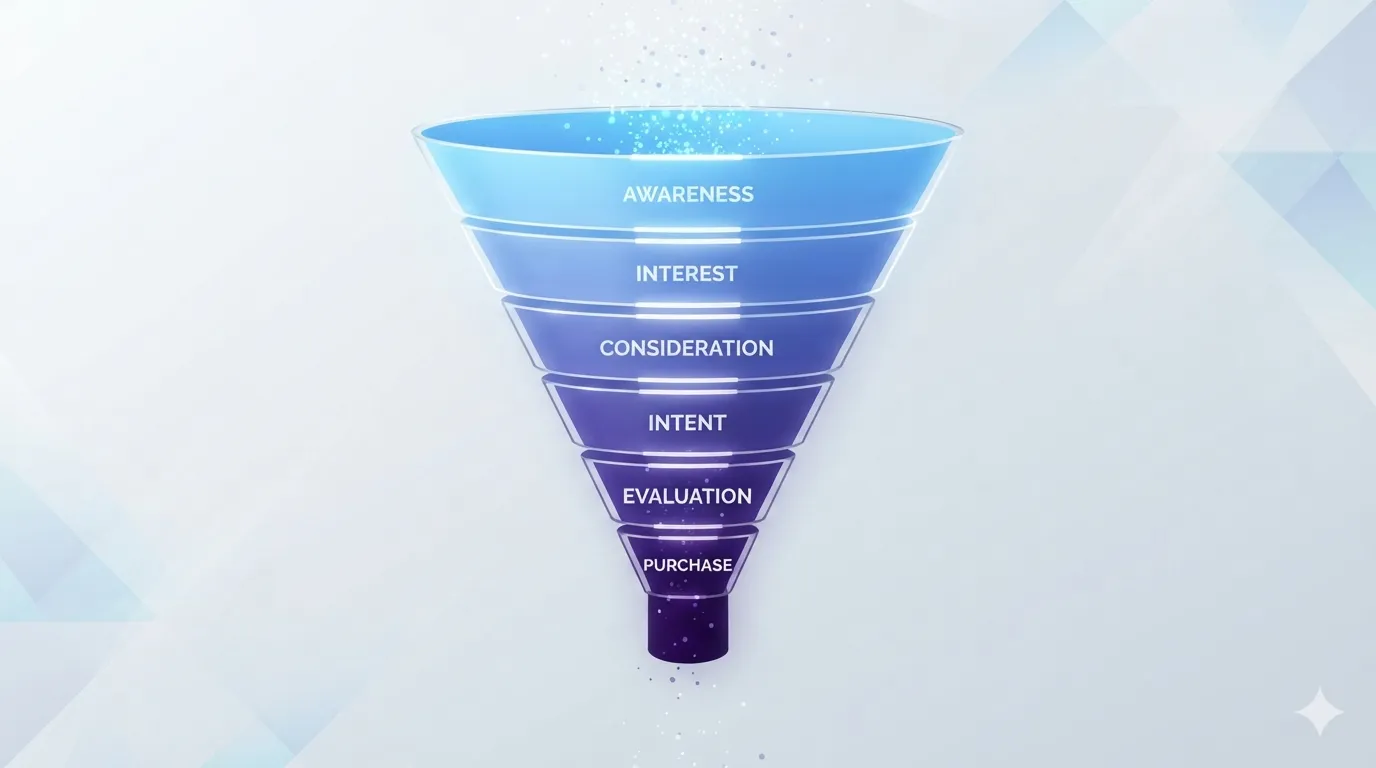
A sales funnel is the representation of the stages a person goes through, from the first contact with your brand to completing a purchase, organized from a large number of interested people (the top of the funnel) down to a small number of actual customers (the bottom of the funnel). The term comes from the funnel shape of this path: many visitors go in, but only a part of them move on to each following stage.
You build a sales funnel by mapping the real stages of your audience's buying decision — usually grouped into three zones: TOFU (top of funnel, awareness), MOFU (middle of funnel, consideration), and BOFU (bottom of funnel, decision) — and assigning distinct content, channels, and budget to each stage, instead of one identical message for everyone.
This guide explains what a sales funnel is, how it differs from a marketing funnel, what its classic stages are (including the AIDA model), how to build one from scratch, with a numeric budget example in RON, which mistakes block it most often, and how to measure and optimize it over time.
Expertise note: HappyWeb builds and optimizes sales funnels for businesses in Romania, integrating Google Ads and Meta Ads campaigns with metrics such as CPC, CPM, CPA, and ROAS at every stage of the funnel, not as isolated "more ads" tactics.
What Is a Sales Funnel, Exactly?
A sales funnel is not a single ad or an isolated campaign — it is the structure of the entire path a customer follows, from the moment they learn a product or service exists, to the moment they pay for it (and, ideally, to a second purchase). At every stage, some of the people who entered the funnel drop out without moving forward — this is normal and predictable, not automatically a sign of a "broken" funnel.
Why a Funnel Is Always Wider at the Top Than at the Bottom
The number of people decreases at every stage because not everyone who sees an ad or a post has a real need for your product, is at the right moment to decide, or has the necessary budget. A healthy funnel does not remove this drop-off — it makes it predictable and measurable, so you can intervene exactly at the stage where you lose the most people, instead of guessing.
Sales Funnel vs. Marketing Funnel: What Is the Difference?
In everyday digital marketing conversations, especially around Google Ads and Meta Ads advertising, the terms "sales funnel" and "marketing funnel" are frequently used as synonyms, because the same team manages the whole path, from first exposure to purchase. The difference becomes relevant mainly in B2B companies with separate marketing and sales teams.
| Criterion | Marketing funnel | Sales funnel |
|---|---|---|
| Who manages it | The marketing team | The sales team (or the same team, in small businesses) |
| Typical stages | Awareness, interest, consideration | Qualified lead, offer, negotiation, closing |
| Main objective | Generates and qualifies leads | Turns qualified leads into customers |
| Typical context | Content and online advertising campaigns | Direct sales processes, common in B2B |
In e-commerce and in most Google Ads/Meta Ads campaigns, the two funnels overlap almost completely, because there is no explicit "handoff" to a sales team — the visitor buys directly from the online store. In B2B, the marketing funnel brings in leads (MQL — marketing qualified lead), which the sales team qualifies and moves further along its own sales funnel (SQL — sales qualified lead, offer, negotiation, closing).
Sales Funnel Stages: TOFU, MOFU, and BOFU Explained
Regardless of the exact number of stages, most funnel models group the customer's path into three zones, known in the industry under the acronyms TOFU, MOFU, and BOFU (Top/Middle/Bottom of the Funnel).
The AIDA Model: The Historical Origin of Funnel Stages
The idea of splitting a buying decision into successive stages is not new. The AIDA model (Attention, Interest, Desire, Action) is traditionally attributed to E. St. Elmo Lewis, in 1898, although recent historical research shows that the exact origin of the formulation is more complex than the simplified single-author attribution. Regardless of authorship, AIDA has remained, for more than a century, the basic skeleton for the funnel stages used in digital marketing today.
Philip Kotler, in his work on marketing management, describes a similar concept through "buyer readiness stages" — awareness, knowledge, preference, conviction, purchase — which, like AIDA, explains why a single, identical message does not work equally well at every stage of the decision. The 4P model by E. Jerome McCarthy (Product, Price, Place, Promotion, 1960) places exactly in the "Promotion" area the decision about what message you send, through which channel, and at which stage of the funnel — that is, allocating the promotion budget across stages, not just across isolated campaigns.
TOFU — Top of the Funnel (Awareness)
In the TOFU stage, the audience does not yet know your brand or has not clearly recognized the problem your product solves. The goal is not a direct sale, but building awareness, through educational content, reach/awareness ads, or blog articles that answer general questions in your niche.
MOFU — Middle of the Funnel (Interest / Consideration)
In the MOFU stage, the person already knows they have a problem and is actively looking for solutions. This is where lead magnets work well (guides, offers, demos, free consultations) and content that compares options, in order to get a lead's contact details and continue the conversation through email, retargeting, or a personalized offer.
BOFU — Bottom of the Funnel (Decision / Action)
In the BOFU stage, the person is ready to decide. The most effective messages here are concrete offers, testimonials, case studies, and retargeting toward visitors who already showed interest (for example, people who abandoned a shopping cart), not generic awareness ads.
| Stage | Main objective | Typical content | Relevant metric |
|---|---|---|---|
| TOFU (Awareness) | Awareness, reach | Educational content, video/display ads, blog articles | CPM, impressions, reach |
| MOFU (Consideration) | Lead generation | Lead magnets, comparisons, demos, newsletter | CPC, form completion rate |
| BOFU (Decision) | Conversion | Concrete offer, testimonials, retargeting | CPA, ROAS, conversion rate |
This breakdown into stages and metrics is not an invention by advertising agencies — it is part of the platforms' own official documentation. Google Ads explicitly structures a "full-funnel" strategy in Reach Planner for YouTube, across three stages — awareness (CPM pricing), consideration (CPV pricing), and action (CPA pricing) — to "drive unique reach" at the top of the funnel and "drive high-intent users to convert" at the bottom (Google Ads Help — About full funnel in Reach Planner, checked 2026-06-23). Meta Ads, in turn, groups campaign objectives into three equivalent categories — Awareness, Consideration, and Conversion/Sales —, recommending a gradual move from reach, to traffic, to leads or sales, as the audience moves down the funnel (Meta Business Help Center — Choose the right objective, checked 2026-06-23).
How to Build a Sales Funnel From Scratch (Practical Plan)
Building a sales funnel does not mean launching a single campaign with a big budget — it means intentionally allocating content, channel, and budget to each stage, depending on how well known your brand already is and how complex your audience's buying decision is.
- Days 1-30: map the funnel stages for your business (TOFU/MOFU/BOFU), define the objective and metric for each stage, and install the technical tracking (Google tag, Meta Pixel, Google Analytics 4).
- Days 31-60: create the content and campaigns for each stage — awareness ads for TOFU, a lead magnet or offer for MOFU, a conversion offer plus retargeting for BOFU — and launch them with separate budgets, not a single undifferentiated budget.
- Days 61-90: analyze the conversion rate between stages, identify where you lose the most people (the biggest "leak" in the funnel), and optimize exactly that stage — the page, the offer, or the message — before increasing the budget on the rest of the funnel.
A short implementation checklist, useful before launching a sales funnel:
- Funnel stages defined and mapped to real business objectives
- Tracking installed and verified (Google tag, Meta Pixel, GA4)
- Distinct content and offer for TOFU, MOFU, and BOFU
- Budget allocated separately per stage, not only on the final conversion
- Conversion rates monitored between each consecutive stage
- A retention/loyalty stage included, not just the first purchase
A Numeric Example: A Sales Funnel With a Budget in RON
An illustrative example, to show the logic of allocating budget across stages: an interior design company in a large city in Romania runs Google Ads and Meta Ads campaigns for one month, with a total budget of 8,000 RON, split across the three funnel stages.
| Stage | Allocated budget | Result (illustrative) |
|---|---|---|
| TOFU (Awareness) | 4,000 RON | ~250,000 impressions, ~5,000 site visitors |
| MOFU (Consideration) | 2,500 RON | ~1,200 clicks, 180 leads (quote requests) |
| BOFU (Decision) | 1,500 RON | 45 new customers, average CPA ~33 RON |
Illustrative figures, meant to demonstrate the typical allocation pattern seen in accounts managed by HappyWeb. They do not represent a real client's results and are not a universal benchmark; results vary by industry, budget, seasonality, and creative quality.
In the example above, the conversion rate from visitors to leads is approximately 3.6% (180 out of 5,000), and the rate from leads to customers is approximately 25% (45 out of 180). The general formula for the conversion rate between two funnel stages is: (Number of people who move to the next stage ÷ Number of people in the current stage) × 100.
How to Measure and Optimize a Sales Funnel
A sales funnel is not built once — it is measured constantly and adjusted wherever it loses the most people. The most useful practice is to track the conversion rate between each pair of consecutive stages, not just the final conversion rate (from visitor to customer).
- Measurement tools: Google Analytics 4 for on-site behavior, the Google tag and Meta Pixel for conversion events, and a CRM or a simple spreadsheet to track leads from first contact to purchase.
- Optimization priority: the stage with the largest percentage drop in people (the biggest "leak") is, as a rule, the priority to optimize, before increasing the budget on the rest of the funnel.
- Continuous testing: test offer, message, or page variations at the stage identified as the priority, through A/B tests, before drawing final conclusions about what "isn't working" in the funnel.
There is no universally "good" conversion rate between funnel stages — it varies strongly by industry, price, channel, and season. The safest basis for comparison is your own business's historical data, measured constantly, not a generic benchmark found online without industry or country context.
Common Sales Funnel Mistakes and How to Avoid Them
- Using the same message at every stage: showing a direct sales ad to people who have not yet heard of your brand. Mitigation: adapt the message and the CTA to the audience's awareness level at that stage (TOFU/MOFU/BOFU).
- Not having proper tracking installed: without the Google Ads tag and Meta Pixel configured, you cannot see where you are losing people in the funnel. Mitigation: install and test tracking before launching any paid campaign.
- A funnel that is too long for a simple product or too short for a complex decision: asking for too many steps for an impulse purchase, or jumping straight to "buy now" for an expensive, complex product. Mitigation: adjust the number of stages to the real complexity of the buying decision.
- Ignoring the retention stage: the whole budget focuses on the first conversion, with no strategy for existing customers. Mitigation: add a retention stage, with remarketing and offers dedicated to current customers.
- Not allocating budget to the top of the funnel: investing only in conversion (BOFU), so the retargeting list shrinks over time. Mitigation: keep a steady balance between prospecting (TOFU) and conversion (BOFU).
- Comparing results to generic benchmarks, without context: a "good" conversion rate read on a foreign blog, with no data on industry, country, or time period, is not a valid basis for comparison. Mitigation: use your own historical data as the main optimization reference.
Related Articles
- Online Marketing Strategy: Owned Assets vs. Paid Channels
- What Is CPC (Cost Per Click) and How to Optimize It
FAQ About Sales Funnels
What is a sales funnel, in simple terms?
It is the path a person follows, from the first contact with a brand to completing a purchase, organized in stages, going from many interested people to few actual customers.
What is the difference between a sales funnel and a marketing funnel?
In digital marketing and e-commerce, the terms are often used as synonyms. In B2B, the marketing funnel generates and qualifies leads (MQL), while the sales funnel turns them into customers through a separate offer-and-negotiation process.
How many stages does a sales funnel usually have?
The most common model groups the stages into three zones — TOFU, MOFU, and BOFU — but the exact number of stages varies depending on how complex the buying decision is and on the business model.
How long does it take to build a working sales funnel?
As a rough guide, a 90-day plan is enough to map the stages, install tracking, launch content and campaigns for each stage, and make the first optimizations based on real data.
What conversion rate is considered good between funnel stages?
There is no universal threshold valid for every industry; the rate varies by price, channel, season, and market. The most useful reference is your own business's historical data, not a generic benchmark.
What mistake most often stops a sales funnel from working?
Using the same direct-sales message at every stage, regardless of whether the audience already knows the brand or is discovering it for the first time, is one of the most common causes of an ineffective funnel.
Conclusion: A Sales Funnel Turns Visitors Into Customers, Stage by Stage
A sales funnel works when every stage has its own objective, message, and budget, not when a single campaign treats a brand-new visitor and an almost-decided customer the same way. The TOFU, MOFU, and BOFU stages, measured constantly through the conversion rate between them, turn the funnel from a theoretical scheme into a concrete growth tool.
If you want a sales funnel built on real Google Ads and Meta Ads campaigns, integrated with CPA and ROAS, not assumptions, contact us for a free audit.
Want campaigns that deliver measurable results?
HappyWeb builds complete sales funnels, with Google Ads and Meta Ads (Facebook and Instagram) campaigns set up for every stage of the funnel. Contact us for a free audit.
Sources
Article last updated: 2026-06-23 · Recommended review: within 90-180 days, since advertising platforms' campaign objectives may be updated.
- Google Ads Help — "About full funnel in Reach Planner". Official documentation: support.google.com/google-ads. Checked 2026-06-23.
- Meta Business Help Center — "Choose the right objective". Official documentation: facebook.com/business/help. Checked 2026-06-23.
- E. St. Elmo Lewis — the traditional attribution of the AIDA model (1898). Reference: en.wikipedia.org/wiki/E._St._Elmo_Lewis.
- Philip Kotler, Kevin Keller — Marketing Management, for the buyer readiness stages concept. Consulted from HappyWeb's internal library.
- E. Jerome McCarthy — Basic Marketing: A Global-Managerial Approach, for the 4P model (Product, Price, Place, Promotion, 1960) and placing the promotion allocation decision across stages within that framework. Consulted from HappyWeb's internal library.
If you want a tailored review of the sales funnel in your business, contact us.
Image generated with AI, used for illustrative purposes.



Write a comment