 English
 Romana

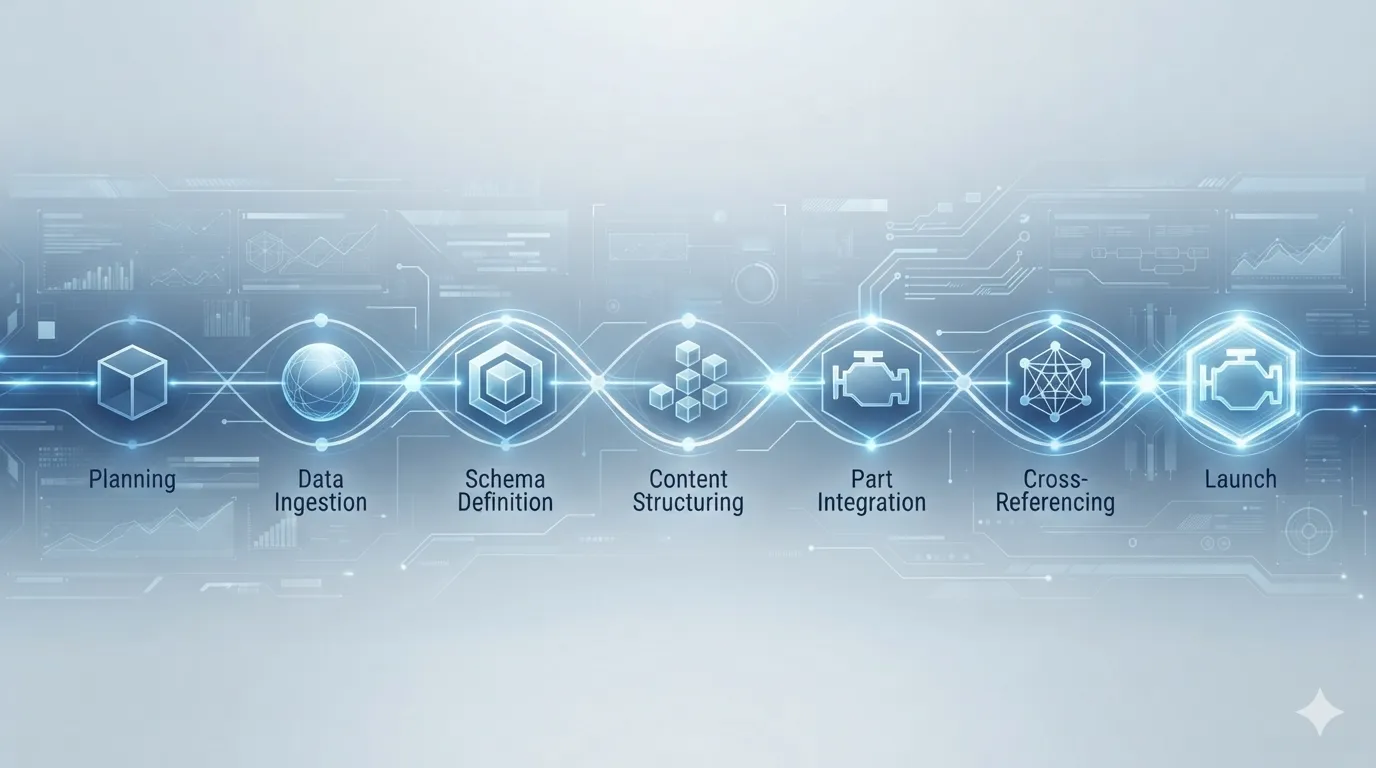
The cost of adding TecDoc to a store that already has YQ Service integrated isn't just the TecDoc license. Most of the real effort comes from reconciling the two catalogs — mapping by technical position, adjusting the search flow, and separately syncing price and stock — not from connecting to a second API itself.
A store that already has the technical foundation for VIN search and OE parts starts from a real advantage: many of the required components (vehicle database, search interface, ecommerce modules) already exist and get extended, not rebuilt. The effort difference between "a new store with both systems" and "extending with a second system" is significant.
This guide walks through the real project stages, the factors that increase or reduce effort, and an estimated implementation plan, using the structure HappyWeb already built for stoauto.ro, an online store for original auto parts with YQ Service integration, as a starting point.
What Adding TecDoc to a YQ-Service-Integrated Store Technically Requires
Three areas of work are unavoidable: licensing and API access to TecDoc, extending the database with an aftermarket parts table and a technical-position mapping table, and adjusting the search interface to display both part types on the same page.
What does NOT need to be rebuilt, if the YQ Service foundation is well built: the vehicle database, customer authentication and accounts, the shopping cart, and the order flow. These stay unchanged — only the source of displayed parts expands.
Real Project Stages and Estimated Effort for Each
- TecDoc licensing and API access — duration depends on the provider, not the development team; runs in parallel with the technical stages.
- Defining the shared technical position dictionary between the two sources — an analysis stage, essential before any code is written.
- Extending the database with the TecDoc table and the mapping table — moderate technical effort, if the YQ Service schema was designed correctly from the start.
- Price/stock sync jobs for TecDoc — separate from the existing YQ Service jobs, with their own frequency.
- Adjusting the search interface and product page — unified display, clear OE vs. aftermarket labeling.
- Testing on real scenarios — vehicles with and without an aftermarket equivalent, verifying correct mapping.
Factors That Increase Integration Effort
- The existing YQ Service database wasn't designed with a clear, reusable technical position key for mapping.
- The catalog covers a very large volume of part categories, increasing the amount of real-scenario testing needed.
- The existing search interface wasn't built modularly, so combined OE + aftermarket display requires refactoring, not just extension.
- No clear display priority policy by part category was decided before development started.
Factors That Reduce Integration Effort
- The YQ Service database already has a well-defined technical position key.
- The search interface was built modularly, with the parts source as a parameter, not hardcoded for a single system.
- The team already has experience integrating a second system from a previous project.
- Display priority rules by part category were set before writing any code.
| Project stage | Type of effort | Main risk |
|---|---|---|
| TecDoc licensing and API access | Administrative, provider-dependent | External approval timelines, not technical |
| Shared technical position dictionary | Analysis and data design | Mismatched mapping if this stage is skipped |
| Database extension | Backend development | Major refactor if the old schema lacks a reusable key |
| TecDoc price/stock sync | Backend development + recurring operation | Imbalance between the two sources if frequencies aren't calibrated |
| Unified search interface | Frontend development | Customer confusion if OE/aftermarket labeling isn't clear |
| Real-scenario testing | QA | Cases with no aftermarket equivalent handled incorrectly |
Checklist Before Starting a Catalog Expansion Project
- Have you confirmed TecDoc licensing and realistic API access timelines?
- Does the YQ Service database schema have an isolated technical position key, not buried inside the free-text part name?
- Have you set display priority rules by part category before writing any code?
- Does the current search interface allow adding a second source without a full rewrite?
- Do you have a test plan for vehicles with no available aftermarket equivalent?
Case Study: The stoauto.ro Foundation and What Extending It With TecDoc Would Involve
stoauto.ro is an online store for original auto parts built by HappyWeb, with yqservice.eu API integration: vehicle database, searchable OE part diagrams, VIN search, sorting by manufacturer/model, price import and updates via CSV, plus integration into the ecommerce modules.
The technical structure already built — mapping by technical position, separate price and stock syncing, unified VIN search — is exactly the foundation needed for a potential TecDoc extension to stay, in terms of effort, closer to a "controlled expansion" than a "new project from scratch".
Frequently Asked Questions About the Cost of Adding TecDoc to YQ Service
Can TecDoc licensing costs be estimated in advance?
Exact licensing costs aren't fully published publicly and vary based on data volume and access type; for an accurate estimate, talk directly to the TecDoc provider and to a specialized development team.
Does extending with TecDoc affect the existing YQ Service catalog's operation?
It shouldn't, if the stages are properly separated: the database, syncing, and interface for YQ Service remain unchanged, only extended with an additional parts source.
What happens if the YQ Service database schema has no clear technical position key?
The expansion stage becomes larger, because this key must first be introduced into the existing structure before aftermarket parts can be mapped correctly.
Is a separate team needed for the TecDoc integration?
Not necessarily a separate team, but the same competencies as the YQ Service integration are required: backend development for data and syncing, frontend development for search and display, plus dedicated testing.
How quickly can a minimal version, covering only the most searched aftermarket parts, go live?
An incremental rollout, on a subset of part categories (for example, consumables only), reduces risk and allows real testing of the combined flow before covering the full catalog.
Conclusion
Adding TecDoc to a store that already has YQ Service integrated isn't a project from scratch, it's a controlled expansion, with effort concentrated in three areas: mapping by technical position, separate data syncing, and adjusting the search interface. A well-designed YQ Service foundation from the start significantly reduces the cost of this expansion. HappyWeb has already built this foundation for stoauto.ro and can assess the real effort for a store that wants to add TecDoc next to an existing OE catalog.
Want a realistic effort estimate for adding TecDoc next to YQ Service in your store? Contact us for a discussion about your existing architecture and the expansion steps.



Write a comment