 English
 Romana

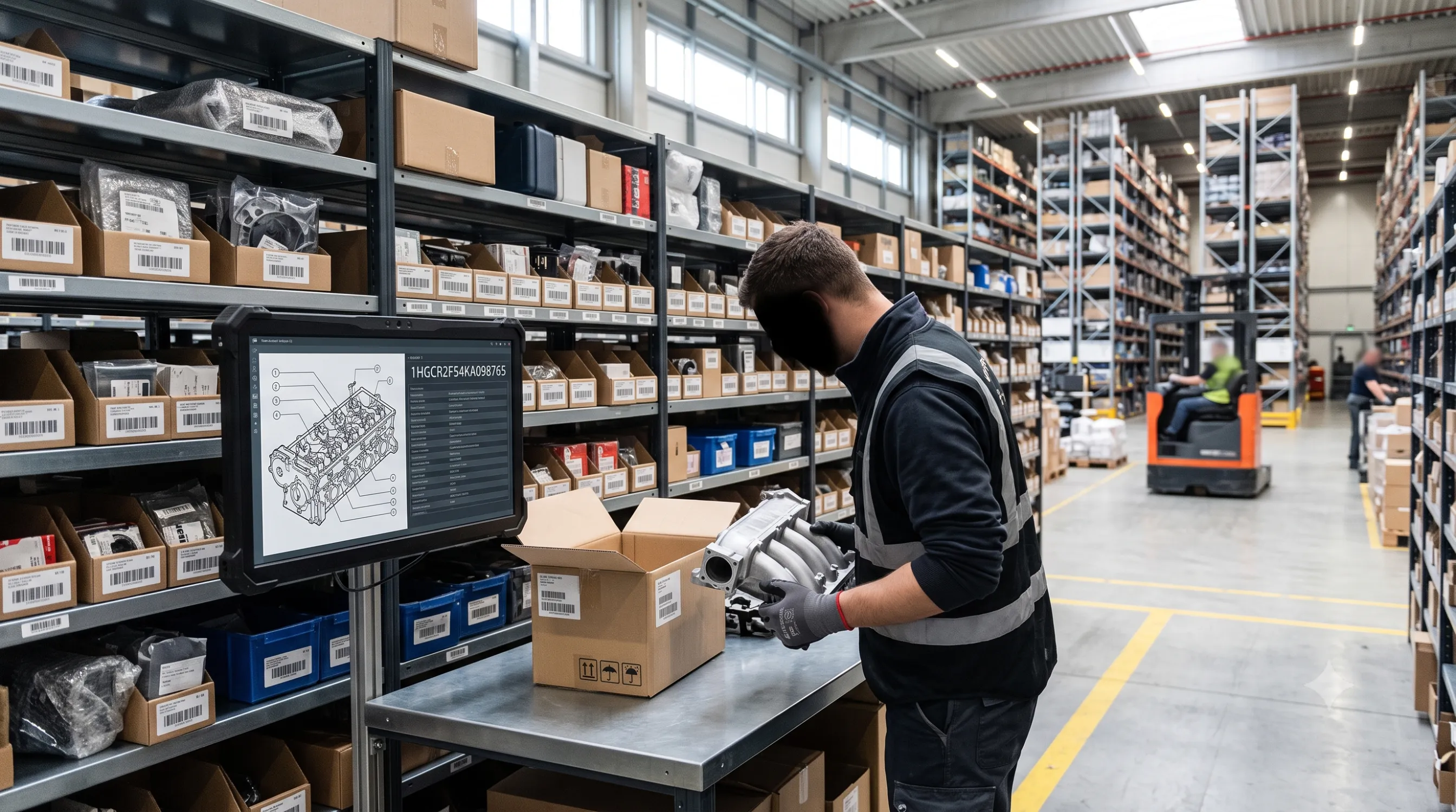
An auto parts distributor loses money every time an order comes back due to compatibility, not quality. The part wasn't faulty — it simply didn't fit the customer's actual vehicle. VIN-based identification, through systems like YQ Service, closes exactly this gap: the customer orders starting from their real vehicle, not from a guess based on make and model.
For a distributor, every return carries a double cost: the logistics of receiving the part back and restocking it, plus the time the support team spends on the phone resolving the complaint. As order volume grows, these costs scale with it, and a return rate of just a few percent can add up to a significant sum over a year.
This guide explains where compatibility-driven returns actually come from, how VIN-based identification works inside a B2B distribution platform, what practical steps a distributor can follow to implement it, and what risks remain even after adoption.
Why compatibility-driven returns cost more than they appear to
On a distribution platform, an order for a part often starts from partial information: a customer (workshop or shop) enters the make and model, sometimes the year, rarely the exact engine variant. A classic search returns parts "compatible with the model," not necessarily with the specific vehicle in question.
- Direct logistics cost — round-trip shipping, inspection on return, repackaging, restocking or, in bad cases, an unsellable part.
- Support cost — every return generates at least one call or ticket, plus the time the team spends identifying the correct part for the second order.
- Trust cost — a B2B customer who receives the wrong part twice reevaluates their supplier, even if the error started with the incomplete information they themselves entered at order time.
- Hidden inventory cost — parts circulating between the warehouse and customers without actually being sold, temporarily tying up space and working capital.
None of these costs shows up on its own, clearly labeled "compatibility returns" line in a financial report — which is why the problem often stays underestimated at the distributor level.
How VIN-based identification works inside a distribution platform
The VIN (Vehicle Identification Number) is the unique 17-character code assigned to every vehicle, containing precise information about the engine variant, body type and, in some cases, factory equipment. A system like YQ Service, built on ACIS (its auto component information system), decodes this code and identifies exactly the parts compatible with that specific vehicle, not with the entire model family.
Integrated into a B2B distribution platform, VIN-based search changes the natural order of an order: the customer enters the VIN of the vehicle they're ordering for, and the platform shows them directly the compatible original (OE) parts, with exact part numbers, before they have to pick manually from a generic list of make-and-model results.
For a broader explanation of the system and how VIN decoding works, read the dedicated article on what YQ Service and ACIS are.
Practical implementation steps for a distributor
Adopting VIN-based identification doesn't require a distributor to rewrite their entire sales platform — it requires integrating an additional data source on top of the existing ordering flow.
- Map the current catalog — establish which part of the catalog is already organized by OEM code or manufacturer reference, so you know what can be linked directly to YQ Service data.
- Integrate the YQ Service API into the ordering platform — the VIN search field is added next to the classic make/model search, not in its place.
- Display both the OE variant and aftermarket alternatives — the customer needs to see both options with price and delivery time, leaving the final decision to them.
- Train the support and sales team — actively recommend VIN-based search to customers who call in for phone or email orders.
- Track the return rate by compatibility reason — separate this reason from other return causes (defective product, damaged package) to measure the real impact of the change.
When YQ Service alone is enough, and when you also need TecDoc
YQ Service covers mainly original (OE) parts, with data sourced directly from vehicle manufacturers' technical schemes. A distributor selling exclusively OE parts can integrate just this data source. But most auto parts distributors also carry aftermarket alternatives, where TecDoc remains the reference catalog in Europe.
The decision isn't "YQ Service or TecDoc" — it's "how much of each does my catalog need." The table below summarizes the decision criteria:
| Criterion | YQ Service (OE) | TecDoc (aftermarket) |
|---|---|---|
| Type of parts covered | Original parts, per manufacturer schemes | Aftermarket parts, from multiple third-party manufacturers |
| Officially targeted customer segment | Distributors, parts manufacturers, online stores | Distributors, online stores, workshops (via partners) |
| Usefulness for a 100% OE catalog | Sufficient as a primary source | Not needed |
| Usefulness for an OE + aftermarket catalog | Covers the OE segment | Completes the aftermarket segment |
For a distributor with a complete catalog, the two data sources are complementary, not alternatives. We covered this topic in more detail in the article on how YQ Service and TecDoc complete each other in a full catalog.
Risks and limits of VIN-based identification for distributors
VIN-based identification significantly reduces compatibility-driven returns, but doesn't eliminate them completely. A distributor needs to account for a few real limits:
- The customer doesn't have the VIN at hand when ordering — especially for quick phone orders. Mitigation: the platform keeps the classic make/model search as a fallback, and phone support guides the customer to the vehicle registration certificate.
- Vehicle modified from factory configuration — the system shows the original factory variant, not a later modification made by the owner. Mitigation: an explicit note on the platform that the result reflects the factory configuration.
- Incomplete coverage for very old vehicles or niche markets — no VIN database covers 100% of the existing vehicle fleet. Mitigation: automatic fallback to classic search when the VIN returns no results.
- Cost and time of the initial integration — connecting the API and mapping the catalog take technical effort upfront. Mitigation: start with a product category that has a high return rate, then gradually extend to the rest of the catalog.
Case study: YQ Service integration in an original parts store
HappyWeb built stoauto.ro, an online store for original auto parts, integrated with yqservice.eu data. The project includes a vehicle database, searchable graphic OE parts diagrams, VIN-based search, sorting by manufacturer/model, and CSV price import/update, all integrated with the standard e-commerce modules (cart, customer account, order management). It's exactly the kind of platform a distributor can use as a reference for their own online sales channel.
Full project details are available on the stoauto.ro portfolio page.
Frequently asked questions about YQ Service for distributors
1. How much can VIN-based identification reduce parts returns?
There's no universal number, since it depends on each distributor's catalog and customer base. The reduction is significant wherever most current returns are caused by compatibility (engine variant, equipment, model variant), not by product defects. Measuring the return rate before and after integration is the only way to confirm the real impact in your own context.
2. Does YQ Service target auto parts distributors directly?
Yes. According to the official site yqservice.eu, the directly targeted customer segments include parts distributors/wholesalers, spare parts manufacturers, and online stores.
3. How does YQ Service integrate into an existing distribution platform?
By connecting the yqservice.eu API to the ordering platform, with a VIN search field added next to the classic make/model search. A full platform rewrite isn't necessary, only mapping the existing catalog to YQ Service data.
4. Does a distributor with an OE and aftermarket catalog also need TecDoc?
Yes, if full coverage through a single platform is the goal. YQ Service covers mainly original parts, while TecDoc is the reference catalog for aftermarket parts in Europe.
5. Does VIN-based identification remove the need for phone support on orders?
No. It reduces the number of compatibility errors, but customers still call for phone orders or unclear situations. The difference is that, when they do call, support can use the VIN itself to confirm the correct part, not just the make and model.
Conclusion
For an auto parts distributor, returns caused by wrong compatibility aren't an inevitable cost of sales volume — they're mostly a symptom of incomplete information at order time. VIN-based identification, through a system like YQ Service, closes this gap right at the source, before the wrong part ever reaches the delivery route.
HappyWeb has already delivered a full YQ Service integration for an original auto parts store and can do the same for your distribution platform, including in combination with a TecDoc aftermarket catalog.
Want VIN-based search and OE parts integrated into your distribution platform? Contact us to discuss the integration, or see our portfolio of delivered projects.
Image generated with AI, used for illustrative purposes.



Write a comment