 English
 Romana

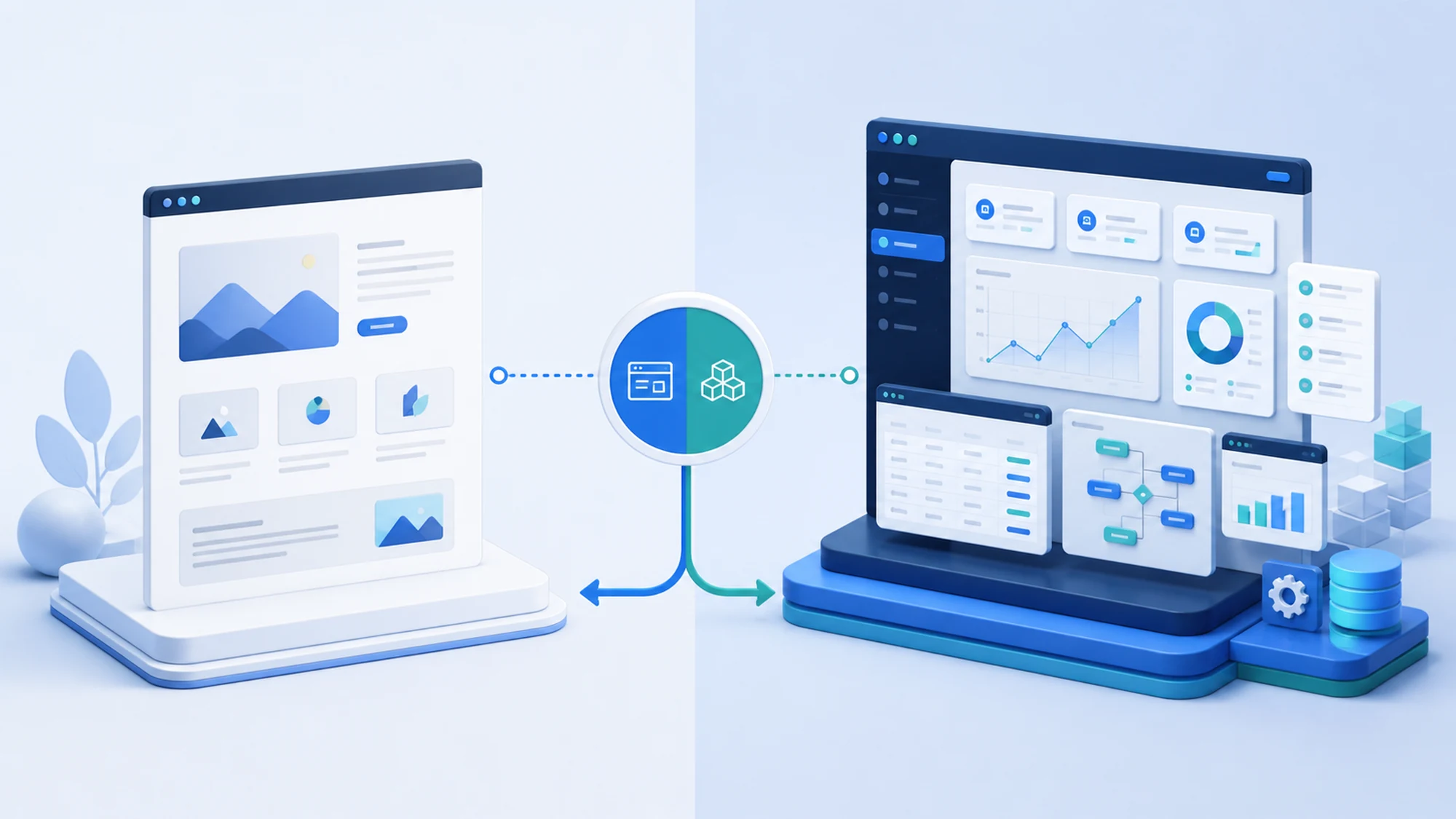
A brochure website is enough as long as its job is to inform visitors about your business. The moment your business needs the website to process data, manage users, or automate an internal process, a plain website no longer covers the requirement, and that's when a custom web application becomes necessary.
The difference between the two is not about how complex the site looks, but about what it actually does behind the scenes. A brochure website delivers static or semi-static content to a visitor. A custom web application processes business logic: calculations, approval flows, integrations with other systems, different user roles.
This article walks through the concrete criteria that show when you need a custom application, the risks of stretching a simple website over application-level needs, and what the transition from one to the other looks like in practice.
What a Brochure Website Is
A brochure website communicates who you are, what you do, and how a visitor can reach you. Typical structure: homepage, about, services or products, portfolio, contact. Content changes rarely, and visitor interaction stops at a contact form or a phone button.
It's the right solution when the goal is visibility and credibility, not data processing. A consulting firm, a construction company, or a B2B service provider that sells through direct conversations rather than an online order flow usually fits here.
What a Custom Web Application Is
A custom web application is built around a business process, not around content to be presented. It has users with different roles (customer, employee, administrator), stores and processes business-specific data, and often connects with other systems (ERP, CRM, shipping, online payment).
Concrete examples from HappyWeb's portfolio: the B2B application built for Kai Ceramics manages displays, tickets, and internal workflows specific to wholesale distribution - things a plain website cannot cover structurally. Similarly, online stores such as autopiesa.ro, camaradauto.ro, or eutruckparts.ro run on application logic (account, order, stock, customer-specific pricing), not on static-site logic.
How to Know a Simple Website Is No Longer Enough
A few practical signals show a business has outgrown a brochure website:
- Customers need to log in to see prices, stock levels, or their order history.
- Your team manually enters or updates information every day that could be automated through your own system.
- You need different access roles: a customer sees something different from an employee, who sees something different from an administrator.
- The website needs to talk to another system (ERP, CRM, shipping, online payment, TecDoc, or another external catalog).
- The current process runs through spreadsheets, emails, and manual data copying between systems.
If at least two of these situations apply to your business, the conversation is no longer "what design should we put on the site" but "what application do we need to build."
The Risks of Forcing a Simple Website to Cover Application-Level Needs
Many businesses try to solve application-level needs by stacking plugins on top of a simple website, usually built on a generic platform such as WordPress or similar. Short-term, it looks cheaper. Medium-term, the risks become visible:
- Performance drops as the number of plugins grows, because each plugin adds code that was never designed to work together with the others.
- Security becomes hard to control, since every external plugin is an extra attack surface maintained by a third party, not by your team.
- Maintenance cost grows over time, not shrinks, because any platform update can break compatibility between plugins.
- Real flexibility drops, because business logic ends up scattered across plugin settings instead of living in code you own and can change directly.
The typical result is a website that "almost" does what's needed, but with exceptions, workarounds, and errors that are hard to diagnose - exactly in the points that matter most for the business.
Website vs Application: Decision Criteria
| Criterion | Brochure Website | Custom Web Application |
|---|---|---|
| Main role | Information and credibility | Automated business process |
| Users with different roles | Usually not | Frequently |
| Integration with other systems | Rarely needed | Often needed (ERP, CRM, shipping, payment) |
| Data volume and complexity | Low | Medium-high |
| Initial cost | Lower | Higher, but proportional to the value generated |
| Long-term cost | Predictable, but limited in flexibility | Investment that pays off through automation |
What the Transition From a Simple Website to a Custom Application Looks Like
The transition doesn't necessarily mean throwing away what you already have. A practical plan, used frequently in HappyWeb projects, looks like this:
- Audit the real process: identify exactly which manual activities consume time and where errors occur (data entry, communication between teams, updating stock or prices).
- Define user roles: establish clearly what each type of user sees and can do - customer, employee, administrator.
- Prioritize modules: choose what gets built first (usually the part that brings the fastest time savings or error reduction), not the entire project at once.
- Technical architecture: build the application on a solid framework capable of growing with the business - at HappyWeb this foundation is Laravel, used consistently across all custom projects.
- Migrate existing data: bring in data from spreadsheets, the old website, or other systems without losing history.
- Test with real users before launch, to confirm the flow reflects the actual business process, not just the initial specification.
How Much Does a Custom Web Application Cost Compared to a Simple Website
The cost of a custom application depends on the number of modules, integration complexity, and data volume processed - there is no fixed price valid for every project. The difference from a brochure website isn't just in the initial budget, but in what you're buying with it: a brochure website buys visibility, a custom application buys time saved and errors avoided repeatedly, month after month.
A simple orientative calculation, useful at the decision stage: if a manual process consumes, say, 10 hours a week of an employee's time, automating it through an application recovers that time permanently, not just once. Over a 1-2 year horizon, this saving often exceeds the initial development cost - but the exact figure is calculated per process, per business, not generalized.
When a Brochure Website Remains the Right Choice
Not every business needs a custom application, and the right recommendation depends on the business model, not company size. A brochure website remains sufficient when:
- Sales happen through direct conversation (phone, meeting, custom offer), not through an automated online process.
- Content changes rarely and there's no need for private areas for customers or partners.
- There's no repetitive internal process worth automating through a dedicated application.
In these cases, investing in a custom application would be oversized relative to the actual need - the right choice is a well-built brochure website, not necessarily the most complex project possible.
Frequently Asked Questions
Can I Start With a Brochure Website and Extend It Later Into an Application?
Yes, this is a common and recommended approach when the initial budget is limited. The condition is that the brochure website is built from the start on an architecture that allows extension (e.g. Laravel), not on a generic platform that's hard to extend later with custom modules.
Why Can't I Solve Application-Level Needs With Plugins on My Current Website?
Plugins can cover simple functions, but they don't replace an architecture designed for your business process. As you add plugins for roles, integrations, and automations, complexity and security risks grow faster than if those functions were built natively into the application.
How Long Does It Take to Develop a Custom Web Application?
It depends on the number of modules and integrations, but a first working module (MVP) can be delivered in a few weeks, followed by further extensions as the business validates the flow in production.
Is Laravel Only Suitable for Large Applications?
No. Laravel can be used both for a simple brochure website and for a complex application with multiple modules, which makes the transition from one to the other easier without changing the technical foundation.
Conclusion
A brochure website and a custom web application solve different needs: one communicates, the other processes. The clear signal that you've outgrown a simple website appears when your team manually does what a system could do, or when customers need personalized access to data, not just general information.
If you recognize at least two of the signals described above in your business, the next practical step is a short audit of the current process, not a design decision.
Want a website or application built around your business's real needs? Contact us for a discussion about your project.
See our web development services: Web development services.



Write a comment