 English
 Romana

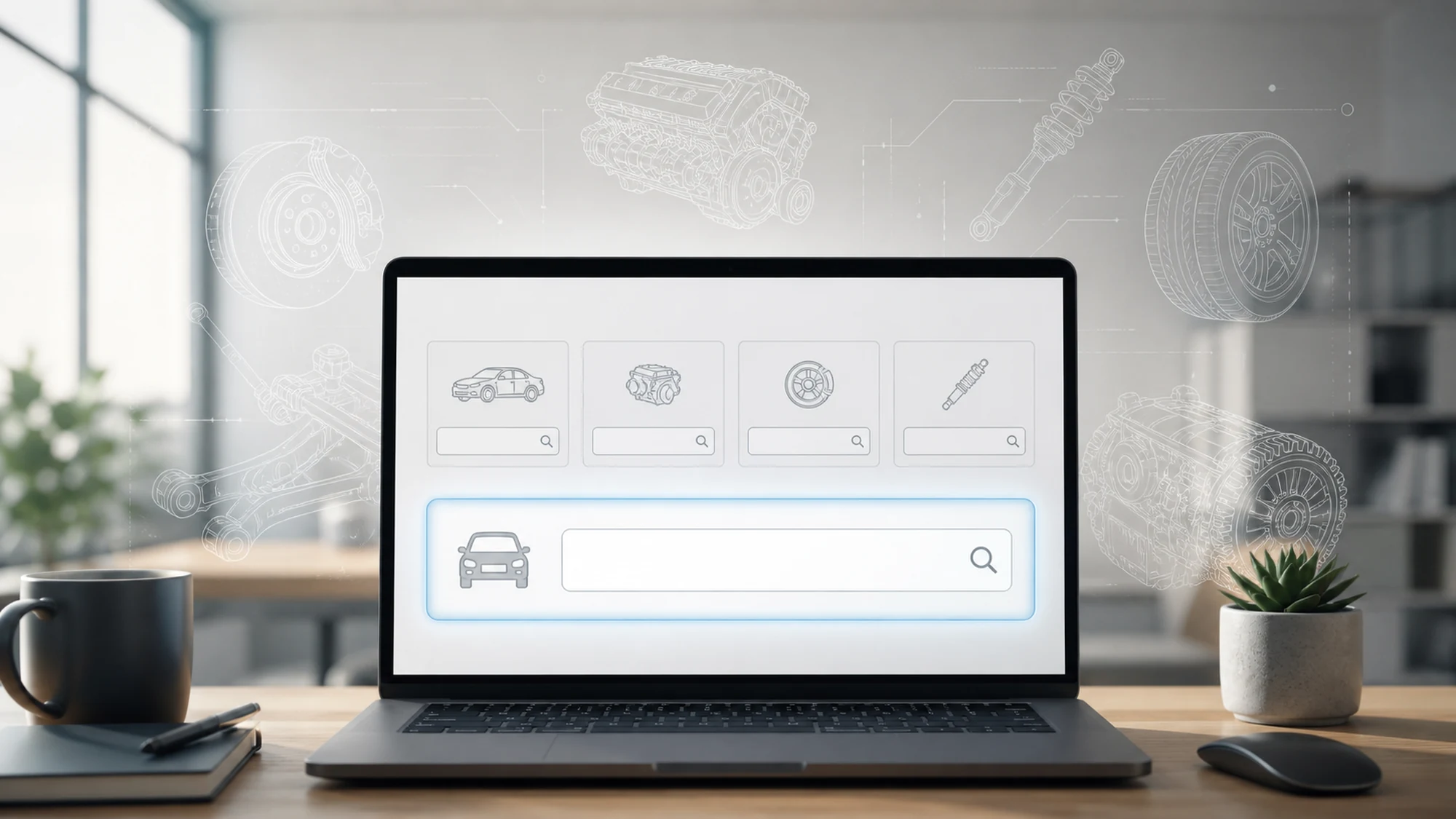
An online auto parts store can identify a part in several ways: by make and model, by a part number entered manually by the customer, or by the vehicle's VIN. Among these, VIN-based search through systems like YQ Service (ACIS) is the only method that links the part directly to the exact car, not just to a generic model.
That difference matters for any store selling parts online: two cars from the same model generation can have different engines, trims, or factory options, and a part that is compatible "in general" with the model is not always compatible with the customer's actual car. VIN-based search removes that risk, because it starts from the vehicle's actual technical data, not from an assumption.
This article reviews the identification methods used today by online auto parts stores, explains where YQ Service and the ACIS system fit into that landscape, and when it makes sense to add VIN search to an existing store.
What identification methods do online parts stores use today
Most online parts stores combine several identification methods in practice, not just one. Each has clear strengths and limits.
- Search by make, model, and year — the simplest to implement, but offers general compatibility, not one verified against the exact vehicle.
- Search by part number (OE or aftermarket manufacturer) — precise, but assumes the visitor already knows the code, which is not the case for most regular buyers.
- Visual search on a technical diagram — useful for parts that are hard to describe in words (gaskets, mounts, installation kits), but usually needs a starting point (model or VIN) to display the correct diagram.
- Search by the vehicle's VIN — identifies the exact car, with its factory engine, trim, and options, and returns parts that are genuinely compatible with that vehicle.
The first three methods remain useful as alternatives for visitors who don't have the VIN at hand, but VIN-based search is the only one that practically removes compatibility ambiguity.
What a VIN is and why it's the most precise starting point
A VIN (Vehicle Identification Number) is the unique 17-character code assigned to every vehicle at manufacturing. Unlike a "make + model + year" combination, the VIN identifies a single car, with its specific factory engine, transmission, and options.
A system that decodes the VIN can, in principle, return exactly the list of parts compatible with that vehicle, not a generic list valid "in most cases." That's the functional difference between VIN-based search and model-based search.
What YQ Service and the ACIS system are
YQ Service is an automotive data platform specialized in identifying replacement parts starting from the vehicle's VIN. According to the official site yqservice.eu, the platform combines original equipment (OE) parts data with aftermarket data into a single component identification system, which we refer to in our materials as the ACIS system.
In practice, an online store does not "buy parts" from YQ Service — it integrates the yqservice.eu API into its own platform, so that the customer enters the VIN and the system returns the technical diagrams and part numbers compatible with that vehicle. The store keeps its own stock, pricing, and order flow; YQ Service only supplies the identification data.
What implementing VIN search in an online store looks like
Technically, the integration generally involves the following steps:
- Setting up access to the yqservice.eu API and the vehicle database (VIN, makes, models).
- Adding a VIN search field to the store interface, visible on the product page and in the header.
- Linking the technical diagrams returned by the system to the store's existing product pages.
- Syncing the identified part numbers with the store's actual stock and pricing (periodic import/update, for example via CSV).
- Testing the full flow: VIN search -> technical diagram -> compatible part -> add to cart -> order.
From the customer's perspective, the result is a simple form: enter the VIN and see the parts compatible with your car directly, without manually searching by model or part number.
When adding VIN search to an existing store is worth it
Not every parts store needs VIN search from day one. Some practical decision criteria:
| Store situation | Does VIN search add value? |
|---|---|
| Sells OE (original) parts, where exact compatibility is critical | Yes, high priority |
| Small catalog, a few dozen models, uniform trims | Optional, limited benefit relative to effort |
| High return rate due to incompatible parts | Yes, high priority |
| Mostly professional customers (repair shops) who already know the part number | Useful, but not mandatory as the primary search channel |
| Mixed OE + aftermarket catalog, high traffic volume | Yes, reduces pressure on customer support |
Common risks and how to avoid them
- Incomplete or outdated vehicle data. Mitigation: sync the vehicle database with the YQ Service API periodically, not just at implementation time.
- The technical diagram isn't correctly linked to actual stock. Mitigation: test the VIN search -> product -> stock flow on real cases before launch.
- The customer doesn't have the VIN at hand. Mitigation: keep an alternative make/model search as a secondary option, not a replacement for VIN search.
- Catalog covered only partially (OE only, or aftermarket only). Mitigation: assess whether the store also needs a complementary system like TecDoc for aftermarket parts, alongside YQ Service for OE parts.
Case study: implementation at stoauto.ro
stoauto.ro is an online store for original auto parts, built by HappyWeb, with a direct integration of the yqservice.eu API. The implementation includes a vehicle database (marked active/inactive), searchable OE parts technical diagrams, VIN search, sorting by manufacturer and model, periodic price import and updates via CSV, and integration into the standard ecommerce flow (cart, customer account, orders, marketplace feeds).
The project shows, in practice, the difference between a theoretical description of VIN search and a working implementation integrated into a real auto parts store.
Frequently asked questions about auto parts identification and VIN search
What is the difference between model-based search and VIN-based search?
Model-based search returns parts compatible "in general" with that model, while VIN-based search identifies the exact vehicle, with its real factory engine and options, so it returns parts verified for that specific car.
Can an online store use only VIN search, with no other methods?
It can, but it's not recommended. Some customers don't have the VIN at hand when searching, so keeping a make/model alternative as a secondary option avoids losing these visitors.
Does YQ Service replace TecDoc?
No. YQ Service mainly covers data for original (OE) parts, while TecDoc covers aftermarket parts. For a complete auto parts catalog, the two systems complement each other rather than replace one another.
How complex is the technical integration of VIN search?
It depends on the store's existing platform, but it generally requires access to the yqservice.eu API, a synced vehicle database, and linking technical diagrams to product pages and actual stock. It's an integration project, not just adding a search field.
Does VIN search reduce returns caused by incompatible parts?
Yes, because it removes the vehicle-specific compatibility ambiguity that is a frequent cause of wrong orders when identification is based only on model.
Choosing the right parts identification method isn't just a technical decision — it directly affects return rates and customer trust in an online auto parts store. VIN search, through YQ Service (ACIS), remains the most precise method available today for original parts.
We've already implemented VIN search for an original auto parts store. See our portfolio or contact us to discuss integrating YQ Service into your store.
Image generated with AI, used for illustrative purposes.



Write a comment