 English
 Romana

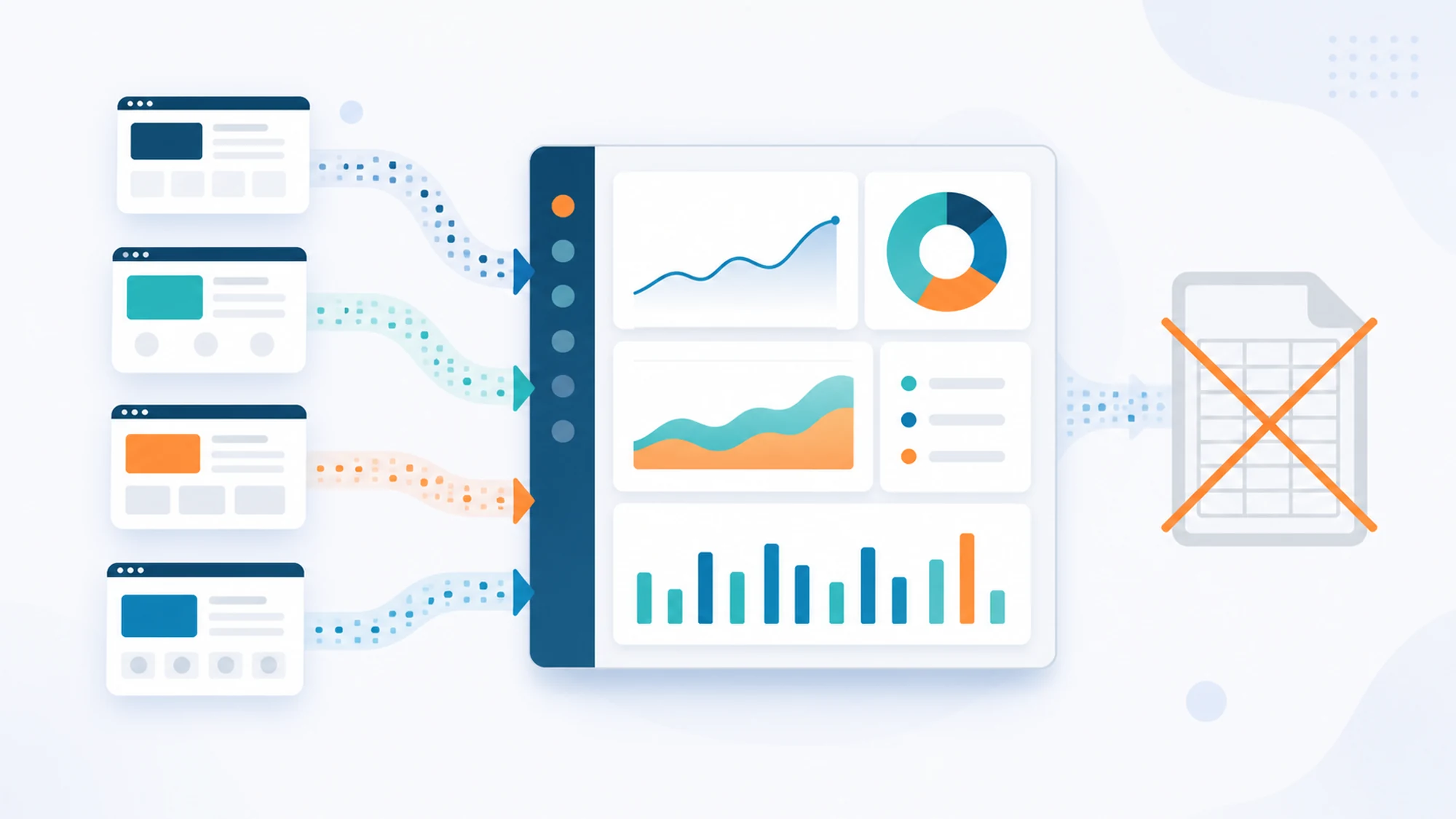
Automating price centralization through web crawling means collecting market prices on a regular, structured schedule through a dedicated script, instead of having a marketing team member manually check competitor sites product by product. The practical difference shows up in hours: manual research for a catalog of a few hundred products can eat up entire days each month — time that could go toward campaigns, analysis, or acting on the price data already collected.
Many marketing teams end up maintaining a manually updated spreadsheet, opened across dozens of browser tabs, checked sporadically and rarely at the same time or frequency. The result is inconsistent research, hard to compare over time, and a drain on human resources spent on a repetitive task rather than a strategic one.
This article explains where time actually gets lost in manual price research, what an automated crawling-based centralization workflow looks like in practice, which marketing decisions become possible once that time is freed up, and which risks need managing when research moves from manual to automated.
Where time actually goes in manual price research
Manual price research is not just opening a site and writing down a number. The real time sink is a set of repetitive activities that, on their own, add no analytical value:
- Repeated browsing through multiple competitors' catalogs, product by product, at every check.
- Manually matching products across different sites when names or codes don't line up exactly.
- Copying and entering data into a centralized file, a step prone to transcription errors.
- Inconsistent updates — checks happen whenever someone has time, not on a fixed interval, which skews comparisons over time.
These four activities consume most of the hours allocated to price research, without the marketing team ever reaching the part that actually matters: interpreting the data and deciding on a campaign or positioning.
What an automated price-centralization workflow looks like in practice
A crawling project for price centralization replaces the manual steps above with a dedicated script, built for the market sources relevant to the business:
- The script periodically accesses the product pages of the chosen sources, at a fixed interval (daily, every few days, or weekly, depending on how volatile the market is).
- It extracts the relevant fields — price, availability, any active promotion — and matches them to your own products using a shared identifier (product code, SKU, or manufacturer code).
- It delivers structured data in the required format: Excel, a relational database, or a feed connected directly to a dashboard.
- The marketing team receives already-centralized, period-over-period comparable data, without manually opening a single competitor site.
The difference from manual research isn't just speed, it's consistency: data is collected at the same time, in the same format, for the same product list, every time — a condition that's hard to sustain manually over the long run.
Marketing decisions unlocked by the reclaimed time
Time saved from manual research doesn't disappear — it gets redirected toward activities that actually influence results:
- Longer-term price trend analysis, possible only when data is collected consistently, not sporadically.
- Building targeted campaigns around segments where the data shows a real price advantage, not an assumed one.
- Testing more positioning scenarios, instead of a single decision based on a one-off check that may already be outdated.
- Faster collaboration with the pricing team, which receives continuously updated data instead of on-demand, delayed requests.
In practice, automation changes not just how much data is available, but the type of work the marketing team does: from collecting data to interpreting it and building strategy.
Manual research vs. automated centralization: when to choose each
Automation isn't automatically justified from the first product monitored. The decision depends on the number of products, the number of sources, and how often the team needs updated data.
| Criterion | Manual research | Automated crawling centralization |
|---|---|---|
| Number of products monitored | Practically under 20-30 products | Hundreds or thousands, no extra effort |
| Data consistency over time | Variable, depends on team availability | Fixed, on a set interval |
| Monthly time spent | Hours to days, recurring | Minimal, after initial setup |
| Upfront cost | No direct cost, high opportunity cost | Upfront investment in the dedicated script |
| Scalability | Drops quickly as products/sources grow | High, without proportional human effort |
4-step practical plan for moving from manual research to automated crawling
- Measure the time currently spent on manual price research (hours per week/month), to have a clear comparison point after automation.
- List the sources (competitors, marketplaces) and check whether they allow automated data extraction (robots.txt, Terms and Conditions).
- Define the delivery format that fits the marketing team — an automatically updated Excel file is enough for small teams, a connected dashboard fits better for high volumes or frequent decisions.
- Set the collection frequency based on how volatile prices are in that segment, not an arbitrary default value.
Risks to manage when research moves from manual to automated
- Relying on a single data format without checks — a structure change on the source site can produce incomplete data. Mitigation: periodic monitoring of extracted data quality, not unattended automated runs.
- Mismatching similar but different products — automation doesn't remove the need for correct product-code mapping. Mitigation: use a confirmed shared identifier (SKU, manufacturer code), not a name-based match.
- Collecting from sources that don't allow automated access — availability depends on each target site's policy. Mitigation: explicitly check robots.txt and the Terms and Conditions before starting collection.
What to check legally before automating price centralization
Automated extraction of prices from market sites must be preceded by checking each target site's robots.txt file and its Terms and Conditions, to confirm whether automated access is allowed. Not every site permits crawling, and the recommendation is to check each source individually rather than assume they all share the same policy.
For unclear cases or projects involving a large volume of data, consulting a legal specialist before starting remains the safe recommendation.
Related crawling articles
- Automated competitor price monitoring through web crawling
- Protecting margin through competitor price monitoring
- Optimal data collection frequency for web crawling
Frequently asked questions about automating price centralization through crawling
How much time does a marketing team actually save through automation?
It depends on the volume of products and sources monitored, but teams that used to spend hours per week on manual checks typically end up reallocating that time to interpreting the data rather than collecting it — the actual collection time drops to nearly zero after the initial setup.
Is automation worth it for a small catalog of under 50 products?
For small volumes, manual research can stay manageable. Automation becomes clearly worthwhile once the number of products or sources grows, or once the team needs data at a consistent frequency that's hard to sustain manually.
Can automatically centralized data be delivered directly into Excel?
Yes, the delivery format is set based on the team's needs — an automatically updated Excel file, a relational database, or a feed connected directly to an internal dashboard.
What happens if a source site changes its page structure?
The script dedicated to that source needs to be adjusted for the new structure. This is why a recurring centralization project usually includes a data-quality monitoring component, not just unattended automated runs.
Is it legal to automate market price collection?
It depends on each target site's policy, expressed through robots.txt and its Terms and Conditions. The recommendation is to explicitly check each source before starting automated collection.
Conclusion: the time saved matters more than the data itself
Automated price centralization through crawling doesn't just replace a manually updated spreadsheet — it replaces the repetitive hours a marketing team spends on a task that doesn't actually require strategic judgment. The reclaimed time turns into analysis, better-targeted campaigns, and positioning decisions built on consistent data instead of sporadic checks.
Want to remove manual price research from your marketing team's agenda?
HappyWeb builds custom crawling scripts for automated market price centralization, delivered in the format your team needs. See our full web crawling service or discuss your project directly with our team.
Sources
Article last updated: 2026-08-09 · Recommended review: within 90-180 days, since target site policies and market practices can change.
- HappyWeb — Web crawling data collection services, definition, use cases, and pricing factors: happyweb.ro/en/services/services-web-crawling.
Image generated with AI, used for illustrative purposes.



Write a comment