 English
 Romana

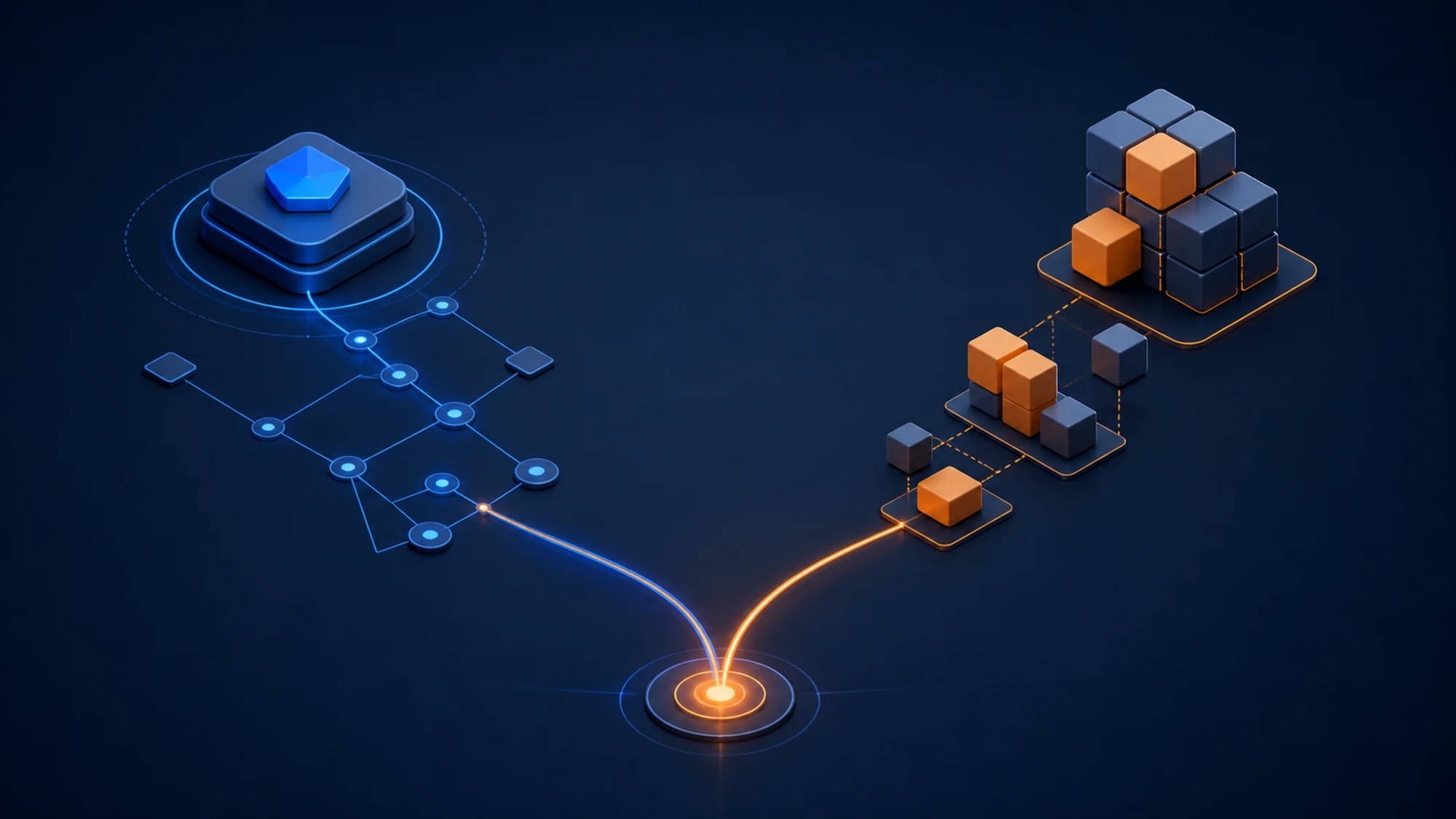
An auto parts store building a new catalog really has only two viable paths: integrate the standardized TecDoc catalog through its API, or build a custom catalog from scratch. TecDoc is the right call in most cases when you need broad vehicle coverage and verified fitment data fast; custom development pays off when you sell a narrow segment of parts with business logic no standardized catalog covers natively.
Picking the wrong path gets expensive in both directions: a custom catalog built for tens of thousands of auto parts references can turn into a project with no real finish line, while forcing a TecDoc integration onto a store with very specific business logic can leave essential functionality outside the catalog entirely. This article compares both directions on concrete criteria and offers a decision plan for your store.
What each option actually means
TecDoc API integration means the store consumes catalog data (vehicles, parts, fitment, images, OE codes) directly from TecAlliance's web services, typically through SOAP/WSDL protocols, and displays it inside its own site structure. The complex technical data (K-Type mappings, linkage tables between part and vehicle) stays managed by TecAlliance, while the store handles presentation, pricing, and stock.
Custom development means building the catalog from zero: a proprietary database schema for products and fitment, mapping rules written and maintained in-house, with no standardized external source. Data typically comes from supplier invoices, manual technical sheets, or an internal ERP, aggregated manually or semi-automatically.
Decision criteria: when to pick TecDoc and when to go custom
| Criterion | TecDoc (API) recommended | Custom development recommended |
|---|---|---|
| Number of brands/models covered | Broad coverage, many brands and vehicle generations | A small number of models or a very specific niche |
| Type of parts sold | Standard aftermarket parts, with known OE codes | Custom parts, tuning, accessories with no equivalent in standard catalogs |
| Time available until launch | Fast launch, a few weeks to months for integration | Flexible timeline, a project spanning several months |
| License vs development budget | Budget for TecDoc license plus integration, predictable cost | Larger budget, fully allocated to in-house development and maintenance |
| Specific business logic | Standard flow: search part, check fitment, buy | Very specific flows (complex configurators, proprietary fitment rules) |
| In-house technical team | Small or outsourced team, no in-house automotive expertise needed | Dedicated technical team, willing to maintain mapping logic long term |
In practice, most general-purpose auto parts stores (aftermarket, online retail, multi-brand dealers) line up clearly on the TecDoc column. Custom development stays justified mainly for very narrow niches or for stores whose business model doesn't fit the standard "vehicle -> compatible part" structure.
Orientative cost and effort for each direction
The figures below are orientative and depend on the store's complexity - confirm an exact cost through a technical discussion for your specific situation.
- TecDoc integration - the main cost is the TecDoc license (variable, per public information on tecdoc.net) plus the effort of API integration and building the search/filtering interface on top of the received data. Maintenance mostly comes down to periodic syncing with catalog updates.
- Custom development - no recurring license cost, but the initial effort of building the data schema, the vehicle-part mapping, and the admin interface is significantly higher. Ongoing maintenance (adding new models, fixing wrong mappings) stays the in-house team's responsibility indefinitely.
- Hybrid solution - some stores use TecDoc for standard aftermarket parts and a separate custom module for a specific niche (e.g. tuning accessories). Effort sits in between, but it requires keeping two data sources coherently in sync within the same store.
Risks specific to each direction and how to avoid them
- Choosing TecDoc without checking real coverage for your niche - if you mainly sell parts for a narrow segment (e.g. old agricultural machinery, very rare models), TecDoc's catalog may have limited coverage for exactly those references. Mitigation: verify actual coverage for your main brands/models before signing the license, not after.
- Custom development without a mapping maintenance plan - a proprietary vehicle-part compatibility schema degrades quickly without a clear process for updating it as new models appear or fitment corrections are needed. Mitigation: assign an owner and a recurring validation process from the start, not just the initial build.
- Underestimating long-term custom maintenance effort - initial development cost often looks comparable to a TecDoc license, but the recurring maintenance effort of a custom catalog, at scale, frequently exceeds initial estimates. Mitigation: calculate the cost over 2-3 years, not just launch cost, before deciding.
- Hybrid setup without a clear boundary between the two data sources - if TecDoc and a custom catalog coexist without clear rules about which product comes from where, duplicates or conflicting fitment data get shown to customers. Mitigation: explicitly define, at the product category level, which source is authoritative.
Practical decision plan
- List the vehicle brands and models you actually sell parts for today, and check their real coverage in the TecDoc catalog.
- Estimate how many of your current products already have an OE code or standardized equivalent, versus how many are fully custom parts with no external reference.
- Calculate the TecDoc license plus API integration cost and compare it, over 2-3 years, against the estimated development and maintenance cost of an equivalent custom catalog.
- Check whether your in-house technical team has the capacity and willingness to maintain a proprietary vehicle-part mapping long term, if you go custom.
- If TecDoc coverage is good for your main brand but there's an uncovered secondary niche, explicitly consider a hybrid approach before picking either extreme.
FAQ: frequently asked questions about TecDoc vs custom catalogs
Can I start with TecDoc and later move to a custom catalog?
Yes, but the migration carries real SEO and data-continuity risks - handling this step requires a separate strategy for redirects and preserving existing Google rankings, not just a simple data source switch.
Does TecDoc also cover parts for older or rarer vehicles?
Coverage varies by brand and generation - the TecDoc catalog is geared toward standard aftermarket, with good coverage for most popular European brands. For very specific niches, verify actual coverage directly in TecAlliance's documentation before deciding.
Is a custom solution always cheaper long term since there's no license?
Not necessarily. The absence of a license cost is typically offset by the ongoing effort of maintaining a proprietary mapping - at scale, this recurring effort can exceed the cost of a TecDoc license plus integration.
Does a hybrid TecDoc + custom catalog setup make sense in the same store?
Yes, it's a fairly common setup when a store sells both standard aftermarket parts and a niche segment (e.g. custom accessories) with no TecDoc equivalent, as long as there are clear rules about which product categories come from which source.
How long does a TecDoc integration take, roughly, compared to an equivalent custom catalog?
A basic TecDoc integration can be delivered, orientatively, in a few weeks to a few months, depending on store complexity. An equivalent custom catalog, with comparable coverage and its own vehicle-part mapping, typically takes significantly longer, since the data structure and fitment rules have to be built from zero.
Conclusion
The choice between TecDoc and a custom auto parts catalog isn't a matter of taste - it depends directly on the vehicle coverage you need, the type of parts you sell, and your team's capacity to maintain a proprietary mapping long term. For most aftermarket stores with broad brand coverage, TecDoc API integration remains the faster, more predictable path; custom development earns its cost mainly for narrow niches or business logic that doesn't fit a standardized catalog.
We build Laravel applications with TecDoc integration, but also custom solutions where your niche demands it. See our portfolio to decide which direction fits your store better.
Image generated with AI, used for illustrative purposes.



Write a comment