 English
 Romana
In 2026, choosing between crawling and an official API for product data is no longer just about "which one is cheaper." The landscape has shifted: more platforms have rolled out much more aggressive anti-bot protections, while others have launched official APIs with usage limits designed specifically for automated agents and AI-driven integrations. The right method depends on three concrete factors: what the data source actually offers, how often you need updates, and how much operational risk you can absorb if the source changes its structure overnight.
This guide gives you a weighted decision score built specifically for product catalogs, plus the 2026-specific factors that shift the calculation compared to a few years ago: the real cost of increasingly sophisticated anti-bot systems and the growing monetization of API access by major platforms.
What has actually changed in 2026 compared to previous years
Three trends directly influence the crawling vs API decision for product data this year:
- Anti-bot protections have become the default, not the exception. Services like Cloudflare Bot Management, or similar solutions, filter automated traffic on a growing share of eCommerce sites, including small and mid-sized ones.
- Large platforms have started monetizing programmatic access. Many marketplaces and aggregators now offer official APIs with subscription plans, precisely to control who extracts data at scale and to reduce uncontrolled crawling pressure on their infrastructure.
- Demand for structured data has grown alongside the wider adoption of AI-based automations, which need clean, predictable data streams rather than raw HTML to parse.
The practical result: crawling has become more expensive to maintain where serious protections exist, while official APIs have, in many cases, become more affordable than they were a few years ago, precisely because platforms prefer a controlled channel.
Quick definitions: crawling vs official API for product data
Crawling (sometimes called scraping) means automatically extracting data directly from a site's public pages, by analyzing the HTML rendered to the browser. It doesn't require explicit consent from the target site, but the site's public rules must be respected (robots.txt, Terms and Conditions).
An official API is a data access channel deliberately made available by the data owner, usually documented, with authentication and clearly defined usage limits (rate limits). Data arrives already structured (JSON/XML), with no need to parse HTML.
Weighted decision score for product data
For each data source, score the following factors from 1 to 5, then multiply by the weight. The final score guides the choice per source, not globally for the whole project.
| Factor | Weight | Official API wins when... | Crawling wins when... |
|---|---|---|---|
| API availability | x3 | A documented API exists with the required fields | No API exists, or essential fields are missing |
| Cost per data volume | x2 | The API plan covers the volume at a predictable cost | The API has prohibitive costs at large scale |
| Update frequency | x2 | The API rate limit covers the desired frequency | You need more frequent updates than the API allows |
| Technical blocking risk | x2 | The site has strong anti-bot protection | The site has no aggressive protections |
| Structure stability | x1 | - | The page structure is stable over time |
In practice: if an official API exists and covers the fields, volume and frequency you need, it almost automatically wins thanks to long-term stability. Crawling stays the default only where the API is missing, incomplete, or too expensive for your volume.
When the official API is the right choice in 2026
- The source offers an API with all the fields you need (price, stock, specifications, images).
- The rate limit covers the actual update frequency your catalog needs.
- The API subscription cost is lower than the maintenance cost of a crawling script fighting that same source's anti-bot protections.
- You need a stable long-term channel, without the risk of sudden blocking.
When crawling remains the right choice in 2026
- The source offers no public API at all, but the data is freely displayed on public pages.
- The existing API is missing critical fields (e.g. detail images, full descriptions).
- The data volume or budget doesn't justify an API subscription with per-request pricing.
- The target site has no aggressive anti-bot protections, keeping maintenance cost low.
2026-specific risks and how to reduce them
| Risk | How to reduce it |
|---|---|
| Sudden blocking due to an anti-bot update on the source site | Automated failure-rate monitoring plus immediate alert to the technical team |
| Unannounced HTML structure changes | Modular script with selectors isolated per field, easy to fix in isolation |
| Unexpected API restriction (provider changes plan/pricing) | Backup plan with partial crawling for critical fields, as a fallback |
| Incomplete or incorrect data after collection | Automated validation of required fields before import into the catalog |
The hybrid approach: combining API and crawling on the same project
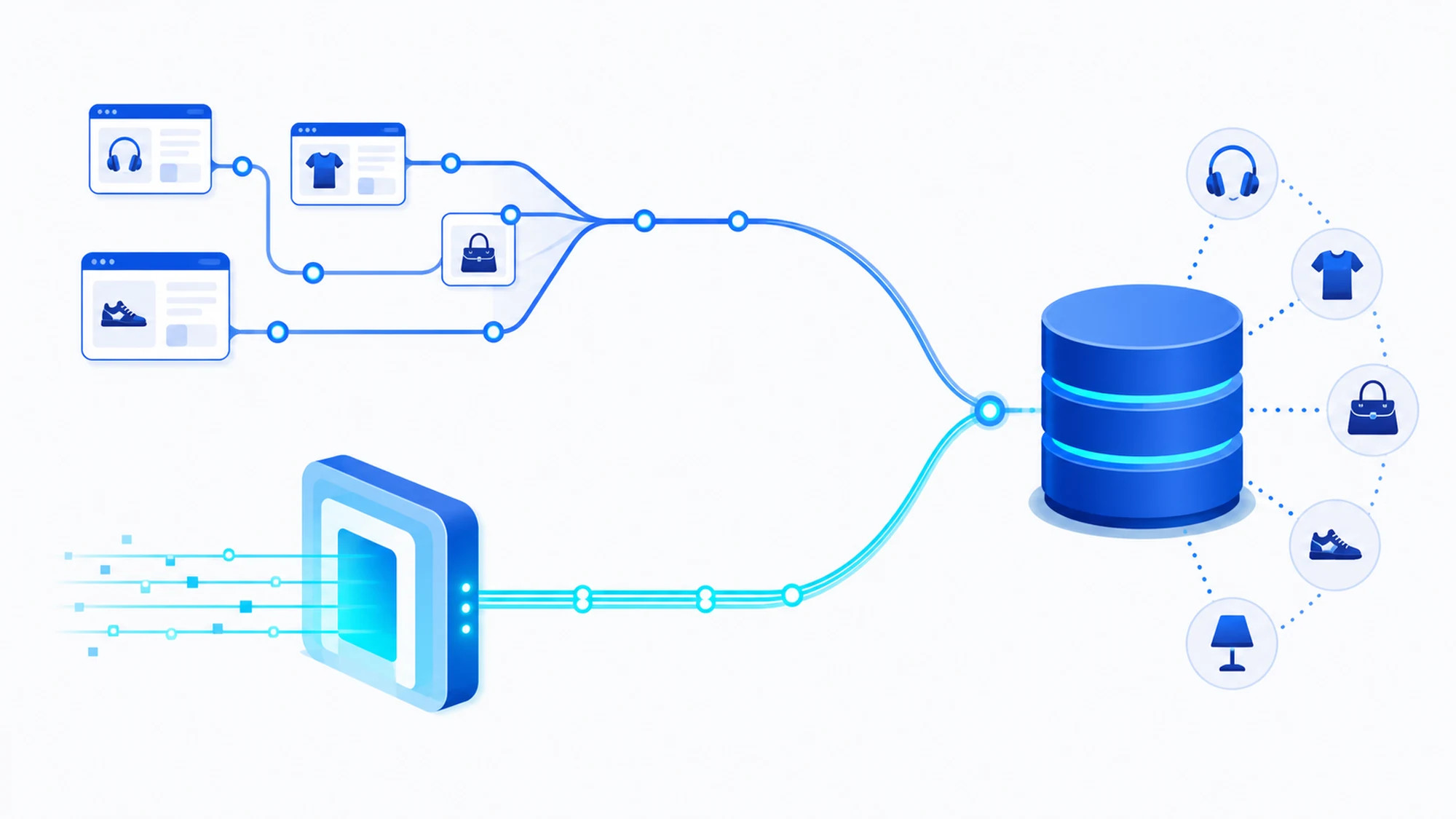
The most common real-world scenario in 2026 isn't "all API" or "all crawling," but a combination per source and per data field:
- Use the official API where it exists, for base fields (price, stock, product code).
- Fill in the missing fields via crawling only where the API falls short (e.g. extra images, public reviews).
- Unify both streams into a single internal catalog, with the same field structure.
- Document, for each source, which method is used and why, for future maintenance.
This approach reduces operational risk: if a source's anti-bot protection tightens, only the crawling component is affected, not the entire data flow.
Legal context: what still holds true in 2026
The basic rules around crawling legality haven't changed radically: check the target source's robots.txt, respect the published Terms and Conditions, and avoid collecting personal data without a legal basis (GDPR). For sensitive projects or sources with unclear Terms and Conditions, we recommend specialized legal advice before starting collection at scale.
Frequently asked questions about crawling vs official API for product data
Is crawling or an official API cheaper in 2026?
It depends on the source. Where an official API exists with an affordable plan, it's often cheaper long-term than a crawling script that needs constant repairs due to anti-bot protections. Where no API exists, crawling remains the only option.
Can I use both methods on the same product data project?
Yes, the hybrid approach (API for base fields, crawling for what's missing) is common and recommended for complex catalogs with multiple sources.
What if the official API doesn't have all the fields I need?
You fill in the missing fields through targeted crawling, directly on the public pages that display that information, while respecting the target site's rules.
Do 2026's anti-bot protections make crawling impossible?
No, but they increase maintenance cost on sources with strong protection. For those sources, an official API (if one exists) becomes much more attractive from a total-cost perspective.
How do I quickly decide for a new product data source?
First check whether a documented official API exists. If so, evaluate whether it covers the fields, volume and frequency you need. If not, or if coverage is partial, move to crawling for the missing part, using the decision score above.
Conclusion: choose the method per source, factoring in the 2026 context
There's no universal answer valid for every product data source. In 2026, the right decision is made per source, using the weighted score above, and explicitly accounts for two new factors: the real cost of anti-bot protections and the growing availability of affordably priced official APIs. For many projects, the optimal solution is hybrid: API where it exists, crawling for the rest.
Want to automate data collection for your store? Contact us for a custom quote. See also our full service: Web crawling services.



Write a comment