 English
 Romana

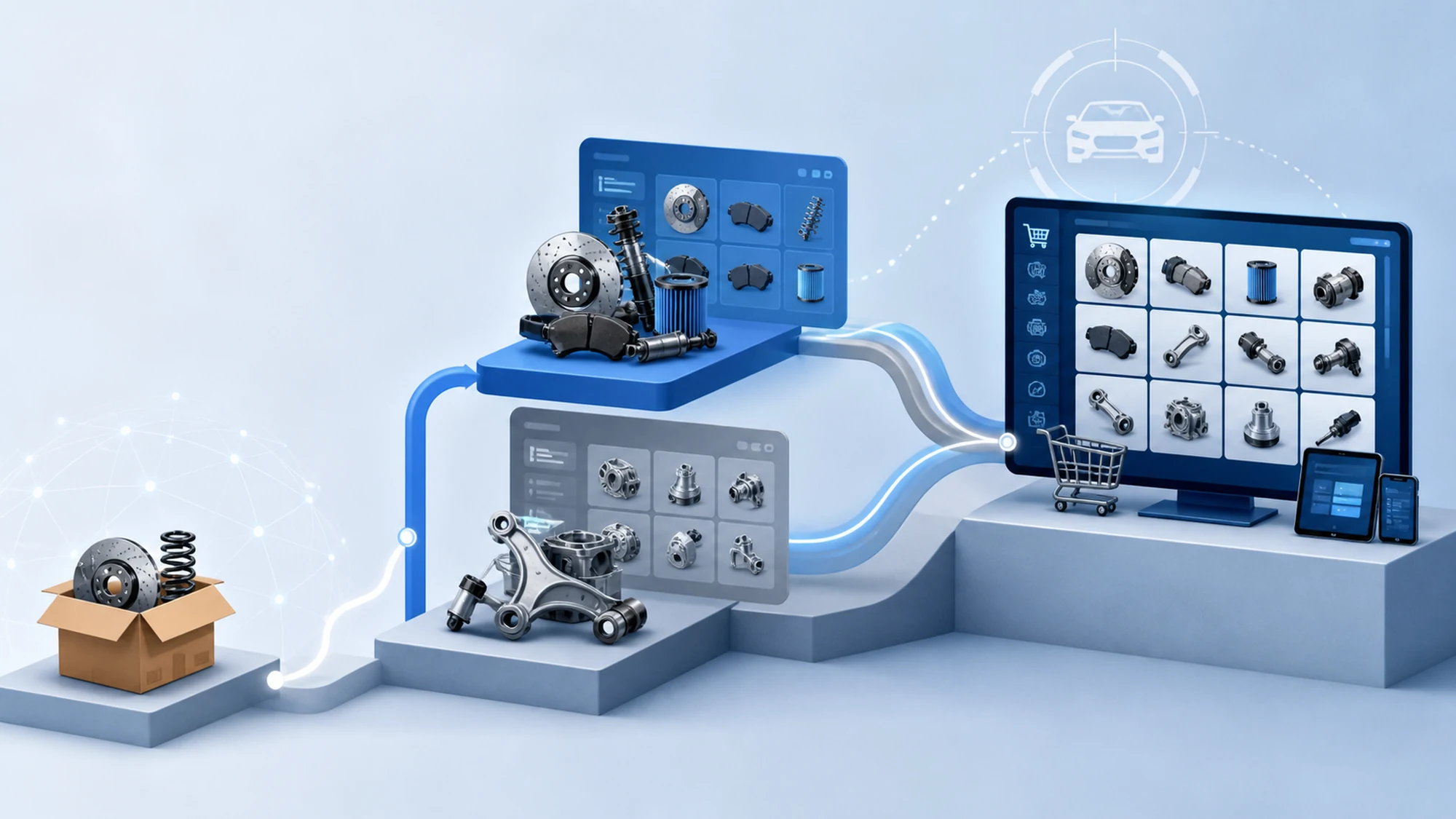
Most online auto parts stores start with an aftermarket catalog, because it launches faster and covers a large share of generic demand. Moving to a complete catalog, with original (OE) parts alongside aftermarket, does not happen overnight - it happens in stages, as the store gains volume, more demanding customers, and competitive pressure.
YQ Service (the ACIS system for identifying original parts by VIN) and TecDoc (the aftermarket catalog) are not alternatives you choose between once at launch, but two layers that get added progressively as the store grows. This guide explains the real stages a store goes through, the signals that show it is time to add OE parts, and a practical transition plan, illustrated with the real implementation from stoauto.ro.
If you are starting out with an aftermarket catalog and wondering when and how to add original parts, this article follows exactly that path, from the first signals to a complete, functional, and manageable catalog.
Why most stores start with aftermarket only
An aftermarket catalog built on TecDoc has a clear advantage at launch: it covers a large number of vehicles and manufacturers through a single integration, with parts comparable in price and available from multiple suppliers. For a new store, that means a shorter time to first orders and a lower entry cost than a dual catalog, OE plus aftermarket, from day one.
Original parts, on the other hand, require either direct licensing or access to a system like YQ Service, plus enough traffic volume to justify the additional integration effort. In practice, the natural order is: aftermarket first, to validate the business model, then OE, once the store already has a customer base and an order history that shows demand for original parts.
The stages of evolving toward a complete OE + aftermarket catalog
In HappyWeb implementations, the transition from an aftermarket catalog to a complete one usually follows four distinct stages. Not every store moves through each stage at the same pace, but the logical order stays the same.
- Stage 1 - mature aftermarket catalog. The store already has a working TecDoc integration, search by vehicle model/version, and a steady order volume.
- Stage 2 - first signals for OE. Explicit requests for original parts appear, along with returns caused by uncertain compatibility on critical parts, or customers asking for an invoice from the manufacturer/OE part.
- Stage 3 - YQ Service integration alongside TecDoc. VIN search and OE parts diagrams are added, initially for a limited number of brands or part categories, without removing the existing aftermarket catalog.
- Stage 4 - complete unified catalog. The customer can choose between the OE part and its aftermarket equivalent for the same vehicle, in the same search interface, with stock and prices synced from both sources.
What signals show the store is ready to add OE parts
Not every aftermarket store needs to add YQ Service right away. There are, however, a few concrete signals that show the time has come:
- Return or complaint rates on compatibility-sensitive parts (sensors, electronic modules, model-specific body parts) rise above the store average.
- Customers explicitly ask, in support tickets or orders, whether a part is "original" or "from the manufacturer," not just an equivalent.
- Traffic and order volume justify the extra integration and maintenance cost of a second catalog.
- Direct competitors already offer VIN-searchable OE parts, and the store is losing orders on this segment.
If none of these signals are present, expanding toward OE can stay at the planning stage, without being an immediate priority.
How to integrate YQ Service alongside an existing TecDoc catalog
Integration does not mean replacing the aftermarket catalog, but adding a further data layer, connected through the shared identifier: the vehicle. In practice, the process involves:
- Connecting to the yqservice.eu API for VIN search and OE parts diagrams.
- Mapping the vehicles already in the aftermarket catalog to the identifiers used by YQ Service, so the same vehicle appears in both sources without duplication.
- Defining a clear display rule for the customer: the OE part and its aftermarket equivalent, with price and delivery time visible for each, without merging them into a single confusing result.
- Updating stock and price import flows so the two sources run on separate jobs, kept in sync in terms of frequency.
For technical details on the data structure and stock sync between the two sources, see the dedicated articles in the same series, listed below in the related resources section.
What changes operationally when you add OE parts
Adding an OE catalog is not just a technical change, it is also an operational one. A few areas that need adjustment:
| Area | Before (aftermarket only) | After (OE + aftermarket) |
|---|---|---|
| Part identification | Search by vehicle model/version | Search by VIN, precise for each individual vehicle |
| Customer support | Questions about part equivalence | Questions about OE vs. aftermarket difference and price |
| Stock management | A single import flow from aftermarket suppliers | Two parallel flows, with different frequencies and formats |
| Marketing/content | Focus on price and availability | Focus also on warranty, originality, and exact compatibility |
Common risks in the transition and how to avoid them
The most frequent problems when moving from aftermarket to a complete catalog are not technical, but process-related:
- Launching without operational readiness - VIN search goes live before the support team can explain the price difference between OE and aftermarket. Avoided with a short internal training session before public launch.
- Inconsistent stock sync - the two sources end up showing different availability for the same part at different times. Avoided with separate sync jobs, monitored from the same dashboard.
- Expanding the whole catalog at once - trying to add OE for all brands simultaneously increases the risk of mapping errors. Avoided by expanding by category or brand, in stages.
- No clear display rule - the customer sees OE and aftermarket mixed together, without understanding the difference. Avoided with an interface that visually separates the two options, with clear labeling.
A practical staged plan for moving to a complete catalog
A realistic expansion plan, applicable to most stores already running on TecDoc, looks like this:
- Weeks 1-2: analyze existing data (returns, support requests, volume on sensitive categories) to confirm the signals for expanding toward OE.
- Weeks 3-5: technical YQ Service integration for a limited number of pilot brands or categories, in a test environment.
- Weeks 6-7: define the OE vs. aftermarket display rules, prepare the support team and site content for the new customer questions.
- Week 8: pilot launch on the chosen categories, monitoring stock, price, and VIN search behavior.
- Months 3-6: gradual expansion to the remaining brands/categories, based on pilot results.
Case study: stoauto.ro, from aftermarket catalog to original parts
stoauto.ro is an online store for original auto parts, developed by HappyWeb with an yqservice.eu API integration. The implementation included a vehicle database (active/inactive), searchable OE parts diagrams, VIN search, sorting by manufacturer and model, price import and updates via CSV, and integration into the ecommerce modules - cart, customer account, orders, and marketplace feeds.
The project shows, in practice, the structure described in this guide: a catalog built around precise VIN-based identification, with stock and price flows managed separately by source. Additional public details about results or business figures are not available; the information above reflects the project's confirmed functionality.
How to decide the right pace of expansion for your store
The pace of expansion depends on three factors worth evaluating before setting a fixed timeline:
- Traffic volume on sensitive categories - the higher it is, the faster the OE integration pays off.
- Support team capacity - a fast rollout without preparation creates confusion for customers, not trust.
- Available technical resources for maintenance - a dual catalog needs constant monitoring of the sync process, not just initial integration.
A store with high traffic and a small team will do better expanding gradually, by category, than launching a full catalog all at once.
Frequently asked questions about moving to an OE + aftermarket catalog
Do I have to drop the aftermarket catalog when I add OE parts?
No. YQ Service and TecDoc remain complementary: original parts cover precision and warranty, while aftermarket covers volume and price variation. The most effective stores keep both sources active in the same catalog.
How long does the transition from aftermarket to a complete catalog take?
Depending on the store's complexity, a pilot on a limited set of categories can be functional in 6-8 weeks, while a full expansion usually spans 3-6 months, in controlled stages.
What happens if I add OE without preparing the support team?
The main risk is customer confusion about the price and delivery difference between OE and aftermarket, which increases support volume and can hurt conversion in the short term.
Do I need a new database for OE parts?
Not necessarily from scratch, but the existing structure needs to be extended to map vehicles and OE parts to the identifiers already used by the aftermarket catalog. Technical details are covered separately in the article about the unified OE/aftermarket database.
How do I know if my store is too small for a complete catalog?
If traffic on sensitive categories (parts with strict compatibility requirements) is low and there are no explicit requests for original parts, expansion can be postponed until volume grows, without significant sales loss.
Conclusion
Moving from an aftermarket catalog to a complete OE + aftermarket one is a staged process, not an all-or-nothing decision. Signals from your data - returns, support requests, competitive pressure - show when the time is right, and integrating YQ Service alongside TecDoc, done by category and with a prepared team, reduces the risk of customer confusion and operational errors. The implementation in stoauto.ro shows this path is feasible for a real store, with measurable results in search structure and stock management.
Want to assess whether your store is ready for OE parts alongside aftermarket? Contact us for a discussion about integration, or see our portfolio for the real implementation from stoauto.ro.



Write a comment