 English
 Romana

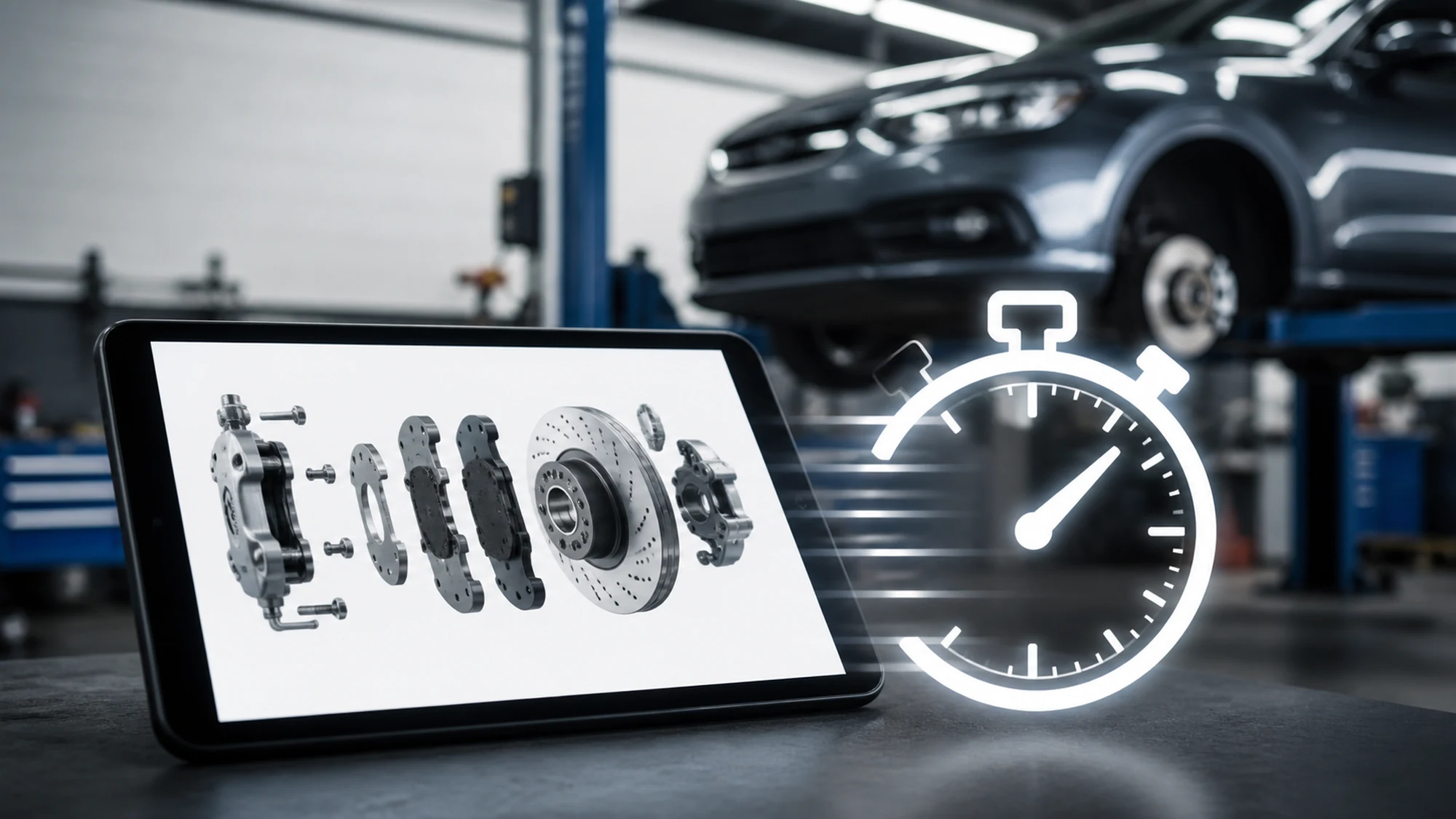
Between the moment a mechanic lifts a car onto the ramp and the moment the correct part gets ordered, more time often passes than the repair itself takes. Not because of the repair, but because of the identification: an OEM code checked, the distributor called, checked again because make and model don't tell the whole story about the actual vehicle on the ramp. VIN-based search, through systems like YQ Service, shortens exactly this interval, because it identifies the exact vehicle directly, with its real engine variant and configuration.
Time matters differently than order accuracy. A wrong order gets discovered and corrected, but it costs hours or days. Time lost during identification, on the other hand, is spent on every single order, whether the part chosen turns out to be correct or not — and this cumulative time directly affects how many cars a shop can process in a day.
This article looks at where the lost time comes from in manual parts identification, what a VIN-based workflow looks like in practice, what factors limit the time gained, and how a repair shop can estimate whether it's worth asking suppliers for this kind of integration.
Where the lost time comes from in the classic parts identification flow
In the classic flow, identifying a part isn't a single step, but a sequence of checks, each with its own waiting time:
- Reading the OEM code off the old part — on worn, dirty, or hard-to-reach parts, the code can be partially illegible, meaning extra disassembly just for identification.
- Searching by make and model in general catalogs — results cover an entire vehicle family, not the exact unit, so the parts clerk has to manually filter the correct variant.
- Phone call or email to the distributor for confirmation — especially for less common parts, confirmation comes from a person, not instantly from a system, which introduces variable waiting time.
- Cross-checking across multiple sources — when information from one catalog doesn't match what's physically visible on the vehicle, the shop searches again, in another source.
Each of these steps carries its own waiting time, and their sum means, in practice, a car sitting on the lift longer than the actual repair requires — time during which that lift can't take on another car.
What a VIN-based identification flow looks like
With a platform that has YQ Service data integrated, the identification flow compresses to a few steps, without repeated checks:
- The parts clerk takes the VIN from the registration certificate or directly from the chassis, when the car is received.
- Enters the VIN into the ordering platform of the distributor or partner store.
- The system automatically decodes the exact vehicle — engine variant, real manufacturing year, body type.
- For the part being searched, the platform displays the correct OE code directly, without needing to read an old code or make a second phone confirmation.
- The order is sent immediately, with the part already validated for that vehicle.
The key difference is that verification happens once, when the VIN is entered, not repeatedly, for every part searched during the same repair job. If you want details on how VIN decoding works technically and what the ACIS system behind YQ Service is, read the dedicated article about what YQ Service is.
Classic flow vs VIN flow: where time is lost and where it's gained
The table below compares the typical steps of the two flows, at the level of a single part order. The times are orientative, not official YQ Service figures, and vary by shop and by the complexity of the part being searched:
| Flow step | Classic flow (make/model + OEM code) | VIN-based flow |
|---|---|---|
| Vehicle identification | Make, model, approximate year — needs manual filtering afterward | Exact vehicle, in a single step (VIN entry) |
| Part compatibility confirmation | Phone/email to distributor, waiting for a reply | Displayed directly in the platform, no extra human input needed |
| Cross-checking | Frequent, especially for optional equipment | Rarely needed — the real configuration comes from the VIN |
| Final outcome | Order placed, but with higher risk of later re-checking | Direct order, with the part validated for the exact vehicle |
The real time gain doesn't come from a single step, but from eliminating the waiting and re-checking steps that, in the classic flow, repeat for every uncertain part in the same order.
What a shop actually gains: from a single part to daily capacity
At the level of a single part, the time gained can look minor — a few minutes. The effect becomes visible at shop level, cumulated over a working day:
- Lift freed up sooner — if identifying the part no longer holds the car on the ramp while waiting for confirmation, the lift becomes available faster for the next car.
- Faster quotes for the customer — a shop can confirm the price and delivery time of the part almost immediately, which shortens the time until the customer approves the repair.
- Less interruption of the parts clerk's workflow — fewer phone calls and manual checks mean more time spent on actual orders, not on clarifications.
Measured correctly over time, this gain translates into extra processing capacity — without investing in more lifts or staff, just by reducing the dead time in the parts identification flow.
What limits the time gained, and how to manage it
VIN-based search reduces identification time, but it doesn't eliminate it completely in every situation:
- Very specific parts or rare vehicles — even with the VIN correctly decoded, part availability at the distributor remains a separate time factor. Mitigation: stock checking stays a distinct step, not to be confused with identification.
- Vehicle modified from the factory configuration — the system shows the original factory variant, not a later modification by the owner. Mitigation: a quick visual check remains necessary for parts likely to have been replaced.
- Inconsistent integration at supplier level — the time gain only exists if the platform used by the shop actually has YQ Service data integrated, not just a generic make/model search. Mitigation: explicitly test the feature before relying on it.
- Unchanged work habits — if the team keeps calling for confirmation "out of habit," the time gain stays theoretical. Mitigation: make the VIN the standard first step when receiving the car, not an option.
How a shop decides whether the integration is worth it
Not every shop faces the same time pressure — the decision depends on a few concrete factors, not a universal rule:
- Daily vehicle volume — the more cars processed per day, the more visible the cumulative minutes gained per order become in total capacity.
- Share of uncertain orders — a shop working mostly on routine repairs, with known parts, has less to gain than one dealing with varied vehicles or frequent optional equipment.
- Number of suppliers used in parallel — the more sources manually checked for the same part, the bigger the benefit of a single source of truth.
- Availability of the integration at current suppliers — if no distributor or partner store offers VIN-based search, the real decision is about pressuring or switching the supplier, not just about the shop itself.
Practical plan for adoption, without rewriting the shop's workflow
Switching to VIN-based part ordering doesn't require a system overhaul, just an adjustment of an existing work habit:
- Check whether current suppliers offer VIN-based search — ask distributors and online stores you regularly order from explicitly.
- Make VIN collection a standard step — at the reception of every car, not only when the mechanic has doubts about compatibility.
- Measure the time before and after — track, even informally, the average time from lifting the car onto the ramp to confirming the order, for a few weeks, as your own baseline.
- Keep the classic flow as a fallback — for old vehicles or situations where the VIN isn't immediately available.
- Review suppliers periodically — if one partner doesn't offer the integration and another does, the time difference can become a real supplier selection criterion.
YQ Service and TecDoc: identification speed when the shop also needs aftermarket parts
According to the official yqservice.eu website, the customer segments the company targets directly are parts distributors/wholesalers, parts manufacturers, and online stores. Repair shops benefit, in practice, from the same identification speed when they order through a distributor or store that has the YQ Service integration active.
For a shop working with both OE and aftermarket alternatives, the time gain only extends if the ordering platform has both sources integrated: YQ Service for original parts and TecDoc, the best-known aftermarket catalog in Europe, for the rest. If either source is missing, the shop partially reverts to manual checking for the uncovered category, which cancels out part of the time gain.
Case study: identification speed in a store with YQ Service integration
HappyWeb developed stoauto.ro, an online store for original auto parts, with yqservice.eu data integration — exactly the type of platform through which a repair shop can indirectly access fast, VIN-based identification. The project includes product-to-vehicle matching by make, model, and engine variant, direct VIN-based search, and full integration with standard e-commerce modules (cart, customer account, order management).
Full project details are available on the stoauto.ro portfolio page.
Frequently asked questions about parts identification speed with YQ Service
1. How much does VIN-based search actually reduce parts identification time?
There's no official figure published by YQ Service for this interval — it depends on the part, the vehicle, and the shop's internal workflow. The clearest and most consistent benefit is eliminating re-checking steps and confirmation calls, not a fixed number of minutes.
2. Does the integration make sense for a small shop with low vehicle volume?
The cumulative gain is more visible at high volume, but even a small shop benefits from faster quotes for the customer and fewer confirmation calls on every uncertain order.
3. Does the shop need its own YQ Service account for this benefit?
Not necessarily. Repair shops aren't listed as a dedicated customer segment on the official YQ Service website — the benefit usually comes through the platform of a distributor or partner store that has the integration active.
4. What happens to identification speed if the VIN isn't available?
The shop falls back to the classic flow, by make, model, and OEM code, with the usual checking times. The speed advantage disappears for that specific order.
5. How does a shop know if it's worth switching suppliers for this benefit?
The simplest practical criterion is the weekly volume of uncertain orders — if confirmation calls and repeated checks consume noticeable time, the speed difference offered by a VIN-based platform becomes a concrete criterion for comparing suppliers.
Conclusion
Lost time in auto parts identification doesn't come from a single step, but from the sum of repeated checks in the classic flow. VIN-based search, through systems like YQ Service, compresses these steps into a single initial check, and the cumulative effect, at shop level, shows up in lifts freed up sooner and faster quotes for the customer.
HappyWeb has already implemented a full YQ Service integration for an original auto parts store and can do the same for your repair shop's ordering partner platform, including in combination with a TecDoc aftermarket catalog.
Want fast VIN-based search and OE parts integrated into an ordering platform for your repair shop? Contact us for a discussion about integration, or see our portfolio of delivered projects.
AI-generated image, used for illustrative purposes.



Write a comment